Abstract
Compounds 4 and 5, including both 4(5)-substituted imidazole or 3-substituted indole units as the entities used in nature, and 2-aminopyridine group as a heterocyclic analogue of the asparagine/glutamine primary amide side chain, were prepared and their binding properties towards carbohydrates were studied. The design of these receptors was inspired by the binding motifs observed in the crystal structures of protein–carbohydrate complexes. 1H NMR spectroscopic titrations in competitive and non-competitive media as well as binding studies in two-phase systems, such as dissolution of solid carbohydrates in apolar media, revealed both highly effective recognition of neutral carbohydrates and interesting binding preferences of these acyclic compounds. Compared to the previously described acyclic receptors, compounds 4 and 5 showed significantly increased binding affinity towards β-galactoside. Both receptors display high β- vs. α-anomer binding preferences in the recognition of glycosides. It has been shown that both hydrogen bonding and interactions of the carbohydrate CH units with the aromatic rings of the receptors contribute to the stabilization of the receptor–carbohydrate complexes. The molecular modeling calculations, synthesis and binding properties of 4 and 5 towards selected carbohydrates are described and compared with those of the previously described receptors.
Graphical Abstract
Introduction
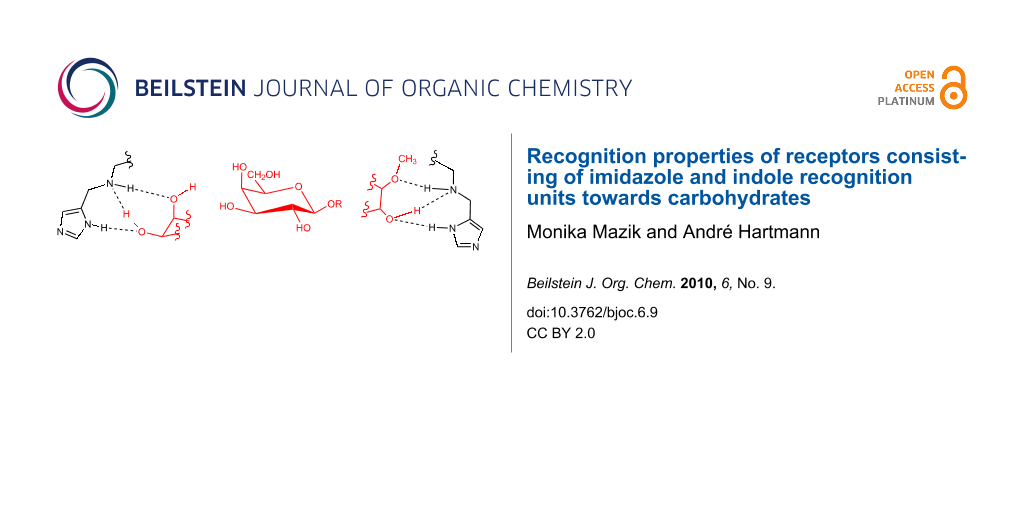
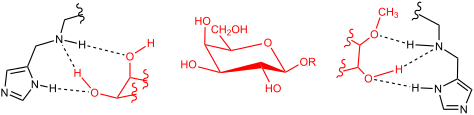
Analysis of the binding motifs found in the crystal structures of protein–carbohydrate complexes [1-5] provides much of the inspiration for the design of artificial carbohydrate receptors which use noncovalent interactions for sugar binding [6-18]. Such receptors provide valuable model systems to study the underlying principles of carbohydrate-based molecular recognition processes and might serve as a basis for the development of new therapeutic agents (for example, anti-infective agents) or saccharide sensors [19-26]. Our previous studies showed that mimicking the binding motifs observed in the crystal structures of protein–carbohydrate complexes by using natural recognition groups or their analogues [27-45] represents an effective strategy for designing carbohydrate receptors. Among other things the crystal structures of protein–carbohydrate complexes revealed that the imidazole and indole groups of His and Trp respectively are able to participate in both hydrogen bonding and stacking interactions with the sugar ring. It should be noted that packing of an aromatic ring of the protein against a sugar is observed in most carbohydrate–binding proteins [1-5]. Such packing arrangements and the hydrogen bonding motifs shown in Figure 1 have inspired the design of receptors 1 and 2 (see Figure 2), including both 4(5)-substituted imidazole or 3-substituted indole units as the entities used in nature, and 2-aminopyridine groups as heterocyclic analogues of the asparagine/glutamine primary amide side chains (in analogy to the binding motif shown in Figure 1a) [31]. The compounds 1 and 2 were established as highly effective receptors for mono- and disaccharides and shown to display remarkable β- vs. α-anomer selectivity in the recognition of glucopyranosides, as well as a binding preference for β-glucopyranoside vs. β-galactopyranoside. It has been shown that both hydrogen bonding and interactions of the carbohydrate CH units with the aromatic rings of the receptors contribute to the stabilization of the receptor–carbohydrate complexes. Compounds 1 and 2 were shown to be more powerful carbohydrate receptors than the symmetrical aminopyridine-based receptor 3.
![[1860-5397-6-9-1]](/bjoc/content/figures/1860-5397-6-9-1.svg?scale=2.0&max-width=1024&background=FFFFFF)
Figure 1: Examples of hydrogen bonds in the complex of a) galactose-binding protein with D-glucose [3], b) Amaranthus caudatus agglutinin with Galβ3GalNAc [1].
Figure 1: Examples of hydrogen bonds in the complex of a) galactose-binding protein with D-glucose [3], b) Amara...
![[1860-5397-6-9-2]](/bjoc/content/figures/1860-5397-6-9-2.svg?scale=2.0&max-width=1024&background=FFFFFF)
We were interested to see whether compounds 4 and 5 (see Figure 2), which consist of two imidazole or indole groups and one 2-aminopyridine unit, would be more effective with mono- and disaccharide substrates. Herein, we describe the synthesis, molecular modeling calculations and the binding properties of the compounds 4 and 5. To compare the binding properties of the new compounds with those of the previously published receptors, octyl β-D-glucopyranoside (6a), methyl β-D-glucopyranoside (6b), octyl α-D-glucopyranoside (7a), methyl α-D-glucopyranoside (7b), octyl β-D-galactopyranoside (8a), methyl β-D-galactopyranoside (8b), methyl α-D-galactopyranoside (9), methyl α-D-mannopyranoside (10) and dodecyl β-D-maltoside (11) were selected as substrates for the binding experiments (see Figure 3). 1H NMR spectroscopic titrations in competitive and non-competitive media as well as binding studies in two-phase systems, such as dissolution of solid carbohydrates in apolar media, revealed highly effective recognition of neutral carbohydrates and interesting binding preferences of these acyclic receptors.
![[1860-5397-6-9-3]](/bjoc/content/figures/1860-5397-6-9-3.svg?scale=2.0&max-width=1024&background=FFFFFF)
Figure 3: Structures of sugars investigated in this study.
Figure 3: Structures of sugars investigated in this study.
Results and Discussion
Synthesis of the receptors
The basis for the synthesis of compounds 4 and 5 was 1,3-bis(aminomethyl)-5-[(4,6-dimethylpyridin-2-yl)aminomethyl]-2,4,6- triethylbenzene (17). The synthesis of compound 17 is described in reference [27]. The reaction of 17 with the corresponding carbaldehyde, such as 4(5)-imidazole-carbaldehyde (18) [46] or 3-indole-carbaldehyde (19), provided the corresponding imines 20 and 21, which were further reduced with sodium borohydride. The synthesis of receptors 4 and 5 is summarized in Scheme 1.
![[1860-5397-6-9-i1]](/bjoc/content/inline/1860-5397-6-9-i1.svg?scale=2.0&max-width=1024&background=FFFFFF)
Scheme 1: Reaction conditions: a) AlCl3, CH3CH2Br, 0 °C to r. t., 12 h (85%) [47]; b) 33% HBr in CH3COOH, ZnBr2, (CH2O)n, 90 °C, 16.5 h (94%); c) 2 equiv of 2-amino-4,6-dimethylpyridine, CH3CN/THF, K2CO3, r. t., 3 d (20%); d) potassium phthalimide, dimethyl sulfoxide, 95 °C, 8 h, (57%); e) hydrazine hydrate, ethanol/toluene, reflux, 19.5 h, KOH (43%) [27]; f) 4 equiv of 4(5)-imidazole-carbaldehyde (18), CH3OH, 3 d; g) 4 equiv of 3-indole-carbaldehyde (19) CH3OH, 3 d; h) 8 equiv of NaBH4, 0 °C to r. t., 12 h (78% of 4, 92% of 5).
Scheme 1: Reaction conditions: a) AlCl3, CH3CH2Br, 0 °C to r. t., 12 h (85%) [47]; b) 33% HBr in CH3COOH, ZnBr2, ...
Binding studies in two-phase systems: liquid-solid extractions
The dissolution of solid carbohydrates in apolar media provides valuable means of studying carbohydrate recognition by organic-soluble receptors (for examples of receptors which are able to dissolve solid carbohydrates in apolar media, see references [6,27,41,43,48-50]). Extractions of sugars 6b, 7b, 8b, 9 and 10 from the solid state into a CDCl3 solution of receptor 4 or 5 (1 mM) provided evidence for strong complexation of β-glucoside 6b and β-galactoside 8b. The extraction of solid methyl α-glucoside 7b, α-galactoside 9 and α-mannoside 10 into a CDCl3 solution of receptor 4 or 5 indicated a weaker binding of these sugars than that of 6b and 8b (see Table 1). The extraction experiments indicated that the imidazole-based receptor 4 is a more powerful carbohydrate receptor than the indole-based compound 5. Receptor 4 was able to dissolve about 1 equiv of β-glucoside 6b and β-galactoside 8b, 0.5 equiv of α-glucoside 7b and about 0.2 equiv of α-galactoside 9. In the case of receptor 5 only about 0.7 equiv of β-glucoside 6b and β-galactoside 8b could be detected in the solution (see Table 1). Regarding 4 and 5, the extractability decreased in the sequence β-glucoside 6b ~ β-galactoside 8b > α-glucoside 7b > α-galactoside 9 > α-mannoside 10 (see Table 1; control experiments were performed in the absence of the receptor). The preference of 4 and 5 for β- vs. α-glucoside (6b vs. 7b) as well as for β- vs. α-galactoside (8b vs. 9) indicated by liquid–solid extractions was further confirmed by 1H NMR spectroscopic titrations (see below). Compared to the previously studied receptors 1–3, the extraction experiments indicated a significantly higher level of affinity of 4 and 5 towards β-galactoside. It should also be noted that the selectivities observed for 4 and 5 are quite different to those of the recently described phenanthroline/aminopyridine-based receptors 22 and 23 (see Figure 4) [27,29], which show a strong preference for α-glucoside and α-galactoside vs. the β-anomers. Thus, depending on the nature of the recognition units used as building blocks for the acyclic structures, effective carbohydrate receptors with different binding selectivities could be obtained. However, the exact prediction of the binding selectivity still represents an unsolved problem.
Table 1: Solubilization of sugars in CDCl3 by receptor 4 and 5 (1 mM solution).
| Sugar | Sugar/4a | Sugar/5a |
|---|---|---|
| β-D-glucoside 6b | 0.98 | 0.72 |
| α-D-glucoside 7b | 0.50 | 0.19 |
| β-D-galactoside 8b | 0.95 | 0.74 |
| α-D-galactoside 9 | 0.20 | 0.09 |
| α-D-mannoside 10 | 0.11 | 0.04 |
aMolar ratios sugar/receptor occurring in solution (the 1H NMR signals of the corresponding sugar were integrated with respect to the receptor’s signals to provide the sugar–receptor ratio; control experiments were performed in the absence of the receptor).
![[1860-5397-6-9-4]](/bjoc/content/figures/1860-5397-6-9-4.svg?scale=2.0&max-width=1024&background=FFFFFF)
Figure 4: Structures of the recently described phenanthroline/aminopyridine-based receptors showing α- vs. β-anomer binding preferences in the recognition of glycosides [27,29].
Figure 4: Structures of the recently described phenanthroline/aminopyridine-based receptors showing α- vs. β-...
Binding studies in homogeneous solution
The interactions of the receptors and carbohydrates were investigated by 1H NMR spectroscopic titrations in CDCl3 and DMSO-d6/CDCl3 mixtures. The stoichiometry of the receptor–sugar complexes was determined by mole ratio plots [51,52] and by the curve-fitting analysis of the titration data [53].
The 1H NMR titration experiments [54] with octyl β-glucoside 6a, α-glucoside 7a, β-galactoside 8a and methyl α-galactoside 9 were carried out by adding increasing amounts of sugar to a solution of receptor 4 or 5. In addition, inverse titrations were performed in which the concentration of the sugar was held constant and that of the receptor was varied. The complexation between receptors 4 or 5 and the monosaccharides was evidenced by several changes in the NMR spectra (for examples, see Table 2 and Figure 5a and Figure 5b). The addition of the monosaccharides 6a, 7a or 8a to a CDCl3 solution of receptors 4 or 5 caused significant downfield shift of the amine NHA signal (for labeling, see Figure 2), downfield shift and strong broadening of the NHD signal as well as changes of the chemical shifts of the CH3F,G, CH2B,C,E, pyridine CH and imidazole or indole CH resonances of 4 or 5 (see Table 2). The signal due to the indole NH of 5 shifted downfield by 0.20–0.40 ppm. The complexation-induced chemical shifts of the NHA, indole-NH, CH2B, CH3F,G and the aromatic CH protons were monitored for the determination of the binding constants, which are summarized in Table 3. Binding studies with β-glucoside 6a and β-galactoside 8a showed the interactions of receptors 4 and 5 with these monosaccharides to be much more favorable than those with the α-anomers 7a and 9.
Table 2: Change in chemical shifta observed during 1H NMR titrations of receptor 4 or 5 with sugar 6a, 7a, 8a or 11 in CDCl3.
|
Receptor–
sugar complex |
Δδa [ppm] |
|---|---|
| 4•6a | NHA: 2.01; CH2B: −0.17; imidazole-CH’s: 0.06, 0.08; CH3F: −0.07 |
| 4•7a | NHA: 1.17; CH2B: −0.15; imidazole-CH’s: 0.05, 0.06; CH3F: −0.05 |
| 4•8a | NHA: 0.79; CH2B: −0.12; CH2E: −0.11; imidazole-CH’s: 0.11, 0.08; CH3F: −0.10; CH3G: 0.05 |
| 4•11 | NHA: 0.80; CH2B: −0.19; CH2C: −0.09; imidazole-CH’s: 0.09, 0.04; CH3F: −0.06; CH3G: 0.03 |
| 5•6a | NHA: 2.06; indole-NH: 0.20; CH2B: −0.18; CH2E: −0.06; CH3F: −0.07; CH3G: 0.04 |
| 5•7a | NHA: 1.50; indole-NH: 0.17; CH2B: −0.18; CH2C: −0.06; CH3F: −0.06 |
| 5•8a | NHA: 1.15; indole-NH: 0.27; CH2B: −0.15; CH2C: 0.06; CH2E: −0.11; pyr-CH’s: −0.01, 0.11; CH3F: −0.09; CH3G: 0.06 |
| 5•11 | NHA: 1.80; indole-NH: 0.40; CH2B: −0.20; CH3F: −0.06; CH3G: 0.04 |
aLargest change in chemical shift observed during the titration for receptor signals (the concentration of receptor was kept constant and that of sugar varied).
b(−) Δδ = upfield shift.
Table 3: Association constantsa,b for receptors 1–6 and carbohydrates 6a, 7a, 8a, 9 and 11.
| Host–guest complex | Solvent | K11 [M −1] | K21c or K12d [M−1] |
β21 = K11K21 or
β12 = K11K12 [M−2] |
|---|---|---|---|---|
| 4•6a | CDCl3 | >105; g | g | |
| 5% DMSO-d6/CDCl3 | 35000 | 1000; d | 3.50×10⁷ | |
| 4•7a | CDCl3 | 7450 | 1150; d | 8.56×10⁶ |
| 4•8a | CDCl3 | >105; g | g | |
| 5% DMSO-d6/CDCl3 | 40700 | 800; d | 3.25×10⁷ | |
| 4•9 | 5% DMSO-d6/CDCl3 | 700 | ||
| 4•11 | CDCl3 | >105; g | g | |
| 5% DMSO-d6/CDCl3 | 12000 | 3000; c | 3.60×10⁷ | |
| 5•6a | CDCl3 | 45900 | 730; d | 3.35×10⁷ |
| 5•7a | CDCl3 | 1280 | 250; d | 3.20×10⁵ |
| 5•8a | CDCl3 | 38000 | 1100; d | 4.18×10⁷ |
| 5•11 | CDCl3 | >105; g | g | |
| 5% DMSO-d6/CDCl3 | 42000 | |||
| 1•6ae | CDCl3 | 191730 | 8560; c | 1.64×10⁹ |
| 1•7ae | CDCl3 | 3160 | 1540; d | 4.86×10⁶ |
| 1•8ae | CDCl3 | 3320 | 300; d | 9.96×10⁵ |
| 1•11e | CDCl3 | 205760 | 8670; c | 1.78×10⁹ |
| 2•6ae | CDCl3 | 156100 | 10360; c | 1.62×10⁹ |
| 2•7ae | CDCl3 | 2820 | 350; d | 9.87×10⁵ |
| 2•8ae | CDCl3 | 7470 | 1100; d | 8.25×10⁶ |
| 2•11e | CDCl3 | 182690 | 14840; c | 2.71×10⁹ |
| 3•6af | CDCl3 | 48630 | 1320; d | 6.42×10⁷ |
| 3•7af | CDCl3 | 1310 | ||
| 3•8af | CDCl3 | 3070 | 470; d | 1.35×10⁶ |
aAverage Ka values from multiple titrations in CDCl3.
bErrors in Ka are less than 10%.
cK21 corresponds to 2:1 receptor–sugar association constant.
dK12 corresponds to 1:2 receptor–sugar association constant.
eResults from ref. [31].
fResults from ref. [41].
gHostest program indicated “mixed” 1:1 and 2:1 receptor-sugar binding model with K11>105 and K21 ~ 104; however, the binding constants were too large to be accurately determined by the NMR method.
The curve fitting of the titration data for 4 and β-glucoside 6a suggested the existence of 1:1 and 2:1 receptor–sugar complexes in CDCl3 solutions with a stronger association constant for 1:1 binding and a weaker association constant for the 2:1 receptor–sugar complex (this model was further supported by the mole ratio plots). The binding constants, however, were too large to be accurately determined by the NMR spectroscopic method (K11 > 105 and K21 ~ 104 M−1; see Table 3; for a review discussing the limitations of the NMR method, see ref. [55]). After the addition of 5% DMSO-d6 the binding constants for 4•6a were determined to be 35000 (K11) and 1000 M−1 (K12). Thus, the affinity of 4 significantly decreases as solvent polarity increases (the addition of dimethyl sulfoxide also caused the change of the binding model; for a discussion on solvent effects in carbohydrate binding by synthetic receptors, see ref. [56]).
The interactions between the β-glucoside 6a and the indole-based receptor 5 in CDCl3 were shown to be strong but less favorable than those with the receptor 4. The best fit of the titration data was obtained with the “mixed” 1:1 and 1:2 receptor–sugar binding model. The association constants for 5•6a were found to be 45900 (K11) and 730 M−1 (K12).
The interactions between β-glucopyranoside 6a and receptors 4 and 5 were also investigated on the basis of inverse titrations in which the concentration of sugar 6a was held constant and that of receptor 4 or 5 was varied. During the titration of 6a with 4 or 5 the signals due to the OH protons of 6a shifted downfield with strong broadening and became almost indistinguishable from the base line after the addition of only 0.1 equiv of the receptor, indicating important contribution of the OH groups of 6a to the complex formation. Furthermore, the addition of 4 or 5 to a CDCl3 solution of β-glucoside 6a caused significant upfield shift of the CH signals of 6a, indicating the participation of the sugar CH units in the formation of the CH···π interactions with the aromatic rings of the receptor (for discussions on the importance of carbohydrate–aromatic interactions, see refs. [57-63]; for examples of CH-π interactions in the crystal structures of the complexes formed between artificial receptors and carbohydrates, see ref. [40]). Among the CH signals, the signal due to the 2-CH proton of 6a showed the largest shift (1.78 and 1.62 ppm for the titration with 4 and 5, respectively). In both cases, 6a•4 and 6a•5, the best fit of the titration data was obtained with the “mixed” 1:1 and 1:2 sugar–receptor binding model. Thus, the inverse titrations fully confirmed the binding model determined through the titrations of 4 or 5 with sugar 6a. The association constants obtained on the basis of these titrations are identical within the limits of uncertainty to those determined from titrations where the role of receptor and substrate was reversed.
Similar to 4•6a, the best fit of the titration data for receptor 4 and β-galactoside 8a was obtained with the “mixed” 1:1 and 2:1 receptor–sugar binding model. However, the binding constants were again too large to be accurately determined by the NMR spectroscopic method (see Table 3). Studies performed in 5% DMSO-d6 in CDCl3 revealed that K11 = 40700 M−1 and K12 = 800 M−1. The titration experiments with β-galactoside 8a clearly showed that receptor 5 is less effective towards this monosaccharide than the imidazole-based receptor 4 but much more effective than the previously described receptors 1–3. The motions of the signals of 5 were consistent with 1:1 and 1:2 receptor–sugar binding and could be analyzed to give association constants of 38000 (K11) and 1100 M−1 (K12). Compared to receptors 1–3 [31,41], receptors 4 and 5 showed a significantly higher binding affinity towards the β-galactoside 8a. The differences in the complexation abilities of receptors 1/3 and 4/5 towards β-galactoside 8a are clearly visible in the comparison of the chemical shifts of the signals of the four receptors after the addition of β-galactoside 8a (illustrated in parts a–d of Figure 5 for the pyridine CH3 signals).
![[1860-5397-6-9-5]](/bjoc/content/figures/1860-5397-6-9-5.svg?scale=2.0&max-width=1024&background=FFFFFF)
Figure 5: Partial 1H NMR spectra (400 MHz; CDCl3) of receptor 4 (a), 5 (b), 1 (c), and 3 (d) before (bottom) and after the addition of β-galactoside 8a. Shown are chemical shifts of the pyridine CH3 resonances of the corresponding receptor. [4] = 0.89 mM, equiv of 8a: 0.00–4.65; [5] = 0.90 mM, equiv of 8a: 00–4.52; [1] = 0.95 mM, equiv of 8a: 0.00–4.26; [3] = 0.90 mM, equiv of 8a: 0.00–5.20.
Figure 5: Partial 1H NMR spectra (400 MHz; CDCl3) of receptor 4 (a), 5 (b), 1 (c), and 3 (d) before (bottom) ...
Our previous studies showed compounds 1–3 to be highly effective receptors for β-maltoside 11 [28,31]. This disaccharide [64] is almost insoluble in CDCl3 but could be solubilized in this solvent in the presence of the corresponding receptor. Similar solubility behavior of 11, indicating favorable interactions between the binding partners, could be observed in the presence of compounds 4 and 5. Thus, the receptor in CDCl3 was titrated with a solution of maltoside dissolved in the same receptor solution. The complexation between 4 or 5 and the disaccharide 11 was evidenced by several changes in the NMR spectra (for example, see Table 2 and Figure 6). The saturation occurred after the addition of about 0.7 equiv of 11. Both the curve fitting of the titration data and and the mole ratio plots suggested the existence of 1:1 and 2:1 receptor–sugar complexes in the chloroform solution (with stronger association constant for 1:1 binding and a weaker association constant for 2:1 receptor–sugar complex). In both cases, 4•11 and 5•11, the binding constants in CDCl3 were too large to be accurately determined by the NMR spectroscopic method (see Table 3). After the addition of DMSO-d6 a substantial fall in the binding affinity was observed. Studies that were performed with 4 and 11 in 5% DMSO-d6 in CDCl3 revealed K11 = 12000 M–1 and K21 = 3000 M–1, those performed with 5 and 11 indicated the formation of complexes with 1:1 receptor–sugar stoichiometry with K11 = 42000 M–1.
![[1860-5397-6-9-6]](/bjoc/content/figures/1860-5397-6-9-6.svg?scale=2.0&max-width=1024&background=FFFFFF)
Figure 6: Partial 1H NMR spectra (400 MHz, CDCl3) of 5 after addition of (from bottom to top) 0.00–1.63 equiv of β-maltoside 11 ([5] = 0.96 mM). Shown are chemical shifts of the pyridine CH3 and indole NH signals of receptor 5.
Figure 6: Partial 1H NMR spectra (400 MHz, CDCl3) of 5 after addition of (from bottom to top) 0.00–1.63 equiv...
Molecular modeling
The formation of hydrogen bonds and CH···π interactions between the binding partners was also suggested by molecular modeling calculations. For example, molecular modeling suggested that all OH groups and the ring oxygen atom of the bound β-galactoside 8b in the complex 4•8b are involved in the formation of hydrogen bonds (see Table 4 and Figure 7a and Figure 8). In addition, interactions of sugar C-H units with the central phenyl ring of 4 (see Table 4) were shown to provide additional stabilization of the complex. Furthermore, the molecular modeling calculations indicated that within the 2:1 receptor–sugar complex the two receptor molecules almost completely enclose the sugar, leading to involvement of all sugar hydroxyl groups in interactions with the two receptor molecules (see Table 4 and Figure 7b). The OH groups are involved in the formation of cooperative hydrogen bonds which result from the simultaneous participation of a sugar OH as donor and acceptor of hydrogen bonds. The phenyl units of the both receptors stack on the sugar ring and both sides of the pyranose ring are involved in CH···π interactions (see Table 4 and Figure 7b).
Table 4: Examples of noncovalent interactions indicated by molecular modeling calculationsa for the complexes formed between receptor 4 and sugar 8a or 8b.
| 1:1 receptor–sugar complexb | 2:1 receptor–sugar complexb,c | 1:2 receptor–sugar complexd |
|---|---|---|
| imidazole-NH···OH-2 | (I) imidazole-NH···OH-2 | imidazole-NH···OH-6 |
| HND···HO-2 | (I) HND···HO-2 | HND···HO-6 |
| NHD···O-CH3 | (I) NHD···O-CH3 | NHD···OH-4 |
| imidazole-NH···OH-3 | (I) imidazole-NH···OH-3 | imidazole-NH···OH-4 |
| HND···HO-3 | (I) HND···HO-3 | pyridine-N···HO-2 |
| NHD···OH-4 | (I) NHD···OH-4 | NHA···OC8H17 |
| phenyl···HO-4 | (I) pyridine-N···HO-6 | phenyl···HO-4 |
| pyridine-N···HO-6 | (I) NHA···O-ring | phenyl···HCH-6 |
| NHA···O-ring | (I) phenyl···HO-4; (I) phenyl···HC-2 | pyridine-N···HC-2e |
| phenyl···HC-2 | (II) imidazole-NH···OH-6; (II) NHD···OH-6 | pyridine-CH3···OH-4e |
| (II) NHA···OH-3 | 3-HO···HO-2f | |
| (II) phenyl···HC-1 | 3-OH···OH-3f | |
| (II) phenyl···HC-3; (II) phenyl···HC-5 | ||
aMacroModel V.8.5, OPLS-AA force field, MCMM, 50000 steps.
bComplex with sugar 8b.
cI and II: two receptors in the 2:1 receptor–sugar complex; for labeling see Figure 2.
dComplex with sugar 8a.
eInteraction with the second sugar.
fSugar–sugar interaction.
![[1860-5397-6-9-7]](/bjoc/content/figures/1860-5397-6-9-7.svg?scale=2.0&max-width=1024&background=FFFFFF)
Figure 7: Energy-minimized structure of the 1:1 a) and 2:1 complex b) formed between receptor 4 and β-galactoside 8b (different representations). MacroModel V.8.5, OPLS-AA force field, MCMM, 50000 steps. Color code: receptor C, grey; receptor N, blue; sugar molecule, yellow.
Figure 7: Energy-minimized structure of the 1:1 a) and 2:1 complex b) formed between receptor 4 and β-galacto...
![[1860-5397-6-9-8]](/bjoc/content/figures/1860-5397-6-9-8.svg?scale=2.0&max-width=1024&background=FFFFFF)
Figure 8: Examples of hydrogen bonding motifs indicated by molecular modeling studies in the 1:1 complex between receptor 4 and β-galactoside 8b (MacroModel V.8.5, OPLS-AA force field, MCMM, 50000 steps).
Figure 8: Examples of hydrogen bonding motifs indicated by molecular modeling studies in the 1:1 complex betw...
Conclusion
The analysis of the binding motifs which are observed in the crystal structures of protein-carbohydrate complexes has influenced the design of receptors 4 and 5, including two 4(5)-substituted imidazole or 3-substituted indole units as well as an aminopyridine-based recognition group. The compounds 4 and 5 were established as highly effective receptors for neutral carbohydrates and were shown to display a significantly higher level of affinity towards β-galactoside than the previously described acyclic receptors. Both receptors were shown to display high β- vs. α-anomer binding preferences in the recognition of glycosides. The binding properties of 4 and 5 were studied on the base of 1H NMR spectroscopic titrations in CDCl3 and DMSO-d6/CDCl3 mixtures as well as binding studies in two-phase systems, such as dissolution of solid carbohydrates in apolar media. The imidazole-based receptor 4 was found to be a more powerful monosaccharide receptor than the indole-based compound 5 and the previously described receptors 1–3. Compared to 1 and 2, incorporating only one imidazole or indole recognition unit, receptor 5 showed increased affinity to β-galactoside but decreased affinity to β-glucoside. The binding affinity of 1–5 towards β-galactoside 8a and β-glucoside 6a increases in the sequence 3 ~ 1 < 2 < 5 < 4 and 3 ~ 5 < 1 ~ 2 < 4, respectively. It is remarkable that the strong enhancement of the binding affinity of 4 and 5 towards β-galactoside was achieved through a relatively simple variation of the receptor structure. In contrast to 4 and 5, the previously described phenanthroline/aminopyridine-based receptors 22 and 23 were shown to display a high binding affinity towards α-galactoside as well as a strong α- vs. β-anomer binding preference. Thus, depending on the nature of the recognition units incorporated into the acyclic receptor structure, effective carbohydrate receptors with different binding preferences can be generated. However, the exact prediction of the binding preference still represents an unsolved problem and remains an important goal for future research.
Experimental section
Analytical TLC was carried out on silica gel 60 F254 plates employing chloroform/methanol mixtures as the mobile phase. Melting points are uncorrected. Sugars 6–11, 4(5)-imidazole-carbaldehyde (18) and 3-indole-carbaldehyde (19) are commercially available.
General procedure for the synthesis of compounds 4 and 5: To a solution of 4(5)-imidazole-carbaldehyde (18) or 3-indole-carbaldehyde (19) (3.40 mmol) in methanol (40 mL) 1,3-bis(aminomethyl)-5-[(4,6-dimethylpyridin-2-yl)aminomethyl]-2,4,6-triethylbenzene (17) (0.85 mmol) dissolved in 20 mL methanol was added. The reaction mixture was stirred for 72 h. The solution was cooled to 0 °C and NaBH4 (6.80 mmol) was added in portions. The reaction mixture was stirred for 1 h at 0 °C and for additionally 6 h at room temperature. The solvent was removed and the residue was taken up in chloroform/water (100 mL, 1:1). The separated organic phase was further washed with water (3×30 mL), dried over MgSO4 and the solvent was removed. The crude product was purified via column chromatography [CHCl3/CH3OH (incl. 1% 7 M NH3 in CH3OH), 2:1 or 3:1 v/v].
1,3-Bis[(4-Imidazolyl-methyl)aminomethyl]-5-[(4,6-dimethylpyridin-2-yl)aminomethyl]-2,4,6-triethylbenzene (4). Yield: 78%; mp: 76–77 °C; 1H NMR (400 MHz, CDCl3, 0.9 mM): δ = 7.54 (s, 2H), 6.93 (s, 2H), 6.33 (s, 1H), 6.07 (s, 1H), 4.28 (s, 2H), 4.18 (br. s, 1H), 3.89 (s, 4H), 3.71 (s, 4H), 2.68 (q, J = 7.3 Hz, 4H), 2.65 (q, J = 7.3 Hz, 2H), 2.34 (s, 3H), 2.23 (s, 3H), 1.17 (t, J = 7.3 Hz, 6H), 1.09 (t, J = 7.3 Hz, 3H) ppm; 13C NMR (100 MHz, CDCl3): δ = 158.33, 156.44, 148.96, 142.75, 142.43, 135.65, 134.07, 132.41, 113.85, 103.58, 46.75, 46.05, 24.01, 22.70, 22.50, 21.11, 16.83, 16.80 ppm; HR-MS (ESI) calcd for C30H42N8Na [M + Na]+: 537.3430, found: 537.3433; Rf = 0.10 [CHCl3/CH3OH (incl. 1% 7 M NH3 in CH3OH), 4:1 v/v].
1,3-Bis[(3-Indolyl-methyl)aminomethyl]-5-[(4,6-dimethylpyridin-2-yl)aminomethyl]-2,4,6-triethylbenzene (5). Yield: 92%; mp: 89–90 °C; 1H NMR (400 MHz, CDCl3, 0.9 mM): δ = 8.00 (s, 2H), 7.68 (d, J = 7.8 Hz, 2H), 7.35 (d, J = 8.0, 2H), 7.16–7.20 (m, 4H), 7.08–7.12 (m, 2H), 6.30 (s, 1H), 6.00 (s, 1H), 4.28 (d, J = 4.2 Hz, 2H), 4.09 (br. s, 1H), 4.08 (s, 4H), 3.75 (s, 4H), 2.66 (m, 6H), 2.33 (s, 3H), 2.20 (s, 3H), 1.09 (t, J = 7.5 Hz, 6H), 1.06 (t, J = 7.5 Hz, 3H) ppm; 13C NMR (100 MHz, CDCl3): δ = 158.28, 156.64, 148.55, 142.87, 142.49, 136.37, 134.51, 132.41, 127.16, 122.48, 122.02, 119.46, 119.00, 115.21, 113.60, 111.03, 103.55, 47.28, 45.51, 40.59, 24.20, 22.59, 22.52, 21.05, 16.77 ppm; HR-MS (ESI) calcd for C40H49N6 [M + H]+: 613.4018, found: 613.4012; Rf = 0.12 [CHCl3/CH3OH (incl. 1% 7 M NH3 in CH3OH) 3:1 v/v].
References
-
Lis, H.; Sharon, N. Lectins; Kluwer Academic Publishers: Dordrecht, The Netherlands, 2003.
Return to citation in text: [1] [2] [3] -
Lis, H.; Sharon, N. Chem. Rev. 1998, 98, 637–674. doi:10.1021/cr940413g
Return to citation in text: [1] [2] -
Quiocho, F. A. Pure Appl. Chem. 1989, 61, 1293–1306. doi:10.1351/pac198961071293
Return to citation in text: [1] [2] [3] -
Weiss, W. I.; Drickamer, K. Annu. Rev. Biochem. 1996, 65, 441–473. doi:10.1146/annurev.bi.65.070196.002301
Return to citation in text: [1] [2] -
Lemieux, R. U. Chem. Soc. Rev. 1989, 18, 347–374. doi:10.1039/cs9891800347
Return to citation in text: [1] [2] -
Davis, A. P.; James, T. D. Carbohydrate Receptors. In Functional Synthetic Receptors; Hamilton, A. D., Ed.; Wiley-VCH: Weinheim, Germany, 2005; pp 45–109. doi:10.1002/352760572X.ch2
For reviews on carbohydrate recognition with artificial receptors using noncovalent interactions, see [6-9].
Return to citation in text: [1] [2] -
Davis, A. P.; Wareham, R. S. Angew. Chem. 1999, 111, 3161–3179. doi:10.1002/(SICI)1521-3757(19991018)111:20<3160::AID-ANGE3160>3.0.CO;2-Z
Angew. Chem., Int. Ed. 1999, 38, 2979–2996. doi:10.1002/(SICI)1521-3773(19991018)38:20<2978::AID-ANIE2978>3.0.CO;2-PP
Return to citation in text: [1] -
Walker, D. B.; Joshi, G.; Davis, A. P. Cell. Mol. Life Sci. 2009, 66, 3177–3191. doi:10.1007/s00018-009-0081-8
Return to citation in text: [1] -
Mazik, M. Chem. Soc. Rev. 2009, 38, 935–956. doi:10.1039/b710910p
Return to citation in text: [1] -
Ferrand, Y.; Klein, E.; Barwell, N. P.; Crump, N. P.; Jiménez-Barbero, J.; Vicent, C.; Boons, G.-J.; Ingale, S.; Davis, A. P. Angew. Chem., Int. Ed. 2009, 48, 1775–1779. doi:10.1002/anie.200804905
For some recent examples of carbohydrate receptors operating through noncovalent interactions see [10-16] and [27-45].
Return to citation in text: [1] -
Abe, H.; Takashima, S.; Yamamoto, T.; Inouye, M. Chem. Commun. 2009, 2121–2123. doi:10.1039/b902269d
Return to citation in text: [1] -
Abe, H.; Horii, A.; Matsumoto, S.; Shiro, M.; Inouye, M. Org. Lett. 2008, 10, 2685–2688. doi:10.1021/ol800783a
Return to citation in text: [1] -
Palde, P. B.; Gareiss, P. C.; Miller, B. L. J. Am. Chem. Soc. 2008, 130, 9566–9573. doi:10.1021/ja802229f
Return to citation in text: [1] -
Klein, E.; Ferrand, Y.; Auty, E. K.; Davis, A. P. Chem. Commun. 2007, 2390–2392. doi:10.1039/b618776e
Return to citation in text: [1] -
Nativi, C.; Cacciarini, M.; Francesconi, O.; Moneti, G.; Roelens, S. Org. Lett. 2007, 9, 4685–4688. doi:10.1021/ol701959r
Return to citation in text: [1] -
Ferrand, Y.; Crump, M. P.; Davis, A. P. Science 2007, 318, 619–622. doi:10.1126/science.1148735
Return to citation in text: [1] -
James, T. D.; Shinkai, S. Top. Curr. Chem. 2002, 218, 159–200. doi:10.1007/3-540-45010-6_6
For reviews on boronic acid-based receptors, which use covalent interactions for sugar binding, see [17,18].
Return to citation in text: [1] -
James, T. D.; Sandanayake, K. R. A. S.; Shinkai, S. Angew. Chem. 1996, 108, 2038–2050. doi:10.1002/ange.19961081706
Angew. Chem., Int. Ed. 1996, 35, 1910–1922. doi:10.1002/anie.199619101
Return to citation in text: [1] -
Davis, A. P. Org. Biomol. Chem. 2009, 7, 3629–3638. doi:10.1039/b909856a
Return to citation in text: [1] -
Kubik, S. Angew. Chem. 2009, 121, 1750–1753. doi:10.1002/ange.200805497
Angew. Chem., Int. Ed. 2009, 48, 1722–1725. doi:10.1002/anie.200805497
Return to citation in text: [1] -
Mazik, M. ChemBioChem 2008, 9, 1015–1017. doi:10.1002/cbic.200800038
Return to citation in text: [1] -
Mazik, M.; Balzarini, J. Preparation of poly(hetero)arenes as antiinfective agents. PCT Int. Appl. WO 2008113557, 2008.
Return to citation in text: [1] -
Mazik, M. Preparation of amino-naphthyridine derivatives as antiinfective agents. PCT Int. Appl. WO 2008113558, 2008.
Return to citation in text: [1] -
Mazik, M.; Balzarini, J. Preparation of poly(hetero)arenes as antiinfective agents. Eur. Pat. Appl. EP 1972338, 2008.
Return to citation in text: [1] -
Mazik, M. Preparation of amino-naphthyridine derivatives as antiinfective agents. Eur. Pat. Appl. EP 1972627, 2008.
Return to citation in text: [1] -
Boltz, K. W.; Gonzalez-Moa, M. J.; Stafford, P.; Johnston, S. A.; Svarovsky, S. A. Analyst 2009, 134, 650–652. doi:10.1039/b823156g
Return to citation in text: [1] -
Mazik, M.; Hartmann, A.; Jones, P. G. Chem.–Eur. J. 2009, 15, 9147–9159. doi:10.1002/chem.200900664
Return to citation in text: [1] [2] [3] [4] [5] [6] -
Mazik, M.; Buthe, A. C. Org. Biomol. Chem. 2009, 7, 2063–2071. doi:10.1039/b901173k
Return to citation in text: [1] [2] -
Mazik, M.; Hartmann, A. J. Org. Chem. 2008, 73, 7444–7450. doi:10.1021/jo8005842
Return to citation in text: [1] [2] [3] -
Mazik, M.; Buthe, A. C. Org. Biomol. Chem. 2008, 6, 1558–1568. doi:10.1039/b719212f
Return to citation in text: [1] -
Mazik, M.; Kuschel, M. Chem.–Eur. J. 2008, 14, 2405–2419. doi:10.1002/chem.200701269
Return to citation in text: [1] [2] [3] [4] [5] -
Mazik, M.; Kuschel, M. Eur. J. Org. Chem. 2008, 1517–1526. doi:10.1002/ejoc.200701097
Return to citation in text: [1] -
Mazik, M.; Buthe, A. C. J. Org. Chem. 2007, 72, 8319–8326. doi:10.1021/jo701370g
Return to citation in text: [1] -
Mazik, M.; Cavga, H. J. Org. Chem. 2007, 72, 831–838. doi:10.1021/jo061901e
Return to citation in text: [1] -
Mazik, M.; König, A. Eur. J. Org. Chem. 2007, 3271–3276. doi:10.1002/ejoc.200700295
Return to citation in text: [1] -
Mazik, M.; Cavga, H. Eur. J. Org. Chem. 2007, 3633–3638. doi:10.1002/ejoc.200700264
Return to citation in text: [1] -
Mazik, M.; König, A. J. Org. Chem. 2006, 71, 7854–7857. doi:10.1021/jo0610309
Return to citation in text: [1] -
Mazik, M.; Cavga, H. J. Org. Chem. 2006, 71, 2957–2963. doi:10.1021/jo052479p
Return to citation in text: [1] -
Mazik, M.; Kuschel, M.; Sicking, W. Org. Lett. 2006, 8, 855–858. doi:10.1021/ol052902g
Return to citation in text: [1] -
Mazik, M.; Cavga, H.; Jones, P. G. J. Am. Chem. Soc. 2005, 127, 9045–9052. doi:10.1021/ja043037i
Return to citation in text: [1] [2] -
Mazik, M.; Radunz, W.; Boese, R. J. Org. Chem. 2004, 69, 7448–7462. doi:10.1021/jo048979k
Return to citation in text: [1] [2] [3] [4] -
Mazik, M.; Sicking, W. Tetrahedron Lett. 2004, 45, 3117–3121. doi:10.1016/j.tetlet.2004.02.087
Return to citation in text: [1] -
Mazik, M.; Radunz, W.; Sicking, W. Org. Lett. 2002, 4, 4579–4582. doi:10.1021/ol0201759
Return to citation in text: [1] [2] -
Mazik, M.; Sicking, W. Chem.–Eur. J. 2001, 7, 664–670. doi:10.1002/1521-3765(20010202)7:3<664::AID-CHEM664>3.0.CO;2-E
Return to citation in text: [1] -
Mazik, M.; Bandmann, H.; Sicking, W. Angew. Chem. 2000, 112, 562–565. doi:10.1002/(SICI)1521-3757(20000204)112:3<562::AID-ANGE562>3.0.CO;2-N
Angew. Chem., Int. Ed. 2000, 39, 551–554. doi:10.1002/(SICI)1521-3773(20000204)39:3<551::AID-ANIE551>3.0.CO;2-7
Return to citation in text: [1] -
Katritzky, A. R.; Pozharski, A. F. Handbook of Heterocyclic Chemistry; Pergamon: Amsterdam, The Neverlands, 2000; p 131.
For a discussion on annular tautomerism of NH-imidazoles, see [46].
Return to citation in text: [1] -
Wallace, K. J.; Hanes, R.; Anslyn, E.; Morey, J.; Kilway, K. V.; Siegel, J. Synthesis 2005, 2080–2083. doi:10.1055/s-2005-869963
Return to citation in text: [1] -
Bähr, A.; Felber, B.; Schneider, K.; Diederich, F. Helv. Chim. Acta 2000, 83, 1346–1376. doi:10.1002/1522-2675(20000705)83:7<1346::AID-HLCA1346>3.0.CO;2-3
Return to citation in text: [1] -
Inouye, M.; Chiba, J.; Nakazumi, H. J. Org. Chem. 1999, 64, 8170–8176. doi:10.1021/jo9911138
Return to citation in text: [1] -
Inouye, M.; Miyake, T.; Furusyo, M.; Nakazumi, H. J. Am. Chem. Soc. 1995, 117, 12416. doi:10.1021/ja00155a006
Return to citation in text: [1] -
Schneider, H.-J.; Yatsimirsky, A. Principles and Methods in Supramolecular Chemistry; John Wiley & Sons: Chichester, 2000; p 148.
For a description of the mole ratio method, see [51,52].
Return to citation in text: [1] -
Tsukube, H.; Furuta, H.; Odani, A.; Takeda, Y.; Kudo, Y.; Inoue, Y.; Liu, Y.; Sakamoto, H.; Kimura, K. In Comprehensive Supramolecular Chemistry; Atwood, J.-L.; Davis, J. E. D.; MacNicol, D. D.; Vögtle, F., Eds.; Pergamon: Oxford, UK, 1996; Vol. 8, p 425.
Return to citation in text: [1] -
Wilcox, C. S.; Glagovich, N. M. Program HOSTEST 5.6. Ph.D. Thesis, University of Pittsburgh, Pittsburgh, PA, 1994.
Hostest program is designed to fit data to different binding models, which include both “pure” binding models, taking into consideration the formation of only one type of complex in solution (1:1, 1:2 or 2:1 receptor–substrate complex), and “mixed” binding models containing more than one type of complex in solution (for example, 1:1 and 1:2 or 1:1 and 2:1 receptor–substrate complex).
Return to citation in text: [1] -
The binding studies were carried out in CDCl3 and DMSO-d6/CDCl3 mixtures at 25 °C. CDCl3 was stored over activated molecular sieves and deacidified with Al2O3. The titration data were analyzed by non-linear regression analysis, using the program HOSTEST 5.6 (see reference [53]). For each system at least three titrations were carried out; for each titration 15–20 samples were prepared. Dilution experiments show that the receptors do not self-aggregate in the used concentration range. Error in Ka was <10%. K11 corresponds to the 1:1 association constant. K21 corresponds to the 2:1 receptor–sugar association constant. K12 corresponds to the 1:2 receptor–sugar association constant. β21 = K11 x K21, β12 = K11 x K12.
Return to citation in text: [1] -
Fielding, L. Tetrahedron 2000, 56, 6151–6170. doi:10.1016/S0040-4020(00)00492-0
Return to citation in text: [1] -
Klein, E.; Ferrand, Y.; Barwell, N. P.; Davis, A. P. Angew. Chem. 2008, 120, 2733–2736. doi:10.1002/ange.200704733
Angew. Chem., Int. Ed. 2008, 47, 2693–2696. doi:10.1002/anie.200704733
Return to citation in text: [1] -
Tsuzuki, S.; Uchimaru, T.; Mikami, M. J. Phys. Chem. B 2009, 113, 5617–5621. doi:10.1021/jp8093726
Return to citation in text: [1] -
Terraneo, G.; Potenza, D.; Canales, A.; Jiménez-Barbero, J.; Baldridge, K. K.; Bernardi, A. J. Am. Chem. Soc. 2007, 129, 2890–2900. doi:10.1021/ja066633g
Return to citation in text: [1] -
Chávez, M. I.; Andreu, C.; Vidal, P.; Aboitiz, N.; Freire, F.; Groves, P.; Asensio, J. L.; Asensio, G.; Muraki, M.; Cañada, F. J.; Jiménez-Barbero, J. Chem.–Eur. J. 2005, 11, 7060–7074. doi:10.1002/chem.200500367
Return to citation in text: [1] -
Screen, J.; Stanca-Kaposta, E. C.; Gamblin, D. P.; Liu, B.; Macleod, N. A.; Snoek, L. C.; Davis, B. G.; Simons, J. P. Angew. Chem., Int. Ed. 2007, 46, 3644–3648. doi:10.1002/anie.200605116
Return to citation in text: [1] -
Kiehna, S. H.; Laughrey, Z. R.; Waters, M. L. Chem. Commun. 2007, 4026–4028. doi:10.1039/b711431a
Return to citation in text: [1] -
Morales, J. C.; Penadés, S. Angew. Chem., Int. Ed. 1998, 37, 654–657. doi:10.1002/(SICI)1521-3773(19980316)37:5<654::AID-ANIE654>3.0.CO;2-X
Return to citation in text: [1] -
Raju, R. K.; Ramraj, A.; Vincent, M. A.; Hillier, I. H.; Burton, N. A. Phys. Chem. Chem. Phys. 2008, 10, 6500–6508. doi:10.1039/b809164a
Return to citation in text: [1] -
Neidlein, U.; Diederich, F. Chem. Commun. 1996, 1493–1494. doi:10.1039/cc9960001493
For examples of receptors, which show strong di- vs. monosaccharide preference, see [14,28,30,33,37,64].
Return to citation in text: [1]
| 1. | Lis, H.; Sharon, N. Lectins; Kluwer Academic Publishers: Dordrecht, The Netherlands, 2003. |
| 2. | Lis, H.; Sharon, N. Chem. Rev. 1998, 98, 637–674. doi:10.1021/cr940413g |
| 3. | Quiocho, F. A. Pure Appl. Chem. 1989, 61, 1293–1306. doi:10.1351/pac198961071293 |
| 4. | Weiss, W. I.; Drickamer, K. Annu. Rev. Biochem. 1996, 65, 441–473. doi:10.1146/annurev.bi.65.070196.002301 |
| 5. | Lemieux, R. U. Chem. Soc. Rev. 1989, 18, 347–374. doi:10.1039/cs9891800347 |
| 1. | Lis, H.; Sharon, N. Lectins; Kluwer Academic Publishers: Dordrecht, The Netherlands, 2003. |
| 2. | Lis, H.; Sharon, N. Chem. Rev. 1998, 98, 637–674. doi:10.1021/cr940413g |
| 3. | Quiocho, F. A. Pure Appl. Chem. 1989, 61, 1293–1306. doi:10.1351/pac198961071293 |
| 4. | Weiss, W. I.; Drickamer, K. Annu. Rev. Biochem. 1996, 65, 441–473. doi:10.1146/annurev.bi.65.070196.002301 |
| 5. | Lemieux, R. U. Chem. Soc. Rev. 1989, 18, 347–374. doi:10.1039/cs9891800347 |
| 27. | Mazik, M.; Hartmann, A.; Jones, P. G. Chem.–Eur. J. 2009, 15, 9147–9159. doi:10.1002/chem.200900664 |
| 29. | Mazik, M.; Hartmann, A. J. Org. Chem. 2008, 73, 7444–7450. doi:10.1021/jo8005842 |
| 27. | Mazik, M.; Hartmann, A.; Jones, P. G. Chem.–Eur. J. 2009, 15, 9147–9159. doi:10.1002/chem.200900664 |
| 28. | Mazik, M.; Buthe, A. C. Org. Biomol. Chem. 2009, 7, 2063–2071. doi:10.1039/b901173k |
| 29. | Mazik, M.; Hartmann, A. J. Org. Chem. 2008, 73, 7444–7450. doi:10.1021/jo8005842 |
| 30. | Mazik, M.; Buthe, A. C. Org. Biomol. Chem. 2008, 6, 1558–1568. doi:10.1039/b719212f |
| 31. | Mazik, M.; Kuschel, M. Chem.–Eur. J. 2008, 14, 2405–2419. doi:10.1002/chem.200701269 |
| 32. | Mazik, M.; Kuschel, M. Eur. J. Org. Chem. 2008, 1517–1526. doi:10.1002/ejoc.200701097 |
| 33. | Mazik, M.; Buthe, A. C. J. Org. Chem. 2007, 72, 8319–8326. doi:10.1021/jo701370g |
| 34. | Mazik, M.; Cavga, H. J. Org. Chem. 2007, 72, 831–838. doi:10.1021/jo061901e |
| 35. | Mazik, M.; König, A. Eur. J. Org. Chem. 2007, 3271–3276. doi:10.1002/ejoc.200700295 |
| 36. | Mazik, M.; Cavga, H. Eur. J. Org. Chem. 2007, 3633–3638. doi:10.1002/ejoc.200700264 |
| 37. | Mazik, M.; König, A. J. Org. Chem. 2006, 71, 7854–7857. doi:10.1021/jo0610309 |
| 38. | Mazik, M.; Cavga, H. J. Org. Chem. 2006, 71, 2957–2963. doi:10.1021/jo052479p |
| 39. | Mazik, M.; Kuschel, M.; Sicking, W. Org. Lett. 2006, 8, 855–858. doi:10.1021/ol052902g |
| 40. | Mazik, M.; Cavga, H.; Jones, P. G. J. Am. Chem. Soc. 2005, 127, 9045–9052. doi:10.1021/ja043037i |
| 41. | Mazik, M.; Radunz, W.; Boese, R. J. Org. Chem. 2004, 69, 7448–7462. doi:10.1021/jo048979k |
| 42. | Mazik, M.; Sicking, W. Tetrahedron Lett. 2004, 45, 3117–3121. doi:10.1016/j.tetlet.2004.02.087 |
| 43. | Mazik, M.; Radunz, W.; Sicking, W. Org. Lett. 2002, 4, 4579–4582. doi:10.1021/ol0201759 |
| 44. | Mazik, M.; Sicking, W. Chem.–Eur. J. 2001, 7, 664–670. doi:10.1002/1521-3765(20010202)7:3<664::AID-CHEM664>3.0.CO;2-E |
| 45. |
Mazik, M.; Bandmann, H.; Sicking, W. Angew. Chem. 2000, 112, 562–565. doi:10.1002/(SICI)1521-3757(20000204)112:3<562::AID-ANGE562>3.0.CO;2-N
Angew. Chem., Int. Ed. 2000, 39, 551–554. doi:10.1002/(SICI)1521-3773(20000204)39:3<551::AID-ANIE551>3.0.CO;2-7 |
| 51. |
Schneider, H.-J.; Yatsimirsky, A. Principles and Methods in Supramolecular Chemistry; John Wiley & Sons: Chichester, 2000; p 148.
For a description of the mole ratio method, see [51,52]. |
| 52. | Tsukube, H.; Furuta, H.; Odani, A.; Takeda, Y.; Kudo, Y.; Inoue, Y.; Liu, Y.; Sakamoto, H.; Kimura, K. In Comprehensive Supramolecular Chemistry; Atwood, J.-L.; Davis, J. E. D.; MacNicol, D. D.; Vögtle, F., Eds.; Pergamon: Oxford, UK, 1996; Vol. 8, p 425. |
| 19. | Davis, A. P. Org. Biomol. Chem. 2009, 7, 3629–3638. doi:10.1039/b909856a |
| 20. |
Kubik, S. Angew. Chem. 2009, 121, 1750–1753. doi:10.1002/ange.200805497
Angew. Chem., Int. Ed. 2009, 48, 1722–1725. doi:10.1002/anie.200805497 |
| 21. | Mazik, M. ChemBioChem 2008, 9, 1015–1017. doi:10.1002/cbic.200800038 |
| 22. | Mazik, M.; Balzarini, J. Preparation of poly(hetero)arenes as antiinfective agents. PCT Int. Appl. WO 2008113557, 2008. |
| 23. | Mazik, M. Preparation of amino-naphthyridine derivatives as antiinfective agents. PCT Int. Appl. WO 2008113558, 2008. |
| 24. | Mazik, M.; Balzarini, J. Preparation of poly(hetero)arenes as antiinfective agents. Eur. Pat. Appl. EP 1972338, 2008. |
| 25. | Mazik, M. Preparation of amino-naphthyridine derivatives as antiinfective agents. Eur. Pat. Appl. EP 1972627, 2008. |
| 26. | Boltz, K. W.; Gonzalez-Moa, M. J.; Stafford, P.; Johnston, S. A.; Svarovsky, S. A. Analyst 2009, 134, 650–652. doi:10.1039/b823156g |
| 6. |
Davis, A. P.; James, T. D. Carbohydrate Receptors. In Functional Synthetic Receptors; Hamilton, A. D., Ed.; Wiley-VCH: Weinheim, Germany, 2005; pp 45–109. doi:10.1002/352760572X.ch2
For reviews on carbohydrate recognition with artificial receptors using noncovalent interactions, see [6-9]. |
| 27. | Mazik, M.; Hartmann, A.; Jones, P. G. Chem.–Eur. J. 2009, 15, 9147–9159. doi:10.1002/chem.200900664 |
| 41. | Mazik, M.; Radunz, W.; Boese, R. J. Org. Chem. 2004, 69, 7448–7462. doi:10.1021/jo048979k |
| 43. | Mazik, M.; Radunz, W.; Sicking, W. Org. Lett. 2002, 4, 4579–4582. doi:10.1021/ol0201759 |
| 48. | Bähr, A.; Felber, B.; Schneider, K.; Diederich, F. Helv. Chim. Acta 2000, 83, 1346–1376. doi:10.1002/1522-2675(20000705)83:7<1346::AID-HLCA1346>3.0.CO;2-3 |
| 49. | Inouye, M.; Chiba, J.; Nakazumi, H. J. Org. Chem. 1999, 64, 8170–8176. doi:10.1021/jo9911138 |
| 50. | Inouye, M.; Miyake, T.; Furusyo, M.; Nakazumi, H. J. Am. Chem. Soc. 1995, 117, 12416. doi:10.1021/ja00155a006 |
| 6. |
Davis, A. P.; James, T. D. Carbohydrate Receptors. In Functional Synthetic Receptors; Hamilton, A. D., Ed.; Wiley-VCH: Weinheim, Germany, 2005; pp 45–109. doi:10.1002/352760572X.ch2
For reviews on carbohydrate recognition with artificial receptors using noncovalent interactions, see [6-9]. |
| 7. |
Davis, A. P.; Wareham, R. S. Angew. Chem. 1999, 111, 3161–3179. doi:10.1002/(SICI)1521-3757(19991018)111:20<3160::AID-ANGE3160>3.0.CO;2-Z
Angew. Chem., Int. Ed. 1999, 38, 2979–2996. doi:10.1002/(SICI)1521-3773(19991018)38:20<2978::AID-ANIE2978>3.0.CO;2-PP |
| 8. | Walker, D. B.; Joshi, G.; Davis, A. P. Cell. Mol. Life Sci. 2009, 66, 3177–3191. doi:10.1007/s00018-009-0081-8 |
| 9. | Mazik, M. Chem. Soc. Rev. 2009, 38, 935–956. doi:10.1039/b710910p |
| 10. |
Ferrand, Y.; Klein, E.; Barwell, N. P.; Crump, N. P.; Jiménez-Barbero, J.; Vicent, C.; Boons, G.-J.; Ingale, S.; Davis, A. P. Angew. Chem., Int. Ed. 2009, 48, 1775–1779. doi:10.1002/anie.200804905
For some recent examples of carbohydrate receptors operating through noncovalent interactions see [10-16] and [27-45]. |
| 11. | Abe, H.; Takashima, S.; Yamamoto, T.; Inouye, M. Chem. Commun. 2009, 2121–2123. doi:10.1039/b902269d |
| 12. | Abe, H.; Horii, A.; Matsumoto, S.; Shiro, M.; Inouye, M. Org. Lett. 2008, 10, 2685–2688. doi:10.1021/ol800783a |
| 13. | Palde, P. B.; Gareiss, P. C.; Miller, B. L. J. Am. Chem. Soc. 2008, 130, 9566–9573. doi:10.1021/ja802229f |
| 14. | Klein, E.; Ferrand, Y.; Auty, E. K.; Davis, A. P. Chem. Commun. 2007, 2390–2392. doi:10.1039/b618776e |
| 15. | Nativi, C.; Cacciarini, M.; Francesconi, O.; Moneti, G.; Roelens, S. Org. Lett. 2007, 9, 4685–4688. doi:10.1021/ol701959r |
| 16. | Ferrand, Y.; Crump, M. P.; Davis, A. P. Science 2007, 318, 619–622. doi:10.1126/science.1148735 |
| 17. |
James, T. D.; Shinkai, S. Top. Curr. Chem. 2002, 218, 159–200. doi:10.1007/3-540-45010-6_6
For reviews on boronic acid-based receptors, which use covalent interactions for sugar binding, see [17,18]. |
| 18. |
James, T. D.; Sandanayake, K. R. A. S.; Shinkai, S. Angew. Chem. 1996, 108, 2038–2050. doi:10.1002/ange.19961081706
Angew. Chem., Int. Ed. 1996, 35, 1910–1922. doi:10.1002/anie.199619101 |
| 27. | Mazik, M.; Hartmann, A.; Jones, P. G. Chem.–Eur. J. 2009, 15, 9147–9159. doi:10.1002/chem.200900664 |
| 29. | Mazik, M.; Hartmann, A. J. Org. Chem. 2008, 73, 7444–7450. doi:10.1021/jo8005842 |
| 27. | Mazik, M.; Hartmann, A.; Jones, P. G. Chem.–Eur. J. 2009, 15, 9147–9159. doi:10.1002/chem.200900664 |
| 47. | Wallace, K. J.; Hanes, R.; Anslyn, E.; Morey, J.; Kilway, K. V.; Siegel, J. Synthesis 2005, 2080–2083. doi:10.1055/s-2005-869963 |
| 1. | Lis, H.; Sharon, N. Lectins; Kluwer Academic Publishers: Dordrecht, The Netherlands, 2003. |
| 27. | Mazik, M.; Hartmann, A.; Jones, P. G. Chem.–Eur. J. 2009, 15, 9147–9159. doi:10.1002/chem.200900664 |
| 3. | Quiocho, F. A. Pure Appl. Chem. 1989, 61, 1293–1306. doi:10.1351/pac198961071293 |
| 31. | Mazik, M.; Kuschel, M. Chem.–Eur. J. 2008, 14, 2405–2419. doi:10.1002/chem.200701269 |
| 46. |
Katritzky, A. R.; Pozharski, A. F. Handbook of Heterocyclic Chemistry; Pergamon: Amsterdam, The Neverlands, 2000; p 131.
For a discussion on annular tautomerism of NH-imidazoles, see [46]. |
| 31. | Mazik, M.; Kuschel, M. Chem.–Eur. J. 2008, 14, 2405–2419. doi:10.1002/chem.200701269 |
| 53. |
Wilcox, C. S.; Glagovich, N. M. Program HOSTEST 5.6. Ph.D. Thesis, University of Pittsburgh, Pittsburgh, PA, 1994.
Hostest program is designed to fit data to different binding models, which include both “pure” binding models, taking into consideration the formation of only one type of complex in solution (1:1, 1:2 or 2:1 receptor–substrate complex), and “mixed” binding models containing more than one type of complex in solution (for example, 1:1 and 1:2 or 1:1 and 2:1 receptor–substrate complex). |
| 54. | The binding studies were carried out in CDCl3 and DMSO-d6/CDCl3 mixtures at 25 °C. CDCl3 was stored over activated molecular sieves and deacidified with Al2O3. The titration data were analyzed by non-linear regression analysis, using the program HOSTEST 5.6 (see reference [53]). For each system at least three titrations were carried out; for each titration 15–20 samples were prepared. Dilution experiments show that the receptors do not self-aggregate in the used concentration range. Error in Ka was <10%. K11 corresponds to the 1:1 association constant. K21 corresponds to the 2:1 receptor–sugar association constant. K12 corresponds to the 1:2 receptor–sugar association constant. β21 = K11 x K21, β12 = K11 x K12. |
| 28. | Mazik, M.; Buthe, A. C. Org. Biomol. Chem. 2009, 7, 2063–2071. doi:10.1039/b901173k |
| 31. | Mazik, M.; Kuschel, M. Chem.–Eur. J. 2008, 14, 2405–2419. doi:10.1002/chem.200701269 |
| 64. |
Neidlein, U.; Diederich, F. Chem. Commun. 1996, 1493–1494. doi:10.1039/cc9960001493
For examples of receptors, which show strong di- vs. monosaccharide preference, see [14,28,30,33,37,64]. |
| 40. | Mazik, M.; Cavga, H.; Jones, P. G. J. Am. Chem. Soc. 2005, 127, 9045–9052. doi:10.1021/ja043037i |
| 31. | Mazik, M.; Kuschel, M. Chem.–Eur. J. 2008, 14, 2405–2419. doi:10.1002/chem.200701269 |
| 41. | Mazik, M.; Radunz, W.; Boese, R. J. Org. Chem. 2004, 69, 7448–7462. doi:10.1021/jo048979k |
| 56. |
Klein, E.; Ferrand, Y.; Barwell, N. P.; Davis, A. P. Angew. Chem. 2008, 120, 2733–2736. doi:10.1002/ange.200704733
Angew. Chem., Int. Ed. 2008, 47, 2693–2696. doi:10.1002/anie.200704733 |
| 57. | Tsuzuki, S.; Uchimaru, T.; Mikami, M. J. Phys. Chem. B 2009, 113, 5617–5621. doi:10.1021/jp8093726 |
| 58. | Terraneo, G.; Potenza, D.; Canales, A.; Jiménez-Barbero, J.; Baldridge, K. K.; Bernardi, A. J. Am. Chem. Soc. 2007, 129, 2890–2900. doi:10.1021/ja066633g |
| 59. | Chávez, M. I.; Andreu, C.; Vidal, P.; Aboitiz, N.; Freire, F.; Groves, P.; Asensio, J. L.; Asensio, G.; Muraki, M.; Cañada, F. J.; Jiménez-Barbero, J. Chem.–Eur. J. 2005, 11, 7060–7074. doi:10.1002/chem.200500367 |
| 60. | Screen, J.; Stanca-Kaposta, E. C.; Gamblin, D. P.; Liu, B.; Macleod, N. A.; Snoek, L. C.; Davis, B. G.; Simons, J. P. Angew. Chem., Int. Ed. 2007, 46, 3644–3648. doi:10.1002/anie.200605116 |
| 61. | Kiehna, S. H.; Laughrey, Z. R.; Waters, M. L. Chem. Commun. 2007, 4026–4028. doi:10.1039/b711431a |
| 62. | Morales, J. C.; Penadés, S. Angew. Chem., Int. Ed. 1998, 37, 654–657. doi:10.1002/(SICI)1521-3773(19980316)37:5<654::AID-ANIE654>3.0.CO;2-X |
| 63. | Raju, R. K.; Ramraj, A.; Vincent, M. A.; Hillier, I. H.; Burton, N. A. Phys. Chem. Chem. Phys. 2008, 10, 6500–6508. doi:10.1039/b809164a |
| 41. | Mazik, M.; Radunz, W.; Boese, R. J. Org. Chem. 2004, 69, 7448–7462. doi:10.1021/jo048979k |
| 55. | Fielding, L. Tetrahedron 2000, 56, 6151–6170. doi:10.1016/S0040-4020(00)00492-0 |
© 2010 Mazik and Hartmann; licensee Beilstein-Institut.
This is an Open Access article under the terms of the Creative Commons Attribution License (http://creativecommons.org/licenses/by/2.0), which permits unrestricted use, distribution, and reproduction in any medium, provided the original work is properly cited.
The license is subject to the Beilstein Journal of Organic Chemistry terms and conditions: (http://www.beilstein-journals.org/bjoc)