This search combines search strings from the content search (i.e. "Full Text", "Author", "Title", "Abstract", or "Keywords") with "Article Type" and "Publication Date Range" using the AND operator.
Beilstein J. Nanotechnol. 2026, 17, 935–973, doi:10.3762/bjnano.17.66
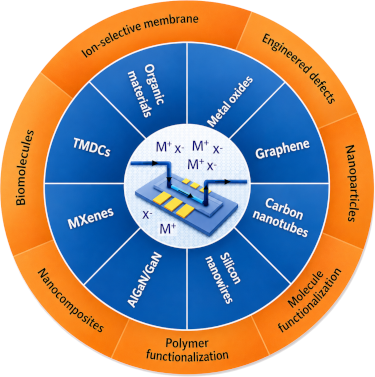
Figure 1: Schematic overview of major electrochemical and electrical sensor geometries for ion detection. (a)...
Figure 2: Design of a water-gated field effect transistor sensor. The inner “tap water” pool acts as a refere...
Figure 3: Structure and fabrication of graphene ion-sensitive field-effect transistors (ISFETs). (a) Schemati...
Figure 4: (a) MoS2−Cys preparation using thioglycolic acid (TGA) to add carboxyl groups followed by amide cro...
Figure 5: Schematic diagram of the rGO/GSH-Au NP hybrid sensor fabrication process. (a) A layer of AET coatin...
Figure 6: Schematic representation of the fabrication of Hg(II)-IIP. Figure 6 was reproduced from [205] (© 2024 E. Shamsab...
Figure 7: Scheme of the preparation route for the NiO/PDDA-RGO composite and its electrochemical application ...
Figure 8: Schematic illustration of the dual-mode assay of arsenate based on CoOOH nanoflakes with peroxidase...
Figure 9: Initial EMF response (squares) and response after 6 months (circles) to pH for an ISE with a PDMA m...
Figure 10: IS-FET sensitivities with respect to their target ions. a) The channel current, Ids, of an Na+ IS-F...
Figure 11: Experimental setup for continuously acquiring water quality data. The ISFET array was deployed in a...
Figure 12: Summary of the properties of classified active-layer materials, highlighting their representative s...