This search combines search strings from the content search (i.e. "Full Text", "Author", "Title", "Abstract", or "Keywords") with "Article Type" and "Publication Date Range" using the AND operator.
Beilstein J. Nanotechnol. 2025, 16, 2055–2076, doi:10.3762/bjnano.16.141
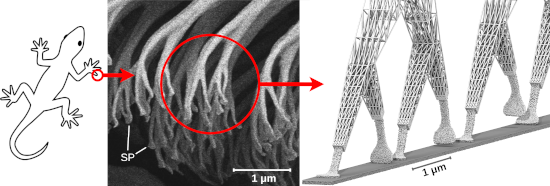
Figure 1: Electron microscopy images of the gecko setae. (A–C) Three hierarchical levels in the scanning elec...
Figure 2: Illustration of the entire multiscale seta model. The red spatulae are modeled using beads, while t...
Figure 3: Schematic for constructing the skeleton of our multiscale model. The dimensions of the figure have ...
Figure 4: The finite element mesh of the setal shaft in our model. The dotted lines at the top of the seta sh...
Figure 5: Geometry of the molecular spatula and substrate. (a) A spatula interacting with the dual-layered sm...
Figure 6: Illustration of the three domains: particle (MD), continuum (FE), and bridging domain (BD). Also sh...
Figure 7: A bridging domain connects one of the spatulae (modeled using molecular dynamics) to the setal shaf...
Figure 8: Reaction forces experienced by the substrate (red), anchor points (green), and the driver FE nodes ...
Figure 9: Number of seta–substrate contacts. (a) Averaged over five runs with error bars in a darker blue col...
Figure 10: Spatula–substrate force profiles for every spatula for a typical pull-off run. For numbering of spa...
Figure 11: Spatula-substrate contact profiles of every spatula for a typical pull-off run. For numbering of sp...
Figure 12: Spatula tip and pad displacement profiles along X-axis (along the surface in the direction of seta ...
Figure 13: Snapshots of spatula 3 just before (load step 155; 217 ns) and after (load step 165; 231 ns) a tip ...
Figure 14: Snapshots of different spatulae at interesting stages during pull-off simulations. Yellow = spatula...