


Search results
Search for "MTS" in Full Text gives 28 result(s) in Beilstein Journal of Nanotechnology.
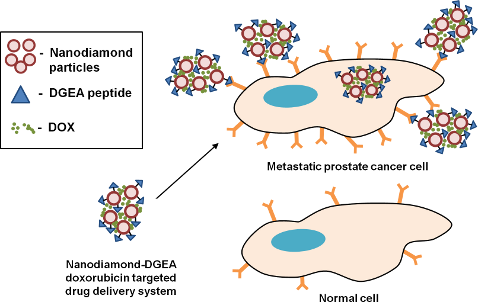
Nanodiamond-DGEA peptide conjugates for enhanced delivery of doxorubicin to prostate cancer
Beilstein J. Nanotechnol. 2014, 5, 937–945, doi:10.3762/bjnano.5.107
- -carboxymethoxyphenyl)-2-(4-sulfophenyl)-2H-tetrazolium (MTS, Promega, Madison, WI) assay. Briefly, MTS assay reagent was added to the cells, and the plates were incubated for 2 h. The absorbance at 490 nm was read with a microplate reader. Cell viability was represented as percentages in reference to the control
- exposed to these treatments for 32 h, and MTS cell viability assay was performed. As shown in Figure 6a, there were no significant differences in cell viability for any of the treatments; the cell viabilities for NDs, DGEA, and ND-DGEA conjugates were all comparable to the control. With the demonstration
- that the individual drug delivery components did not elicit toxicity, PC3 cells then were exposed to no treatment (control) and various concentrations of free DOX, ND-DOX, and ND-DGEA-DOX for 32 h. Figure 6b summarizes the results of the MTS cell viability assay. The ND-DGEA+DOX systems caused


Optimizing the synthesis of CdS/ZnS core/shell semiconductor nanocrystals for bioimaging applications
Beilstein J. Nanotechnol. 2014, 5, 919–926, doi:10.3762/bjnano.5.105
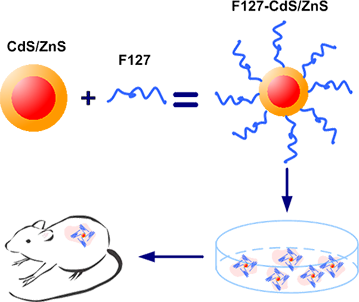
- studies, a cell viability (MTS) assay was carried out for F127-CdS/ZnS QDs. As shown in Figure 10, we tested the cell viability of Panc-1 cells, treating them with various concentrations of ternary nanocrystal formulations for 48 h. The cell viability remained at 84% even at a concentration as high as 500


Synthesis and catalytic applications of combined zeolitic/mesoporous materials
Beilstein J. Nanotechnol. 2011, 2, 785–801, doi:10.3762/bjnano.2.87
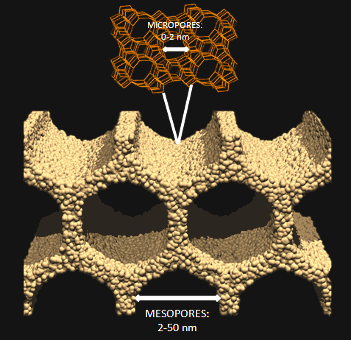
- coordinated Ti [35][43]. Therefore, in the last decade, research has been focused on the combination of mesoporosity and zeolitic features [20][44][45][46][47][48][49][50]. Many promising materials, such as MTS-9 [51] and Ti-MMM-1 [52] have already been developed. The ultimate goal is to develop a “true
- that give rise to an enhanced catalytic performance in comparison with their purely zeolitic and/or mesoporous counterparts [51][52][57][58][59]. MTS-9 for example [51], gives rise to a higher catalytic activity in the epoxidation of styrene than Ti-MCM-41 and shows a selectivity and activity similar
- to TS-1 zeolite. In the hydroxylation of 2,3,6-trimethylphenol, MTS-9 is more active than both Ti-MCM-41 and TS-1. However, there are also examples of combined zeolitic/mesoporous materials, wherein there is no significant improvement when a comparison is drawn with standard zeolites or mesoporous





Other Beilstein-Institut Open Science Activities



