


Search results
Search for "N-doping" in Full Text gives 28 result(s) in Beilstein Journal of Nanotechnology.
Nanostructure sensitization of transition metal oxides for visible-light photocatalysis
Beilstein J. Nanotechnol. 2014, 5, 696–710, doi:10.3762/bjnano.5.82
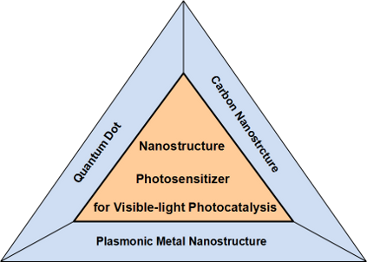
- [38]. A synergetic effect of nitrogen-doping and CdSe quantum-dot-sensitization on nanocrystalline TiO2 was also investigated. Interestingly, a significant photoelectrochemical hydrogen generation enhancement was observed due to CdSe sensitization and N-doping that can facilitate hole transport from
- CdSe to TiO2 via oxygen vacancy states mediated by N-doping [39][40]. There are also a large number of heterostructures in literature consisting of quantum dots and transition metal oxides, for instance, CdS/CdSe co-sensitized TiO2 [41], CdTe or CdTe/CdSe quantum dots on TiO2 nanotube arrays [42][43
- spectra between transition metal oxides and gold nanoparticles. Due to N-doping and N- and F-impurities generated in the anodization process, the N-doped TiO2 nanoparticles and TiO2 nanotubes have absorption spectra in the visible range and show an overlap with that of gold nanoparticles. Therefore, when




Tensile properties of a boron/nitrogen-doped carbon nanotube–graphene hybrid structure
Beilstein J. Nanotechnol. 2014, 5, 329–336, doi:10.3762/bjnano.5.37
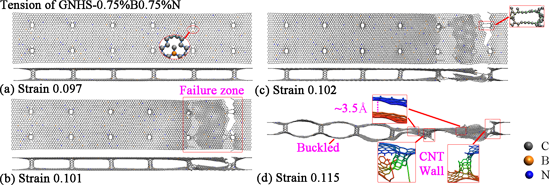
- of the dopant concentration, however, does not further reduce YS and YP. It is interesting to mention that an earlier work reported that 2% of N-doping in graphene monolayers induce a reduction of YS of more than 35% [10], which is much more significant than the reduction observed in the hybrid


En route to controlled catalytic CVD synthesis of densely packed and vertically aligned nitrogen-doped carbon nanotube arrays
Beilstein J. Nanotechnol. 2014, 5, 219–233, doi:10.3762/bjnano.5.24
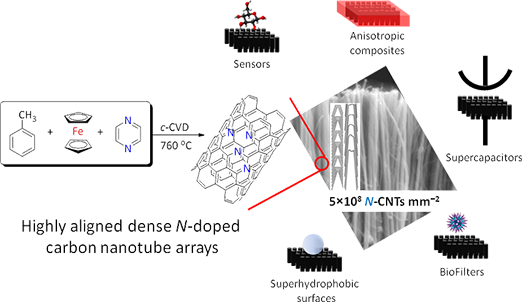
- ] atoms has been frequently used to enhance or tune their physicochemical properties. Among the elemental dopants, nitrogen emerges as of particular interest in electronics since N-CNTs should be characterized by a higher electrical conductivity (n-doping). Consequently, the significance of N-CNTs in a
- plasma enhancements, with typical parameters of the synthesis being the selection of the nitrogen source and/or the catalyst, and temperature. The literature survey (Table 1) shows that the N-doping of CNTs usually induced lattice deformations, i.e., the formation of regular and irregular compartments
- it is the presence of nitrogen species, which affects the growth of N-CNTs and, further, their morphology. Additionally, ID/IG ratios increase with an increased N-doping at higher temperature. Continuing our insights into the mechanism of N-CNTs growth, we have investigated particular stages of the


Other Beilstein-Institut Open Science Activities



