


Search results
Search for "PEDOT:PSS" in Full Text gives 26 result(s) in Beilstein Journal of Nanotechnology.
Low-temperature synthesis of carbon nanotubes on indium tin oxide electrodes for organic solar cells
Beilstein J. Nanotechnol. 2012, 3, 524–532, doi:10.3762/bjnano.3.60
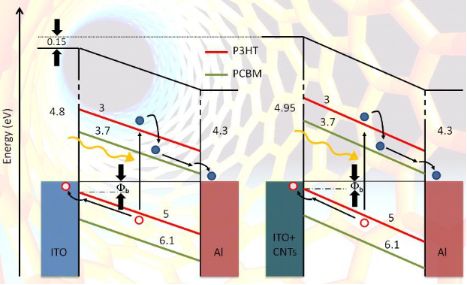
- states of ITO–CNT lying lower than those of ITO. A similar kind of band alignment is almost achieved in the standard cell architecture by the insertion of a layer of poly(3,4-ethylene dioxythiophene):(polystyrene sulfonic acid) (PEDOT:PSS). This polymer is used to improve the contact (and reduce the
- mismatch in energy level) between the ITO and the P3HT, although it is also known to shorten the device lifetime [33]. Being slightly acidic, the PEDOT:PSS is in fact able to etch the ITO and causes interface instability through indium diffusion into the polymer active layer. In our case instead, we
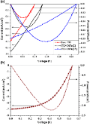
- comparison with the data obtained for a reference cell made with a standard ITO-coated glass anode (i.e., without the addition of PEDOT:PSS). The I–V characteristic of a standard ITO/PEDOT:PSS/P3HT:PCBM/Al cell is also reported in Figure 5b, for a full understanding of the experimental results. All the




Other Beilstein-Institut Open Science Activities



