


Search results
Search for "PTCDA" in Full Text gives 30 result(s) in Beilstein Journal of Nanotechnology.
STM tip-assisted engineering of molecular nanostructures: PTCDA islands on Ge(001):H surfaces
Beilstein J. Nanotechnol. 2013, 4, 927–932, doi:10.3762/bjnano.4.104
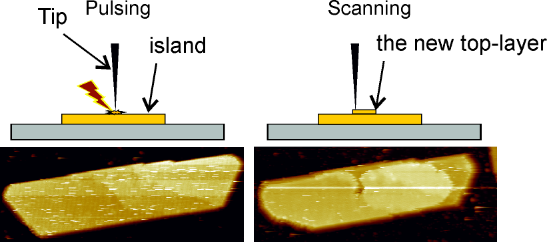
- -tetracarboxylic dianhydride (PTCDA) molecules are grown on a hydrogen passivated Ge(001):H surface. The islands are studied with room temperature scanning tunneling microscopy and spectroscopy. The spontaneous and tip-induced formation of the top-most layer of the island is presented. Assistance of the scanning
- -tetracarboxylic dianhydride (PTCDA) molecular islands on a hydrogen passivated germanium surface, Ge(001):H, are presented. The application of bias voltage pulses in STM allows for the modification of the islands. We found that the presence of a scanning tip of the tunneling microscope facilitates and speeds the
- impossible. At the high coverage, however, the accumulation of the PTCDA molecules is dominated by molecule–molecule interactions and molecular islands are formed. The islands grow in the Volmer–Weber mode. The density of the islands is 2.5 × 109 cm−2 for coverage of 0.7 ML. Approximately 60% of the islands

Probing three-dimensional surface force fields with atomic resolution: Measurement strategies, limitations, and artifact reduction
Beilstein J. Nanotechnol. 2012, 3, 637–650, doi:10.3762/bjnano.3.73
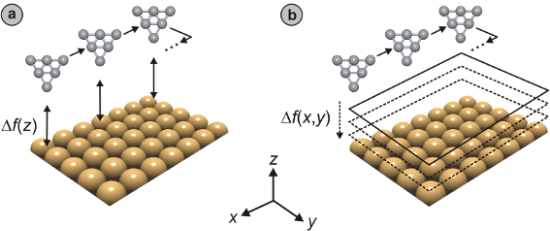
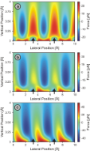
- sample surface. Force fields have now been recorded on NiO(001) [10][12][13], MgO/Ag(001) [14], NaCl(001) [15][16], Si(111)-(7×7) [17][18][19], HOPG [20][21], KBr(001) [9][22][23], Cu(111) [24], and CaCO3() [25] surfaces, as well as single molecules of PTCDA [26][27], pentacene [28], CO [29], C60 [30




A measurement of the hysteresis loop in force-spectroscopy curves using a tuning-fork atomic force microscope
Beilstein J. Nanotechnol. 2012, 3, 207–212, doi:10.3762/bjnano.3.23
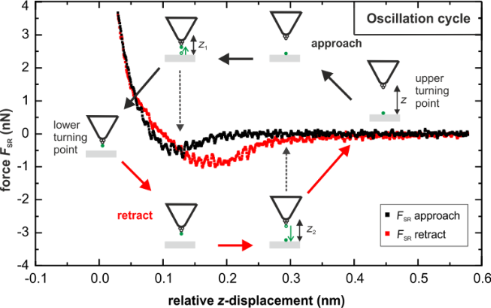
- process can be understood as a hysteresis of forces between approach and retraction of the tip. In this paper, we present the direct measurement of the whole hysteresis loop in force-spectroscopy curves at 77 K on the PTCDA/Ag/Si(111) √3 × √3 surface by means of a tuning-fork-based NC-AFM with an
- oscillation amplitude smaller than the distance range of the hysteresis loop. The hysteresis effect is caused by the making and breaking of a bond between PTCDA molecules on the surface and a PTCDA molecule at the tip. The corresponding energy loss was determined to be 0.57 eV by evaluation of the force
- about 0.22 eV/cycle. Keywords: atomic force microscopy; energy dissipation; force spectroscopy; hysteresis loop; PTCDA/Ag/Si(111) √3 × √3; Introduction Noncontact atomic force microscopy (NC-AFM) is a powerful tool for the study of surface properties. The invention of the frequency-modulation mode (FM


Intermolecular vs molecule–substrate interactions: A combined STM and theoretical study of supramolecular phases on graphene/Ru(0001)
Beilstein J. Nanotechnol. 2011, 2, 365–373, doi:10.3762/bjnano.2.42
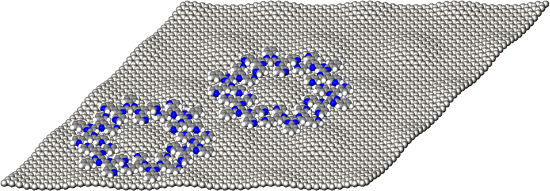
- -(pyridin-3-yl)pyridin-2-yl)pyrimidine (3,3'-BTP) and (ii) 3,4,9,10-perylene tetracarboxylic-dianhydride (PTCDA) on graphene/Ru(0001). For PTCDA adsorption, a 2D adlayer phase was formed, which extended over large areas, while for 3,3'-BTP adsorption linear or ring like structures were formed, which
- different intermolecular interactions, namely (i) 2-phenyl-4,6-bis(6-(pyridin-3-yl)-4-(pyridin-3-yl)pyridin-2-yl)pyrimidine (3,3'-BTP) [24][25] and (ii) 3,4,9,10-perylene tetracarboxylic dianhydride (PTCDA) on graphene/Ru(0001). Schematic representations and space filling models of these molecules are
- bonds, however, are rather different for the two molecules. In the case of the 3,3'-BTP molecules, weak C–H…N-type hydrogen bonds are formed which are typically in the range of 100 meV [25]. The C–H…O-type hydrogen bonds formed between PTCDA molecules are somewhat stronger and result in intermolecular


Oriented growth of porphyrin-based molecular wires on ionic crystals analysed by nc-AFM
Beilstein J. Nanotechnol. 2011, 2, 34–39, doi:10.3762/bjnano.2.4
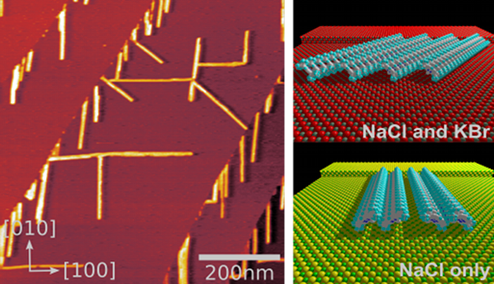
- studies by non-contact atomic force microscopy (nc-AFM) were done on ionic crystals with adsorbed PTCDA [17][18][19][20][21][22], PTCDI [23] or C60 [24]. In the case of porphyrins, the growth [25][26][27] and electronic properties [28] of stable, monolayered molecular wires on KBr(001) with a length of up


Other Beilstein-Institut Open Science Activities



