


Search results
Search for "QCM" in Full Text gives 34 result(s) in Beilstein Journal of Nanotechnology.
Mechanical properties of MDCK II cells exposed to gold nanorods
Beilstein J. Nanotechnol. 2015, 6, 223–231, doi:10.3762/bjnano.6.21
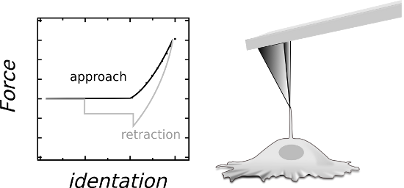
- the cell’s surface. Another aspect could be the collapse of the plasma membrane on the actin cortex. Particles coated with PEG do not show a significant change in elastic properties. This observation is consistent with QCM measurements that show a considerable drop in frequency upon administration of
- CTAB coated rods suggesting an increase in acoustic load corresponding to a larger stiffness (storage modulus). Keywords: atomic force microscopy; CTAB; gold nanorods; membrane tension; MDCK II cells; QCM; Introduction The interest in gold nanoparticles (NP) for biomedical applications in the field
- about cellular properties like the cytoskeleton or the plasma membrane [21]. Alternatively, mechanical properties of cells in response to nanoparticle exposure can be monitored time resolved by the quartz crystal microbalance with dissipation monitoring (D-QCM) [14][22][23]. The QCM-method records


The fate of a designed protein corona on nanoparticles in vitro and in vivo
Beilstein J. Nanotechnol. 2015, 6, 36–46, doi:10.3762/bjnano.6.5
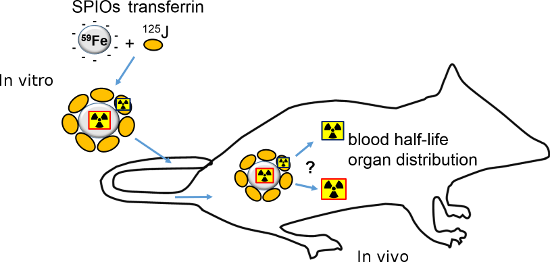
- experimental setups. Various techniques such as ITC (isothermal titration calorimetry), SPR (surface plasmon resonance), DCS (differential centrifugal sedimentation), QCM (quartz crystal microbalance), and FCS (fluorescence correlation spectroscopy) have been used to monitor the affinities of proteins for


Real-time monitoring of calcium carbonate and cationic peptide deposition on carboxylate-SAM using a microfluidic SAW biosensor
Beilstein J. Nanotechnol. 2014, 5, 1823–1835, doi:10.3762/bjnano.5.193
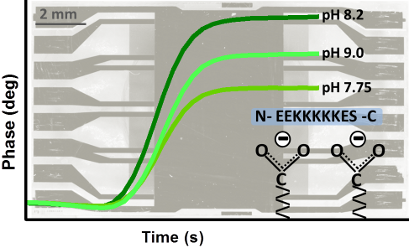
- microbalances with dissipation QCM-D [35]. Mass and viscosity changes can be continuously and simultaneously monitored in standardized systems, as long as the amplitude signal is strongly correlated with the viscosity of the fluid [36]. Recently, multichannel experiments became possible, enhancing the


Purification of ethanol for highly sensitive self-assembly experiments
Beilstein J. Nanotechnol. 2014, 5, 1254–1260, doi:10.3762/bjnano.5.139
- sensitive for small and larger molecules, in contrast to SPR, second-harmonic generation (SHG) spectroscopy [35] and quartz-crystal microbalance (QCM) experiments [36]. To employ this extremely sensitive technique for the determination of adsorption kinetics, we tested ethanol of several commercial

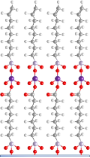
Organic and inorganic–organic thin film structures by molecular layer deposition: A review
Beilstein J. Nanotechnol. 2014, 5, 1104–1136, doi:10.3762/bjnano.5.123
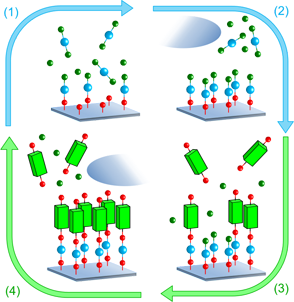
- acid [57] and TMA+oxiran-2-ylmethanol (glycidol, GLY) [38]. The characterization techniques used to investigate the thin films deposited by using MLD do not vary much from those techniques used for inorganic thin films grown by ALD. An in situ quartz crystal microbalance (QCM) is often used to give




Towards precise defect control in layered oxide structures by using oxide molecular beam epitaxy
Beilstein J. Nanotechnol. 2014, 5, 596–602, doi:10.3762/bjnano.5.70
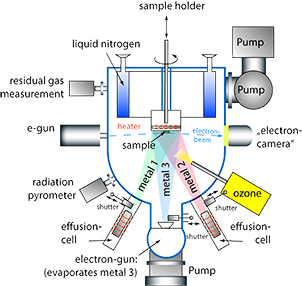
- source can be opened for service and replacement of a source element without venting the growth chamber within a short period of time, even during the film growth. The differential pumping module is also used to pump the electron gun of the RHEED system and the load locked quartz crystal monitor (QCM
- ) head. The QCM, which is mounted on a linear bellows assembly and is separated from the growth chamber by a gate valve, is used to calibrate the absolute deposition rates for each source before starting the process, while the RHEED system allows for the in-situ monitoring of the growth in real time. The


3D-nanoarchitectured Pd/Ni catalysts prepared by atomic layer deposition for the electrooxidation of formic acid
Beilstein J. Nanotechnol. 2014, 5, 162–172, doi:10.3762/bjnano.5.16
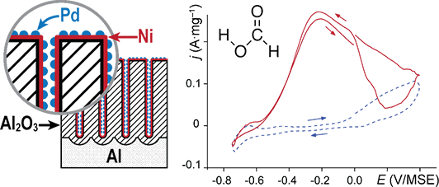
- onto the Ni films (Figure 1g). Both NiO and Pd deposition processes have been monitored by quartz crystal microbalance (QCM). The morphology, the chemical composition and the crystalline structures have been investigated by scanning and transmission electron microscopy (SEM and TEM) and atomic force
- deposition of NiO is carried out from nickelocene (NiCp2) and O3 precursors and the reduction of this oxide film to metallic Ni is obtained by a reductive annealing process under H2 atmosphere. The relative mass, m, gain and loss have been monitored during the process by QCM and are plotted in Figure 2a. A
- sequence. The QCM measurements indicate that the exposure and purging duration are optimized for both NiCp2 and O3 pulses. The mass variations are indeed reaching a plateau at the end of the exposure and purging stages. After the short NiCp2 pulse (green period on the far left of Figure 2b), the mass


Mapping mechanical properties of organic thin films by force-modulation microscopy in aqueous media
Beilstein J. Nanotechnol. 2012, 3, 464–474, doi:10.3762/bjnano.3.53
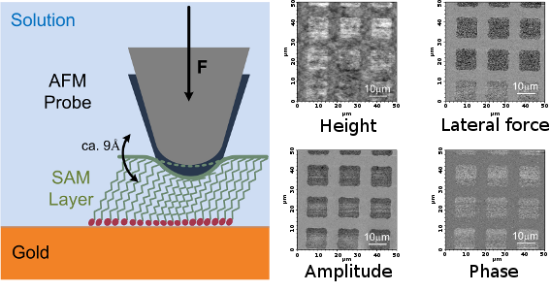
- , including surface plasmon resonance (SPR) [58], quartz-crystal microbalance (QCM) [59][60][61] and ellipsometry [62]. These methods, however, do not resolve differences in the grafting density and packing of the molecules with high spatial resolution (micrometer or less). Here we show that FMM in solution



Sensing surface PEGylation with microcantilevers
Beilstein J. Nanotechnol. 2010, 1, 3–13, doi:10.3762/bjnano.1.2
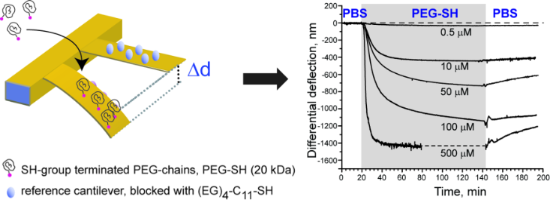
- (QCM-D) [11] and surface plasmon resonance (SPR) [12] also allow for the characterization of adsorption-induced and structural changes in interfacial polymer layers. The high sensitivity of microcantilever sensors has proven to be a powerful platform for detecting molecular interactions in a label-free
- chains into their swelling state. Discussion We have studied the behavior of 20 kDa mPEG–SH “grafted to” Au surfaces using a microcantilever array-based sensor. Consistent with XPS [8], ellipsometry [8][34], QCM [35] and AFM [36] polymer “grafting to” studies, we find that the adsorption profile of mPEG



Other Beilstein-Institut Open Science Activities



