


Search results
Search for "RF magnetron sputtering" in Full Text gives 30 result(s) in Beilstein Journal of Nanotechnology.
Characterization of nanostructured ZnO thin films deposited through vacuum evaporation
Beilstein J. Nanotechnol. 2015, 6, 971–975, doi:10.3762/bjnano.6.100
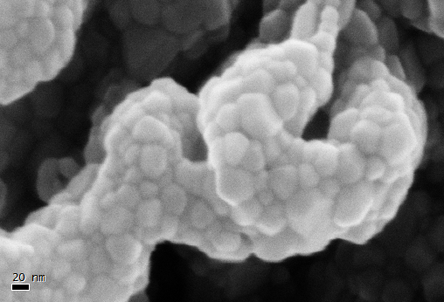
- ], and RF magnetron sputtering [10]. However, the vacuum evaporation technique is used to deposit worm-form nanostructured thin films. This technique is different from those reported in the literature such as thermal evaporation assisted by inert gases [11], or e-beam evaporation [12]. So this technique


Nanostructuring of GeTiO amorphous films by pulsed laser irradiation
Beilstein J. Nanotechnol. 2015, 6, 893–900, doi:10.3762/bjnano.6.92
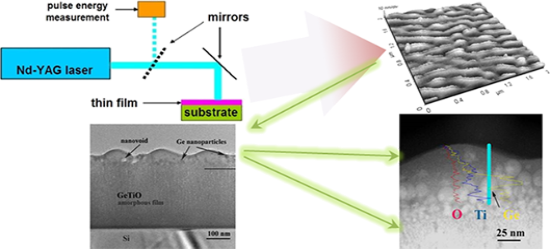
- obtained by RF magnetron sputtering with 50:50 initial atomic ratio of Ge:TiO2. Laser irradiation was performed by using the fourth harmonic (266 nm) of a Nd:YAG laser. The laser-induced nanostructuring results in two effects, the first one is the appearance of a wave-like topography at the film surface
- GeTiO matrix. Experimental Amorphous GeTiO films with a thickness of 330 nm were deposited by RF magnetron sputtering on Si(100) wafer substrates using Ge:TiO2 with 50:50 atomic ratio. Details on the film deposition are found in [23]. These GeTiO amorphous films were irradiated with laser fluences from
- results from the RF magnetron sputtering films preparation. This shows that about 1/3 of the Ge content is lost from the surface layer affected by the laser radiation, and 2/3 of it can be segregated in amorphous Ge nanoparticles. Discussion The nanostructure formed at the GeTiO film surface by pulsed


Integration of ZnO and CuO nanowires into a thermoelectric module
Beilstein J. Nanotechnol. 2014, 5, 927–936, doi:10.3762/bjnano.5.106
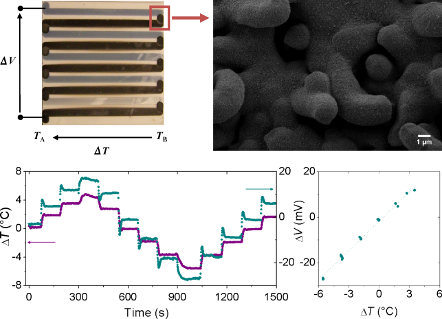
- dried with synthetic air. Gold nanoparticles have been deposited by RF magnetron sputtering (70 W Ar plasma for 5 s at room temperature, pressure 5 × 10⁻³ mbar) on the substrate, as they will act as catalyst for the nanowire growth. This technique was very easy and straightforward to use and allowed a
- alumina substrates [24]. Samples have been first cleaned in acetone using ultrasonic bath for 10 min and then dried with synthetic air. Then, a thin layer of metallic Cu has been deposited on samples by RF magnetron sputtering (50 W Ar plasma at room temperature, pressure 5 × 10⁻³ mbar, thickness 1 μm
- , with an argon flow of 10 sccm (30 min deposition). Afterwards, copper oxide nanowires were synthesized by thermal oxidation. Copper metallic film was deposited via RF magnetron sputtering, as described before, using a 50 W argon plasma at room temperature (thickness 2 µm, 5 × 10⁻³ mbar pressure


Deformation-induced grain growth and twinning in nanocrystalline palladium thin films
Beilstein J. Nanotechnol. 2013, 4, 554–566, doi:10.3762/bjnano.4.64
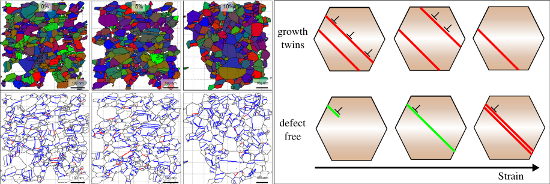
- frequency (RF) magnetron sputtering using 2’’ diameter planar targets with 99.95% purity. Three sets of pure Pd samples were prepared with constant sputtering power of 60 W at a working gas pressure (Ar) of 0.005 mbar at room temperature. Pd films of 1 µm nominal thickness were grown in 100 steps of 10 nm


Functionalised zinc oxide nanowire gas sensors: Enhanced NO2 gas sensor response by chemical modification of nanowire surfaces
Beilstein J. Nanotechnol. 2012, 3, 368–377, doi:10.3762/bjnano.3.43
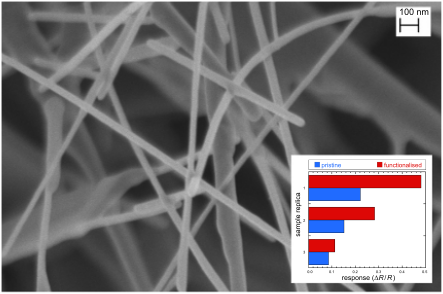
- interacted with residual oxygen to give ZnO nanowires [13]. The stabilised samples were then provided by interdigitated Pt electrodes deposited by RF magnetron sputtering, while on the back side a Pt meander was deposited to act as heater (by Joule effect) and temperature sensor. Ex situ functionalisation of


Other Beilstein-Institut Open Science Activities



