


Search results
Search for "SERS substrate" in Full Text gives 33 result(s) in Beilstein Journal of Nanotechnology.
Sandwich-like layer-by-layer assembly of gold nanoparticles with tunable SERS properties
Beilstein J. Nanotechnol. 2016, 7, 1028–1032, doi:10.3762/bjnano.7.95
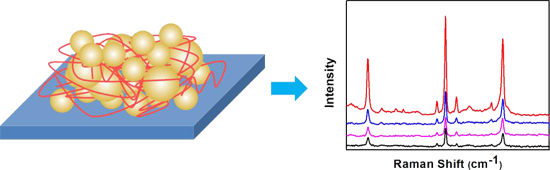
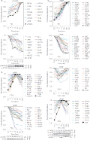
- Ibulk are the intensity of a vibrational mode in the SERS spectrum and bulk sample, and Nads and Nbulk are the number of molecules adsorbed on the SERS substrate and bulk molecules excited by the laser, respectively. Using the 1587 cm−1 band, the EF values for the SSS, SBS, BSB and BBB thin films are
- films. Conclusion Sandwich-like LbL assemblies of Au NPs were designed as model SERS substrate. The SERS performance could be readily tuned by using Au NPs of different sizes or introducing insert layers with controllable thickness. The methods and strategies involved in this work are rather simple. The


Chemiresistive/SERS dual sensor based on densely packed gold nanoparticles
Beilstein J. Nanotechnol. 2015, 6, 2498–2503, doi:10.3762/bjnano.6.259
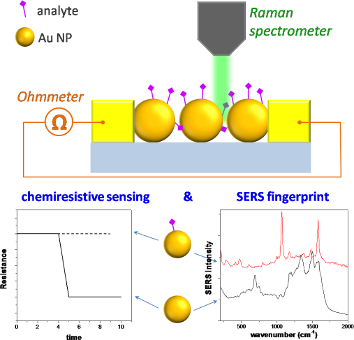
- , respectively [15][16]. This is an indication for the adsorption of MBA molecules. These bands were observed also in control experiments performed on another kind of gold SERS substrate without capping ligands such as folic acid on the NPs (see Supporting Information File 1). Some less intense bands, e.g., at
- online analyte injection, which we might tackle in the near future. Conclusion This work demonstrated the proof-of-concept of a nanoparticle-based dual-mode (bio)chemo-sensor capable of working as both chemiresistor and SERS substrate. At the heart of the proposed DEOS lie strips of gold nanoparticles


Protein corona – from molecular adsorption to physiological complexity
Beilstein J. Nanotechnol. 2015, 6, 857–873, doi:10.3762/bjnano.6.88

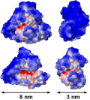
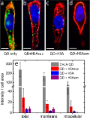
- ][126]. In the context of protein adsorption, it needs to be pointed out that the enhancement effect in SERS strongly depends on the distance between the Raman/SERS active bond and the surface of the SERS substrate [121][123][124][125][126][127]. An intriguing aspect in the work of Grass and Treuel [36



Electromagnetic enhancement of ordered silver nanorod arrays evaluated by discrete dipole approximation
Beilstein J. Nanotechnol. 2015, 6, 686–696, doi:10.3762/bjnano.6.69
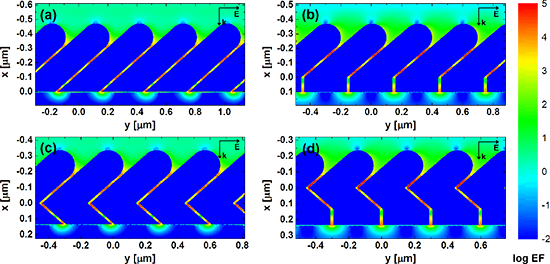
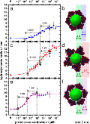
- not only depends on the intrinsic properties and the dielectric environment of the metal nanoparticles, but also on their shape, size and spatial arrangement. The incident wavelength, angle and polarization were also proven to greatly affect the performance of an SERS substrate. Previously, Chaney et


Synthesis of embedded Au nanostructures by ion irradiation: influence of ion induced viscous flow and sputtering
Beilstein J. Nanotechnol. 2014, 5, 105–110, doi:10.3762/bjnano.5.10
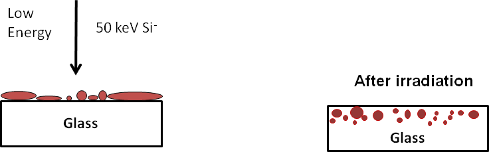
- nanostructures that are embedded near the surface. These embedded Au nanostructures have great potential for the application as substrates for surface enhanced Raman spectroscopy (SERS). Such a SERS substrate is expected to be reusable due to the embedded nanostructures. TRIDYN [20][21], a binary-collision Monte


The morphology of silver nanoparticles prepared by enzyme-induced reduction
Beilstein J. Nanotechnol. 2012, 3, 404–414, doi:10.3762/bjnano.3.47
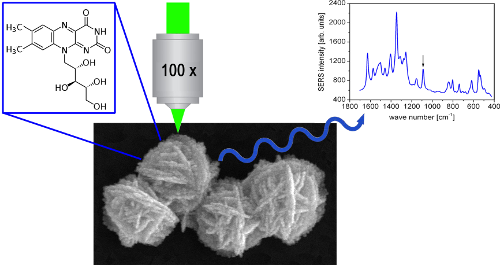
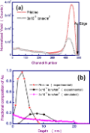
- the first layer next to the silver nanoparticles undergo the most efficient signal amplification. The simplest approach for quantitative investigations may be to carry out SERS measurements of solutions only in such concentration ranges, in which all binding sites of the SERS substrate are saturated


Distinction of nucleobases – a tip-enhanced Raman approach
Beilstein J. Nanotechnol. 2011, 2, 628–637, doi:10.3762/bjnano.2.66
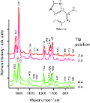
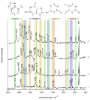
- take into account that a SERS experiment is either done in a colloidal solution or the dissolved sample is brought into contact with a solid SERS substrate. In both cases the molecules can select favoured binding sites to adsorb to the metal particles. In case of adenine these are the four nitrogen



Tip-enhanced Raman spectroscopic imaging of patterned thiol monolayers
Beilstein J. Nanotechnol. 2011, 2, 509–515, doi:10.3762/bjnano.2.55
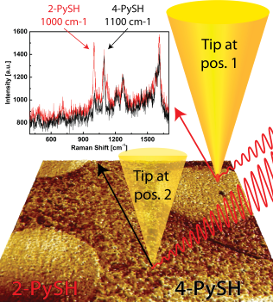
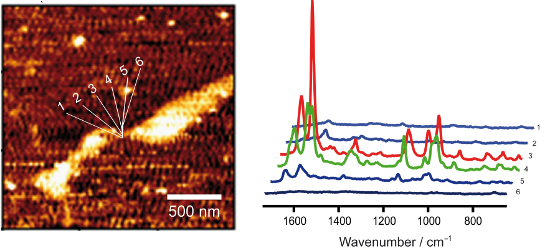
- thickness 6 nm), the printed patterns could not be detected and localized by confocal RS. Either no Raman signals at all or homogeneous signals from all over the substrate were detected (data not shown). Due to the strong but inhomogeneous enhancement by single sites on a typical SERS substrate, it is most
- likely that a very small fraction of molecules diffusing on the Ag surface during production of the samples dominated the spectra, preventing a localization of the molecules. Another possible explanation is that the roughness of the SERS substrate interfered with the patterning process used (compare




Other Beilstein-Institut Open Science Activities



