


Search results
Search for "anticancer drug" in Full Text gives 36 result(s) in Beilstein Journal of Nanotechnology.
A nanocomplex of C60 fullerene with cisplatin: design, characterization and toxicity
Beilstein J. Nanotechnol. 2017, 8, 1494–1501, doi:10.3762/bjnano.8.149
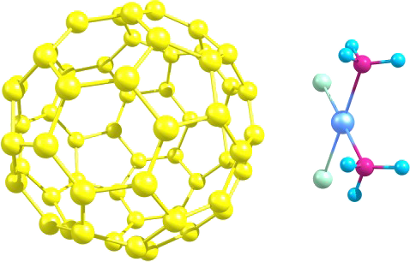
- are transformed into lymphoblast) a large set of genes are activated to allow the entry of cells in the G1 phase of the cell cycle [51]. Probably, such transformation that never occurs in vivo in lymphocytes under normal conditions, leads to an increase in the cells' sensitivity to the anticancer drug
- evaluate the level of blast transformation (the fraction of lymphoblasts). Incubation of lymphocytes and lymphoblasts The cell suspension in RPMI 1640 medium (cell concentration in the range of 1 × 10⁵ to 5 × 10⁵ cells per mL) was incubated in the presence of either C60 fullerene (0.1 mg/mL), anticancer
- drug Сіs (0.01, 0.1 or 0.15 mg/mL) or the complex of C60 fullerene with Cis (Cis concentration was 0.1 or 0.15 mg/L, the C60 fullerene to Cis molar ratio was equal to 1:2.4) for 1.5 h at 37 °C, washed once in 0.15 M NaCl, and then used for the comet assay. Five to seven independent repeats of the



Development of polycationic amphiphilic cyclodextrin nanoparticles for anticancer drug delivery
Beilstein J. Nanotechnol. 2017, 8, 1457–1468, doi:10.3762/bjnano.8.145
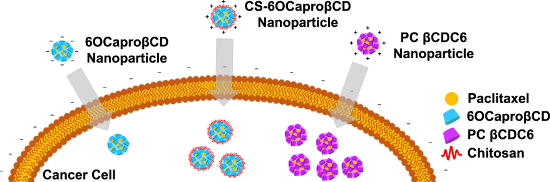
- , Spain Department of Organic Chemistry, University of Sevilla, C/ Prof García Gonzalez 1, Sevilla, 41012, Spain Department of Pharmaceutical Technology, Faculty of Pharmacy, Hacettepe University, Ankara, 06100, Turkey 10.3762/bjnano.8.145 Abstract Background: Paclitaxel is a potent anticancer drug that
- cells. The amphiphilic, cationic PC βCDC6 derivative was used as the anticancer drug carrier delivery system for PCX for the first time in this study. There are various studies in which this derivative is used as a gene transfer delivery system; however, there is only example where this derivative was
- used as a drug delivery system. This was a study regarding the non-polar anxiolytic drug diapezam realized by Mendez-Ardoy et al. [22]. Our goal is to evaluate the potential of the polycationic CD nanoparticles as an anticancer drug delivery system. In fact, these polycationic CDs were evaluated for


Cationic PEGylated polycaprolactone nanoparticles carrying post-operation docetaxel for glioma treatment
Beilstein J. Nanotechnol. 2017, 8, 1446–1456, doi:10.3762/bjnano.8.144
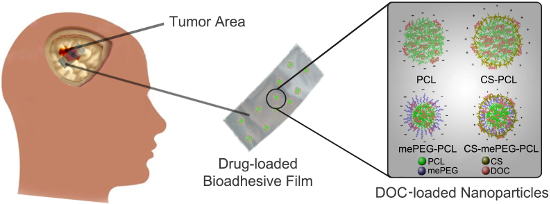
- that active targeted PEG/PCL nanoparticles enhanced tumor penetration [22]. Besides that, Ungaro et al. obtained docetaxel-loaded core–shell PEO/PCL nanoassemblies for passive targeting of the anticancer drug to cancer cells. Their results showed that docetaxel-loaded PEO/PCL nanoparticles were more
- when compared with non-coated nanoparticles. Conclusion In this study, the anticancer drug DOC, encapsulated in anionic and cationic polymeric nanoparticles and administered in a bioadhesive film formulation, was successfully developed to apply the chemotherapeutic drug directly to the action site
- from Sigma-Aldrich, USA. Chitosan (Protasan® G 113, MW < 200 kDa, deacetylation degree 75–90%) was purchased from FMC Biopolymers, Norway. HpC (Klucel™ hydroxypropylcellulose) was purchased from Ashland, USA. The model anticancer drug, docetaxel (purity 97%), was purchased from Fluka, Switzerland




Chitosan-based nanoparticles for improved anticancer efficacy and bioavailability of mifepristone
Beilstein J. Nanotechnol. 2016, 7, 1861–1870, doi:10.3762/bjnano.7.178
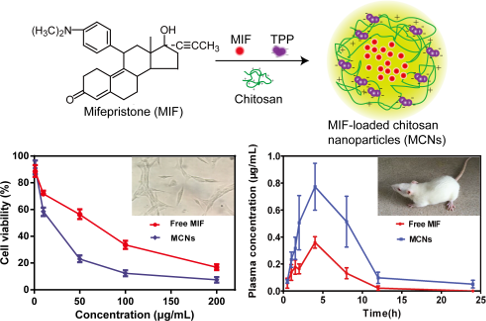
- , College of Life Sciences, China Jiliang University, Hangzhou, Zhejiang, 310018, China 10.3762/bjnano.7.178 Abstract In addition to its well-known abortifacient effect, mifepristone (MIF) has been used as an anticancer drug for various cancers in many studies with an in-depth understanding of the


Comparison of the interactions of daunorubicin in a free form and attached to single-walled carbon nanotubes with model lipid membranes
Beilstein J. Nanotechnol. 2016, 7, 524–532, doi:10.3762/bjnano.7.46
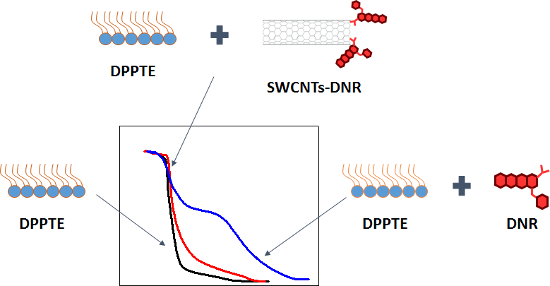
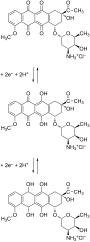
- Dorota Matyszewska Faculty of Chemistry, Biological and Chemical Research Centre, University of Warsaw, Żwirki i Wigury 101, 02089 Warsaw, Poland 10.3762/bjnano.7.46 Abstract In this work the interactions of an anticancer drug daunorubicin (DNR) with model thiolipid layers composed of 1,2
- agent as the drug in the free form but in the same time they do not influence the organization and properties of the membranes to such extent as the free drug. Conclusion Interactions of anticancer drug daunorubicin with model thiolipid membranes were investigated using Langmuir technique and




Silica micro/nanospheres for theranostics: from bimodal MRI and fluorescent imaging probes to cancer therapy
Beilstein J. Nanotechnol. 2015, 6, 546–558, doi:10.3762/bjnano.6.57
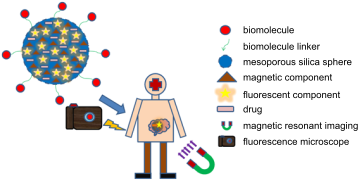
- synthesis was enhanced by using Y(NO3)3·6H2O and Eu2O3 as reactants, CTAB as surfactant and TEOS as alkyl silicate. Finally, the anticancer drug doxyrubicin (DOX) was loaded into the prepared NPs. Characterization of mesoporous silica NPs (MSN), YVO4:Eu3+ NPs and YVO4-MSNs were done by XRD, FTIR, TEM and


Release behaviour and toxicity evaluation of levodopa from carboxylated single-walled carbon nanotubes
Beilstein J. Nanotechnol. 2015, 6, 243–253, doi:10.3762/bjnano.6.23
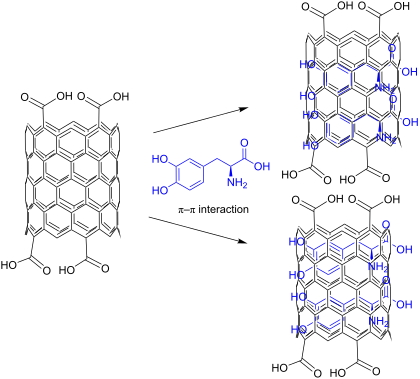
- (anticancer drug) onto the epidermal growth factor functionalized SWCNT [23]. Release behaviour of LD In this study, the release profiles for LD from SWCNT–COOH at PBS pH values of 7.4 and 4.8 were investigated and shown in Figure 5. Both of the release curves show a fast release in the early stage, followed




Anticancer efficacy of a supramolecular complex of a 2-diethylaminoethyl–dextran–MMA graft copolymer and paclitaxel used as an artificial enzyme
Beilstein J. Nanotechnol. 2014, 5, 2293–2307, doi:10.3762/bjnano.5.238
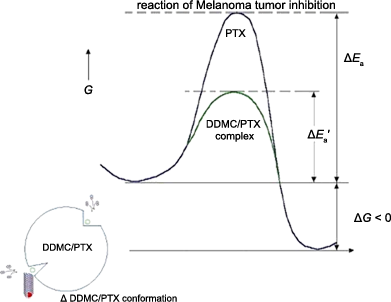
- modulation, was developed as a new type of anticancer drug. However, even if a patient is prescribed an anticancer agent, a cancer cell will soon change an antidrug gene, thereby increasing the power of multi-drug resistance (MDR) [10]. It can be imagined that the development of fatal MDR by a cancer cell to


Near-infrared dye loaded polymeric nanoparticles for cancer imaging and therapy and cellular response after laser-induced heating
Beilstein J. Nanotechnol. 2014, 5, 313–322, doi:10.3762/bjnano.5.35
- often been correlated to a poor therapeutic outcome, since HIF-1 could circumvent the anticancer drug effect by protecting cells from drug-induced apoptosis [12][13][14]. Moreover, tumor angiogenesis occurs partly by activating the expression of VEGF, which is partially regulated by HIF-1 [15][16][17


Extracellular biosynthesis of gadolinium oxide (Gd2O3) nanoparticles, their biodistribution and bioconjugation with the chemically modified anticancer drug taxol
Beilstein J. Nanotechnol. 2014, 5, 249–257, doi:10.3762/bjnano.5.27

- were bioconjugated with the chemically modified anticancer drug taxol with the aim of characterizing the role of this bioconjugate in the treatment of cancer. The biosynthesized Gd2O3 nanoparticles were characterized by UV–vis spectroscopy, transmission electron microscopy (TEM), X-ray diffraction (XRD
- simple biological protocol for the synthesis of gadolinium oxide nanoparticles, studied their biodistribution, and bioconjugated these nanoparticles with the chemically modified anticancer drug taxol. This particular bioconjugation may result in an enhancement of the hydrophilicity of taxol and may


Magnetic-Fe/Fe3O4-nanoparticle-bound SN38 as carboxylesterase-cleavable prodrug for the delivery to tumors within monocytes/macrophages
Beilstein J. Nanotechnol. 2012, 3, 444–455, doi:10.3762/bjnano.3.51
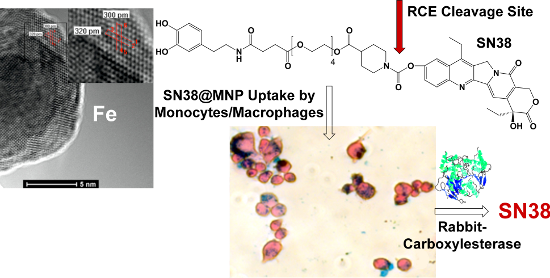
- not been used as an anticancer drug directly in humans due to its inherent poor solubility in any pharmaceutically acceptable media (solubility in water <5 µg/mL). To overcome this disadvantage of SN38, two major basic strategies have been developed. The first strategy is to directly introduce





