


Search results
Search for "biofilm" in Full Text gives 31 result(s) in Beilstein Journal of Nanotechnology.
BN/Ag hybrid nanomaterials with petal-like surfaces as catalysts and antibacterial agents
Beilstein J. Nanotechnol. 2018, 9, 250–261, doi:10.3762/bjnano.9.27
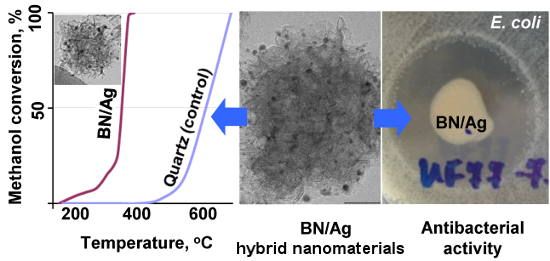
- 9d, lines 3 and 4), whereas control and BN NP samples did not show any antibacterial effect (Figure 9d, curves 1 and 2). In order to estimate the antibacterial activity of the BN/Ag HNMs at the early stage of biofilm formation, the coupon method was used. The obtained results show that, unlike the
- control sample, there is no biofilm formation on the surface of CVD and UV BN/Ag HNMs (Figure 9e). Thus, our data demonstrate that both types of BN/Ag HNMs possess a strong antibacterial effect against E. coli bacteria and inhibit the early stage of biofilm formation. Despite a broad spectrum of
- counted. In order to estimate the antibacterial activity of the BN/Ag HNMs at the early stage of biofilm formation, the coupon method was used. Three standard plastic coupons, 300 mm2, were immersed into E. coli bacterial culture together with the BN/Ag HNMs at 37 °C for 8 h. After the tests, the coupons





Bi-layer sandwich film for antibacterial catheters
Beilstein J. Nanotechnol. 2017, 8, 1982–2001, doi:10.3762/bjnano.8.199
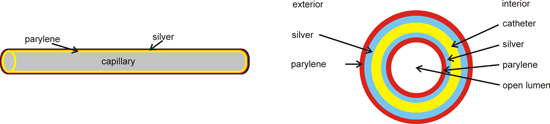
- of bacteria can be fought relatively easily. Once the invasion is permitted and the small islands have grown to a highly structured biofilm with a protecting polysaccharide, the prospects for an effective attack are severely diminished [7]. Because catheterization was a giant step towards a better


Viability and proliferation of endothelial cells upon exposure to GaN nanoparticles
Beilstein J. Nanotechnol. 2016, 7, 1330–1337, doi:10.3762/bjnano.7.124
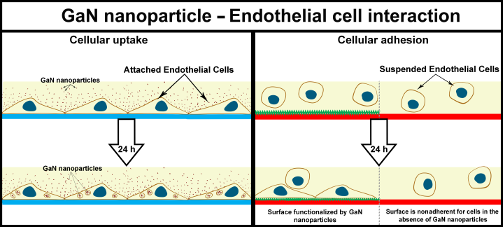
- functionalization is important to prevent biofilm formation on implants or prostheses and can improve the endothelialization process for other applications. It was recently shown that GaN nanoparticles could inhibit biofilm formation, being most effective against Gram-negative bacterial species [26]. Endothelial



Mammalian cell growth on gold nanoparticle-decorated substrates is influenced by the nanoparticle coating
Beilstein J. Nanotechnol. 2014, 5, 2479–2488, doi:10.3762/bjnano.5.257
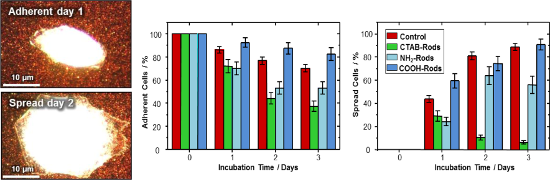
- (i.e., the marking of cell movement by the voids created on a nanoparticle carpet) was used already in 1977 to visualize cell migration [15]. Because nanoparticles are so prevalently used to coat surfaces (for instance, to create biofilm resistance on implants [16], to enhance stability or to create a


Aquatic versus terrestrial attachment: Water makes a difference
Beilstein J. Nanotechnol. 2014, 5, 2424–2439, doi:10.3762/bjnano.5.252
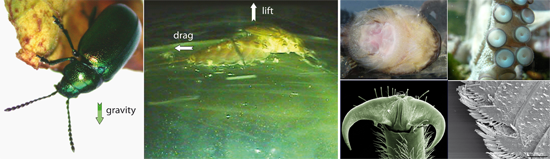
- pressure difference at vacuum conditions can be ameliorated under water, due to the increasing pressure with water depth. Keywords: adhesion; biofilm; friction; hooks; suction; Introduction Attachment in animals, plants and microorganisms serves a variety of functions: the interconnection of body parts
- considered for aquatic systems. While most terrestrial animals make contact directly with the substrate, in aquatic environments the substrates are usually covered with a biofilm and fouling organisms (Figure 3). Biofilms play not only an important role in stimulating or inhibiting the settlement of fouling
- , and fluid properties, implies they will be useful. A further complication in water bears mention: The biofilm of fouled surfaces has a high effective viscosity and is also viscoelastic [26]. It is likely that an empirical understanding of viscous adhesion of animals to biofilms will have to be


Antimicrobial nanospheres thin coatings prepared by advanced pulsed laser technique
Beilstein J. Nanotechnol. 2014, 5, 872–880, doi:10.3762/bjnano.5.99
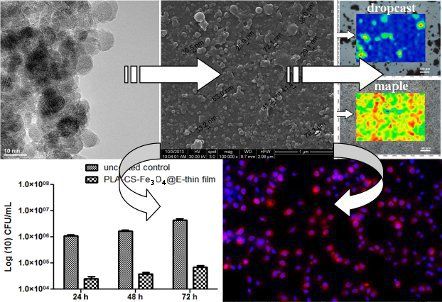
- -CS-Fe3O4@EUG nanospheres diameter sizes range between 20 and 80 nm. These MAPLE-deposited coatings acted as bioactive nanosystems and exhibited a great antimicrobial effect by impairing the adherence and biofilm formation of Staphylococcus aureus (S. aureus) and Pseudomonas aeruginosa (P. aeruginosa
- in combating microbial infections both in vitro and in vivo [5][6]. In the past years a series of papers have been published in prestigious journals highlighting the relevance of magnetite nanostructures in preventing the development of microbial biofilm and the opportunity of utilizing these
- driven by the Axio-Vision 4.6 (Carl Zeiss, Germany) software. In vitro microbial biofilm development Staphylococcus aureus ATCC 25923 and Pseudomonas aeruginosa ATCC 27853 strains were purchased from American Type Cell Collection (ATCC, USA). For the biofilm assays, fresh bacteria cultures were obtained




Other Beilstein-Institut Open Science Activities



