


Search results
Search for "biofilms" in Full Text gives 31 result(s) in Beilstein Journal of Nanotechnology.
Preparation of micro/nanopatterned gelatins crosslinked with genipin for biocompatible dental implants
Beilstein J. Nanotechnol. 2018, 9, 1735–1754, doi:10.3762/bjnano.9.165
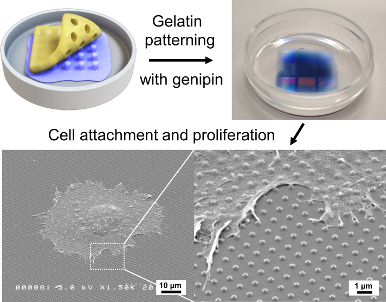
- differentiation [7], to functionalize implant surfaces [8][9], and to prevent the formation of bacterial biofilms [10]. In the dental field, we have used different micro/nanopatterns that employ an apatite paste [11], a flowable composite resin [12], a titanium coat [13], and curable dental materials [14]. The


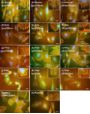


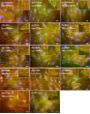


Impact of surface wettability on S-layer recrystallization: a real-time characterization by QCM-D
Beilstein J. Nanotechnol. 2017, 8, 91–98, doi:10.3762/bjnano.8.10
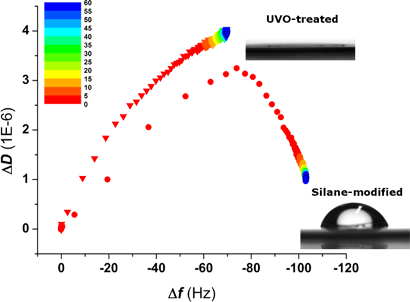
- characterize the formation of biofilms in the recent years [19][20][21][22][23]. In this manuscript, our study is focused on a physico-chemical analysis about how changes in the wettability (hydrophilic vs hydrophobic) of SiO2 surfaces influence the recrystallization pathways of SbpA proteins. By means of


Aquatic versus terrestrial attachment: Water makes a difference
Beilstein J. Nanotechnol. 2014, 5, 2424–2439, doi:10.3762/bjnano.5.252
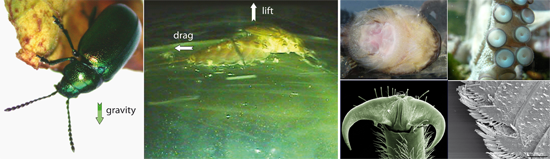
- considered for aquatic systems. While most terrestrial animals make contact directly with the substrate, in aquatic environments the substrates are usually covered with a biofilm and fouling organisms (Figure 3). Biofilms play not only an important role in stimulating or inhibiting the settlement of fouling
- invertebrates [20][21][22][23][24][25], but they also change the surface properties of the primary substrate considerably and by this can affect the attachment forces significantly [26][27]. While biofilms can vary greatly in composition and thickness, they are usually softer than the primary substrate, and
- , and fluid properties, implies they will be useful. A further complication in water bears mention: The biofilm of fouled surfaces has a high effective viscosity and is also viscoelastic [26]. It is likely that an empirical understanding of viscous adhesion of animals to biofilms will have to be


Hydrophobic interaction governs unspecific adhesion of staphylococci: a single cell force spectroscopy study
Beilstein J. Nanotechnol. 2014, 5, 1501–1512, doi:10.3762/bjnano.5.163
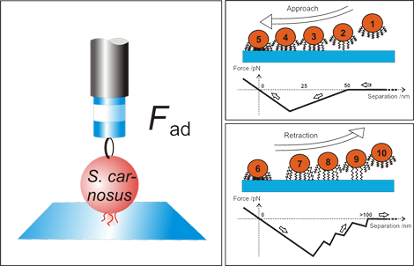
- ), University of California at Berkeley, Berkeley, California 94720, USA Institute of Medical Microbiology and Hygiene, Saarland University, D-66421 Homburg/Saar, Germany 10.3762/bjnano.5.163 Abstract Unspecific adhesion of bacteria is usually the first step in the formation of biofilms on abiotic surfaces
- hydrophobic (hydrophilic) surfaces. Keywords: atomic force microscopy (AFM); force spectroscopy; hydrophobic interaction; single cell; Staphylococcus carnosus; Introduction Members of the genus Staphylococcus are known to form extremely resistant biofilms, some of which can cause severe infectious diseases
- abiotic surfaces [8][9][10]. Therefore, and because adhesion is the first step of the formation of biofilms, the characterization of bacterial adhesion forces has gained increasing importance in recent years [11]. In general, the adhesion of bacteria to a surface is determined by the nature of the


Antimicrobial nanospheres thin coatings prepared by advanced pulsed laser technique
Beilstein J. Nanotechnol. 2014, 5, 872–880, doi:10.3762/bjnano.5.99
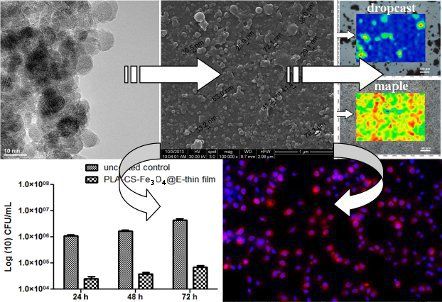
- biocompatibility with human cells, the newly synthesized nano-active thin coating exhibited a great antimicrobial activity. The surface inhibited both S. aureus and P. aeruginosa attachment and also the formation of non-specific biofilms. MAPLE deposited thin films interfere with biofilm formation both in the
- initial phase and during biofilm maturation. S. aureus (Figure 7) biofilms were significantly impaired at all tested points of time, while P. aeruginosa (Figure 8) biofilms are especially affected after 24 and 48 h of incubation. Even though magnetite nanoparticles displayed a great antimicrobial effect
- reports the successful MAPLE deposition of bioactive thin films based on PLA–CS-Fe3O4@EUG magnetic nanospheres with diameters between 20 and 80 nm. These nano-coatings displayed great antimicrobial colonization and antibiofilm formation properties, inhibiting S. aureus and P. aeruginosa biofilms. Due to




Characterization of protein adsorption onto FePt nanoparticles using dual-focus fluorescence correlation spectroscopy
Beilstein J. Nanotechnol. 2011, 2, 374–383, doi:10.3762/bjnano.2.43
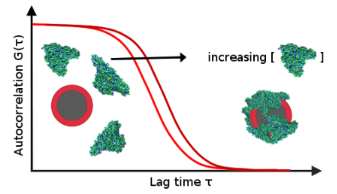
- of proteins. Their structures may change upon contact with a NP surface, up to the point that they entirely unfold. Such effects are known from the development of nanostructured surface coatings designed to prevent unspecific biomolecular adsorption (‘biofilms’) [15][16][17], which is an important


Other Beilstein-Institut Open Science Activities



