


Search results
Search for "biomineralization" in Full Text gives 29 result(s) in Beilstein Journal of Nanotechnology.
Magnesiothermic conversion of the silica-mineralizing golden algae Mallomonas caudata and Synura petersenii to elemental silicon with high geometric precision
Beilstein J. Nanotechnol. 2014, 5, 554–560, doi:10.3762/bjnano.5.65
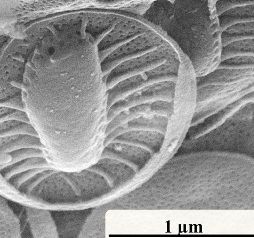
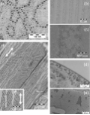
- petersenii into elementary silicon by magnesium vapour, nanostructured defined replicates were produced which were clearly seen after removal of the formed magnesium oxide with acid. Keywords: biomineralization; golden algae; magnesiothermic conversion; silica; silicon; Introduction In nature, there are


Oriented attachment explains cobalt ferrite nanoparticle growth in bioinspired syntheses
Beilstein J. Nanotechnol. 2014, 5, 210–218, doi:10.3762/bjnano.5.23
- , Austria 10.3762/bjnano.5.23 Abstract Oriented attachment has created a great debate about the description of crystal growth throughout the last decade. This aggregation-based model has successfully described biomineralization processes as well as forms of inorganic crystal growth, which could not be
- monomers as the smallest aggregates from which nuclei form. Coarsening, in which smaller crystals dissolve in favor of bigger ones, often occurs at later stages of the crystal growth. Throughout the last decades, several studies of nanoparticle growth and biomineralization processes showed a different
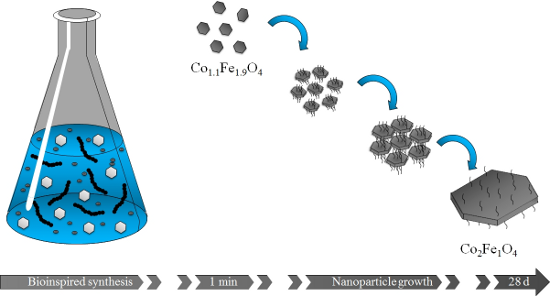
- matches the description of an oriented attachment process. Crystal growth via oriented attachment as well as mesocrystal formation have been described previously for biomineralization and biomimetic syntheses [19][25]. A schematic of this multistep process can be found in Figure 5. Nanoparticle growth via


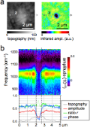
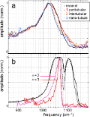
Nano-FTIR chemical mapping of minerals in biological materials
Beilstein J. Nanotechnol. 2012, 3, 312–323, doi:10.3762/bjnano.3.35
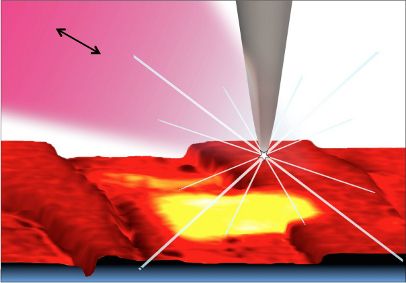
- osteopathies. Keywords: biomineralization; chemical mapping; infrared spectroscopy; nanocrystals; optical near-field microscopy; Introduction Fourier-transform infrared spectroscopy (FTIR) [1] is a standard tool in chemical analysis. It can identify virtually any substance through the "fingerprint" of the
- nanotechnology, the pharmaceutical industry, or solid-state physics. For this study we have chosen biominerals over other obvious candidates because biomineralization is unexplored in its nanometer-scale detail but is yet of great medical importance. Author contributions F. K. conceived this study, P. Z., W. W





Review and outlook: from single nanoparticles to self-assembled monolayers and granular GMR sensors
Beilstein J. Nanotechnol. 2010, 1, 75–93, doi:10.3762/bjnano.1.10
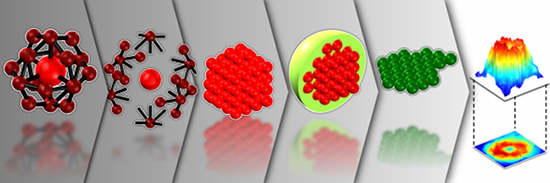
- the synthesis which leads to a low efficiency in comparison to the thermolysis. A very similar mechanism can be found with magnetotactic bacteria which produce ferrite nanoparticles under mild conditions as part of their metabolism. The biomineralization process within such bacteria is not yet well




Other Beilstein-Institut Open Science Activities



