


Search results
Search for "caps" in Full Text gives 32 result(s) in Beilstein Journal of Nanotechnology.
Functionalization of vertically aligned carbon nanotubes
Beilstein J. Nanotechnol. 2013, 4, 129–152, doi:10.3762/bjnano.4.14
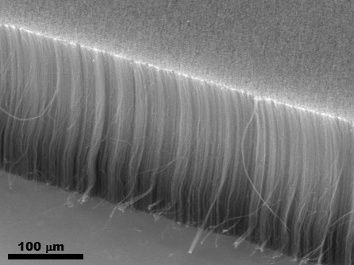
- ; functionalization; graphene; nitration; oxidation; Introduction Carbon nanotubes (CNTs) have stirred the curiosity of the scientific community for two decades now. They consist of layers of graphene rolled up on themselves in order to form cylinders often closed at the two ends by fullerenic caps. Either they are
- nanoparticle) can occur at the fullerenic caps, which are more reactive than the CNT sidewalls [16], at the defects, or exclusively at the sidewalls of the nanotubes. The non-covalent functionalization (creation of a physical bond between the CNT and the chemical group or particle) involves for instance CNTs
- physical and chemical properties of the CNTs due to the plasma process (i.e., fluorination in CF4 of the CNTs, defect-density increase and opening of the CNT caps). Oxidation of VA-CNTs: As-grown VA-CNTs are superhydrophobic [89]. In 2010, Ramos et al. [90] emphasized that a post-treatment by using oxygen

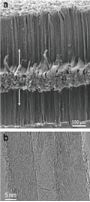


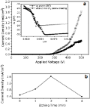

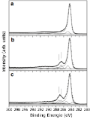




Characterization and properties of micro- and nanowires of controlled size, composition, and geometry fabricated by electrodeposition and ion-track technology
Beilstein J. Nanotechnol. 2012, 3, 860–883, doi:10.3762/bjnano.3.97
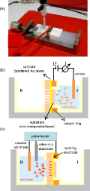
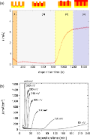
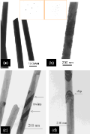
- the material reaches the top side of the membrane and caps start to grow on top; and (4) if the process is continued, the caps grow further and eventually form a continuous layer. Current–time characteristics displaying these four distinct regions have been reported for the growth of Cu [52], Au [53
- nanowires reach the top side of the porous membrane, the deposition continues outside the pores forming so-called caps (Figure 6a, zone 3). The shape and morphology of the caps are a direct indication of the crystalline structure of the wires as shown for various materials (e.g., Cu, Au, Bi, Sb). Round caps
- are typically formed on top of polycrystalline wires (Figure 11a), while facetted caps grow on top of single-crystalline wires, or on wires consisting of large grains (Figure 11b–d). The facetted Au caps (Figure 11b) exhibit a cubic shape, revealing the cubic structure of the corresponding Au wires








Tuning the properties of magnetic thin films by interaction with periodic nanostructures
Beilstein J. Nanotechnol. 2012, 3, 831–842, doi:10.3762/bjnano.3.93
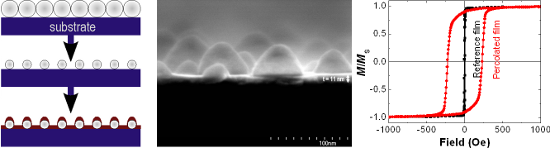
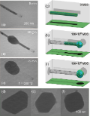
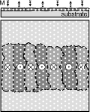
- this way, in addition to the exchange-coupled film in between the objects, magnetic caps are formed on top of them. As a result, the achievable storage density is determined by the defect density. Different preparation techniques have been tested for high defect densities, i.e., serial e-beam or ion
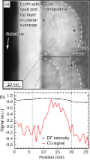
- between the 35 nm particles a smooth film grows on Si/SiO2 substrates, Fe caps can be easily identified. Remarkably, Fe caps are in contact with the film between the colloidal spheres, although the deposited film thickness (11 nm) is small compared to the average particle diameter of d = 35 nm. Note that
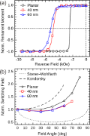
- PS spheres including the magnetic caps on top may also be removed by chemo-mechanical polishing leading to a void structure, which may potentially be used as 2-D artificial spin-ice systems [27]. In the following, however, we focus on percolated films with magnetic caps present. In summary, the


Zirconium nanoparticles prepared by the reduction of zirconium oxide using the RAPET method
Beilstein J. Nanotechnol. 2011, 2, 198–203, doi:10.3762/bjnano.2.23
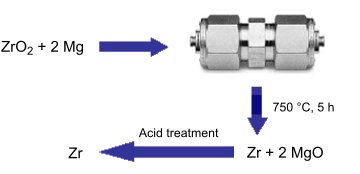
- ). A 3/8” union part was plugged from both sides by standard caps. For the synthesis, 0.500 g of zirconium dioxide (ZrO2) and 0.200 g of magnesium powder (molar ration 1:2, respectively) were introduced into the cell, and the cell was closed tightly at room temperature under a nitrogen atmosphere (in a



Functional morphology, biomechanics and biomimetic potential of stem–branch connections in Dracaena reflexa and Freycinetia insignis
Beilstein J. Nanotechnol. 2011, 2, 173–185, doi:10.3762/bjnano.2.21
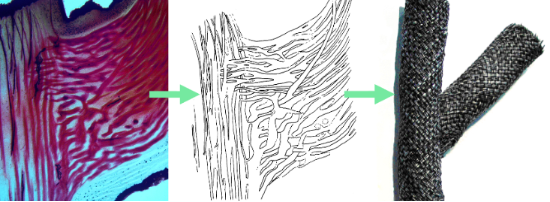
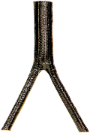
- large amount of secondary wood from the main stem is in direct connection with the branches, in arborescent monocotyledons vascular bundles with fibre caps (both summed up as ‘fibrous bundles’ in this study) are isolated, i.e., with no or little tangential or radial interconnection, and arranged in a





Switching adhesion forces by crossing the metal–insulator transition in Magnéli-type vanadium oxide crystals
Beilstein J. Nanotechnol. 2011, 2, 59–65, doi:10.3762/bjnano.2.8
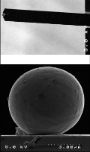
- -MDT Ltd.), which consists of an array of sharp spikes [25][38][39]. Scanning this grating with a spherical AFM probe creates an image consisting of an array of spherical caps, i.e., the microsphere itself is imaged repeatedly by each spike in the scanning area. This technique allows the precise



A collisional model for AFM manipulation of rigid nanoparticles
Beilstein J. Nanotechnol. 2010, 1, 158–162, doi:10.3762/bjnano.1.19
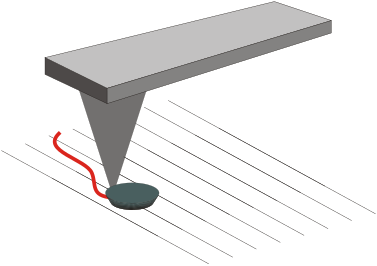
- applicable provided that the particle does not roll and that its shape is not cylindrical. Translation and wobbling of nanorods The manipulation of a rigid nanorod formed by a cylinder (with length L) and two hemispherical caps (with radius a) is particularly instructive. Here, any possible rolling can be


Other Beilstein-Institut Open Science Activities



