


Search results
Search for "entanglement" in Full Text gives 30 result(s) in Beilstein Journal of Nanotechnology.
Non-covalent and reversible functionalization of carbon nanotubes
Beilstein J. Nanotechnol. 2014, 5, 1675–1690, doi:10.3762/bjnano.5.178
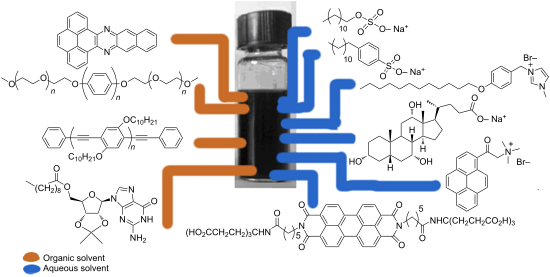
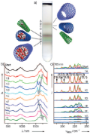
- scarcely soluble in most organic solvents due to the high molecular weight and their tendency to entangle and form 3D networks through persistent van der Waals interactions. Therefore, for CNTs applications, the prime aim is to promote CNTs entanglement by energetic agitation. Generally, agitation is



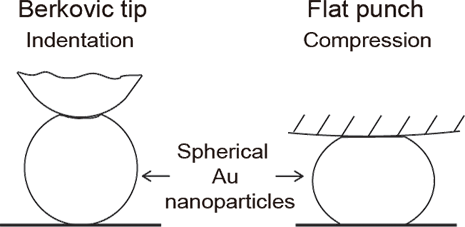
Scale effects of nanomechanical properties and deformation behavior of Au nanoparticle and thin film using depth sensing nanoindentation
Beilstein J. Nanotechnol. 2014, 5, 822–836, doi:10.3762/bjnano.5.94
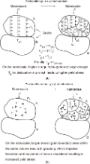
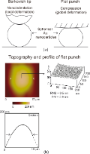
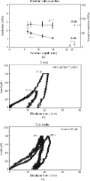
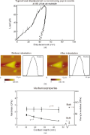
- (right) compared to the macroscale (left), resulting in a greater number of dislocations per unit area or density (ρ). This entanglement of dislocations impedes the formation and motion of new dislocations and multiplication of existing dislocations necessary to accommodate strain gradient and subsequent






Dynamic nanoindentation by instrumented nanoindentation and force microscopy: a comparative review
Beilstein J. Nanotechnol. 2013, 4, 815–833, doi:10.3762/bjnano.4.93
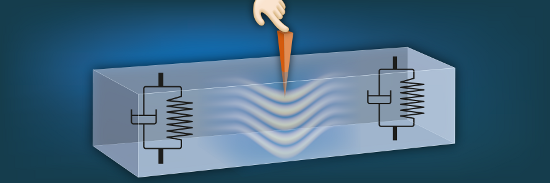
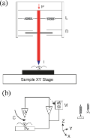
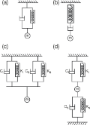
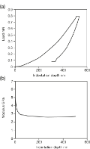
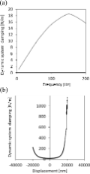
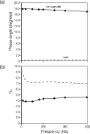
- measures the energy dissipated during an oscillation cycle. The phase lag, referred to as loss tangent (tan δ), arises from any of a number of molecular-level lossy processes such as entanglement, slip or friction between the monomer units. Although the phase lag is not amenable to a direct theoretical




Plasticity of Cu nanoparticles: Dislocation-dendrite-induced strain hardening and a limit for displacive plasticity
Beilstein J. Nanotechnol. 2013, 4, 173–179, doi:10.3762/bjnano.4.17
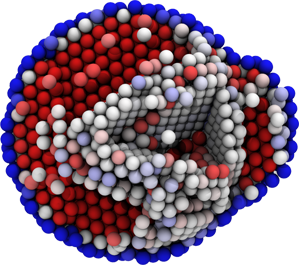
- movement, multiplication, and entanglement of mobile dislocations. As system size decreases, the relative surface (nanoparticle) or interface area (nanograined material) increases, and nucleation or annihilation of dislocations at surfaces or interfaces becomes a dominant factor since conventional


P-wave Cooper pair splitting
Beilstein J. Nanotechnol. 2012, 3, 493–500, doi:10.3762/bjnano.3.56
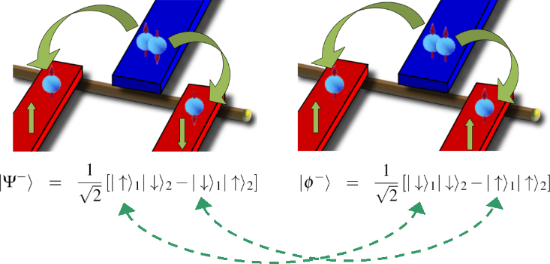
- pair splitters, that can otherwise only be realized by using p-wave superconductors. In particular, it provides access to Bell states that are different from the typical spin singlet state. Keywords: Cooper pair splitting; entanglement; Hamiltonian approach; spin-active scattering; superconductivity


![[Graphic 23]](/bjnano/content/inline/2190-4286-3-56-i36.png?max-width=637&scale=1.18182) according to Equation 13 is cal...
according to Equation 13 is cal...
Other Beilstein-Institut Open Science Activities



