Search results
Search for "environmental impact" in Full Text gives 40 result(s) in Beilstein Journal of Nanotechnology.
Nanocellulose: Recent advances and its prospects in environmental remediation
Beilstein J. Nanotechnol. 2018, 9, 2479–2498, doi:10.3762/bjnano.9.232
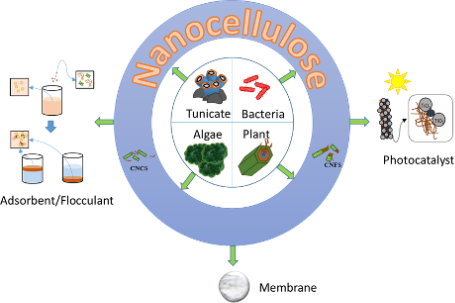
- -specific and true only under certain conditions [35]. Conversely, CNC properties are source-dependent, thus suitable cellulosic raw material and appropriate extraction techniques must be established based on the required final CNC properties and applications [33]. Furthermore, the environmental impact


Lead-free hybrid perovskites for photovoltaics
Beilstein J. Nanotechnol. 2018, 9, 2209–2235, doi:10.3762/bjnano.9.207
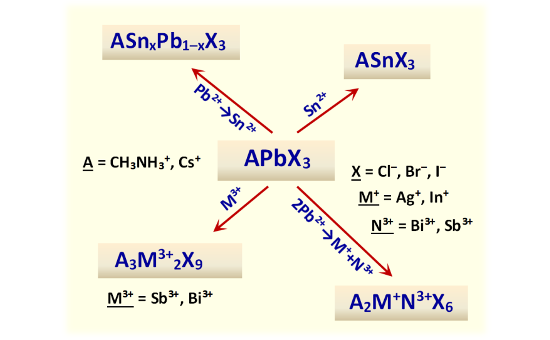
- well as issues of stability, environmental impact and possible recycling of the Pb-HP-based devices [11][12][13][16][23][26][27][29][30][31][32][33][34][35][36][37][38][39][40][41][42][43][44][45][46][47][48][49][50]. A tremendous amount of work has been performed in searching for the most efficient


Review on nanoparticles and nanostructured materials: history, sources, toxicity and regulations
Beilstein J. Nanotechnol. 2018, 9, 1050–1074, doi:10.3762/bjnano.9.98



Review: Electrostatically actuated nanobeam-based nanoelectromechanical switches – materials solutions and operational conditions
Beilstein J. Nanotechnol. 2018, 9, 271–300, doi:10.3762/bjnano.9.29


Study of the correlation between sensing performance and surface morphology of inkjet-printed aqueous graphene-based chemiresistors for NO2 detection
Beilstein J. Nanotechnol. 2017, 8, 1023–1031, doi:10.3762/bjnano.8.103
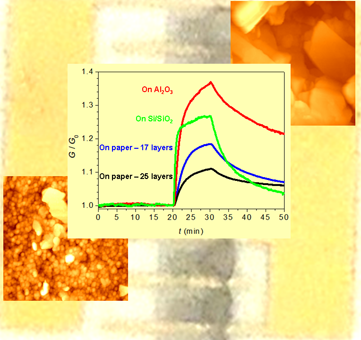
- -boiling and need to be handled with care because of their toxicity. Recently, the potential to effectively exfoliate natural graphite in a hydro-alcoholic mixture in a process of low environmental impact has been demonstrated [8]. In general, the liquid-phase preparation of graphene extends its
- suspension synthesized by using eco-friendly solvents deposited onto recyclable substrates by IJP well meets the technological requirements for the production of low-environmental impact, low-cost sensing devices. The aim of the current research is a feasibility study of chemiresistive gas sensors by inkjet


Needs and challenges for assessing the environmental impacts of engineered nanomaterials (ENMs)
Beilstein J. Nanotechnol. 2017, 8, 989–1014, doi:10.3762/bjnano.8.101
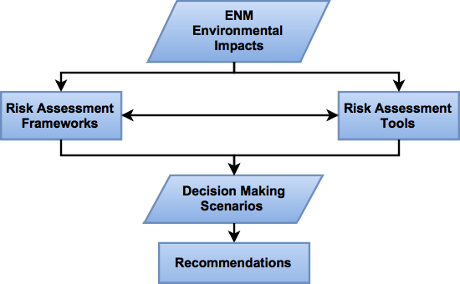
- /bjnano.8.101 Abstract The potential environmental impact of nanomaterials is a critical concern and the ability to assess these potential impacts is top priority for the progress of sustainable nanotechnology. Risk assessment tools are needed to enable decision makers to rapidly assess the potential
- process for evaluating the potential impacts of ENMs would be to use existing frameworks that were developed to assess the environmental health and safety (EHS) impacts of new chemicals and new industrial technologies more broadly. One such general framework is Environmental Impact Assessment (EIA), which
- Nanotool [53] and the Web-Based Tool for Risk Prioritization of Airborne Manufactured Nano Objects (Stoffenmanager Nano) [54]. The potential for using existing frameworks for environmental impact/risk assessment and other relevant health and safety assessment of ENMs was evaluated systematically (see

Biological and biomimetic materials and surfaces
Beilstein J. Nanotechnol. 2017, 8, 403–407, doi:10.3762/bjnano.8.42

- systematic comparative product sustainability assessment (PROSA), the authors demonstrated that this cost-effective and resource-saving product is indeed biomimetic. It is also shown that Lotusan® has a low environmental impact [21]. The regular solution theory was applied by Akerboom et al. to study the
The cleaner, the greener? Product sustainability assessment of the biomimetic façade paint Lotusan® in comparison to the conventional façade paint Jumbosil®
Beilstein J. Nanotechnol. 2016, 7, 2100–2115, doi:10.3762/bjnano.7.200
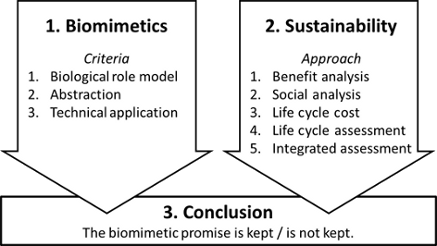
- assessment: In the course of the life-cycle impact assessment (LCIA), potential environmental impacts of the two compared façade paints are determined by linking the LCI results, namely materials flow and energy flow, to specific environmental impact categories. According to the requirements of [41], the
- has been put on selecting such impact categories providing maximum transparency and representing the scientific state of the art. Result monitoring was carried out by using a combination of four environmental impact assessment models, including the cumulative energy demand (CEDfossil, CEDnuclear
- , CEDnon-renewable as sum of the aforementioned), the ReCiPe environmental impact assessment model in the version of 2008, the IPCC method regarding the global warming potential (GWP) and the USEtox model for dealing with toxicology aspects related to the production and use of the two paints. A short


Nanoinformatics for environmental health and biomedicine
Beilstein J. Nanotechnol. 2015, 6, 2449–2451, doi:10.3762/bjnano.6.253
- nanomaterials, which provides critical information for the environmental impact assessment of nanomaterials [18]. Another contribution addresses the issue of nanomaterial risk assessment and proposes a decision analysis scheme for furthering nanoinformatics work [19]. This work considers an array of decision
NanoE-Tox: New and in-depth database concerning ecotoxicity of nanomaterials
Beilstein J. Nanotechnol. 2015, 6, 1788–1804, doi:10.3762/bjnano.6.183
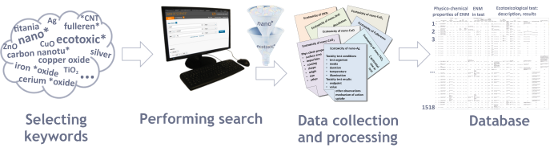
- included in the database and regarding testing conditions, only the test duration is reported in a few cases. As a different approach, some databases, e.g., NHECD (Knowledge on the Health, Safety and Environmental Impact of Nanoparticles) [21] and Hazardous Substances Data Bank [22] comprise


Analysis of soil bacteria susceptibility to manufactured nanoparticles via data visualization
Beilstein J. Nanotechnol. 2015, 6, 1635–1651, doi:10.3762/bjnano.6.166
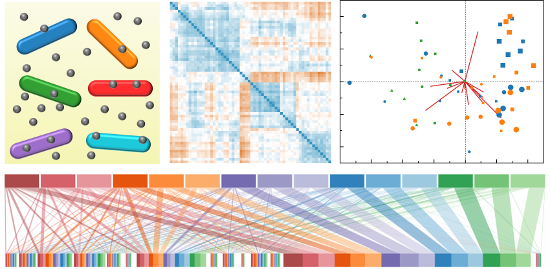
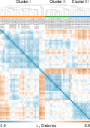
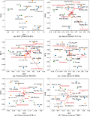
- communities exposed to MNPs and thus evaluate the potential for environmental impacts. Keywords: environmental impact; manufactured nanoparticles; nanoinformatics; soil bacteria; visualization; Introduction Manufactured nanoparticles (MNPs) are now routinely used in numerous products and applications due to
- indicators of soil health [29]. Therefore, information about MNP effects on soil microbial communities is critical for environmental impact assessment [13]. Recently, efforts [18][19][26][30][31] have been devoted to investigate the impacts of various MNPs on soil bacterial communities, resulting in large





Using natural language processing techniques to inform research on nanotechnology
Beilstein J. Nanotechnol. 2015, 6, 1439–1449, doi:10.3762/bjnano.6.149
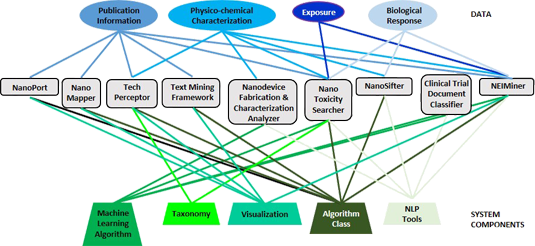
- and CEINT). Surprisingly, only one group was found to describe the use of NLP techniques in a tool analyzing the environmental nanotechnology literature. NEIMiner The Nanomaterial Environmental Impact data Miner, or NEIMiner, is a web-based tool built using CMS and Drupal [39]. NEIMiner consists of
- four parts: 1) nanomaterial environmental impact (NEI) modeling framework – similar to Framework for Risk Analysis of Multi-Media Environmental Systems (FRAMES), 2) data integration, 3) data management and access, and 4) model building. This web-based tool is supported by the company’s previously
- the human health or environmental impact of ENMs, it is important to recognize that risk is a function of exposure and hazard. Without exposure, there is no risk. All substances are potentially hazardous depending on the dose or concentration encountered. In addition, the biological response data of
Simulation tool for assessing the release and environmental distribution of nanomaterials
Beilstein J. Nanotechnol. 2015, 6, 938–951, doi:10.3762/bjnano.6.97
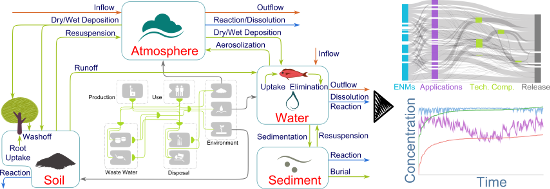
- . In this regard, various environmental impact assessment (EIA) frameworks have been proposed [6], which all require knowledge of the potential environmental distribution of ENMs in addition to their potential toxicological effects. However, reported ENM source release rates, environmental monitoring
- an acceptable level for compartmental models [22][23][24]. Compartmental models can be used to provide a first-tier analysis for estimating the magnitudes of potential ENM exposure concentrations. However, in order to support timely decision analysis regarding the potential environmental impact of


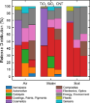
Nanocrystalline ceria coatings on solid oxide fuel cell anodes: the role of organic surfactant pretreatments on coating microstructures and sulfur tolerance
Beilstein J. Nanotechnol. 2014, 5, 1712–1724, doi:10.3762/bjnano.5.181

- more efficiently and with lower environmental impact than conventional power sources. A fuel cell consists of a dense ionically conducting layer (electrolyte) with porous electronically conducting layers (the electrodes) on each side, separating the fuel (e.g., H2) from its oxidant (typically O2 in air


Nanostructure sensitization of transition metal oxides for visible-light photocatalysis
Beilstein J. Nanotechnol. 2014, 5, 696–710, doi:10.3762/bjnano.5.82
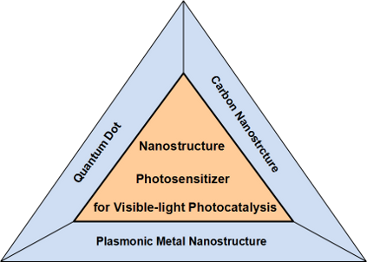
- clean and abundant, yet its utilization is still very low. There is a strong need for scientists to develop a sustainable and cost-effective manner for harvesting solar energy to satisfy the growing energy demand of the world with a minimal environmental impact. Photocatalysis plays an important role