


Search results
Search for "fluid flow" in Full Text gives 33 result(s) in Beilstein Journal of Nanotechnology.
Contact-free experimental determination of the static flexural spring constant of cantilever sensors using a microfluidic force tool
Beilstein J. Nanotechnol. 2016, 7, 492–500, doi:10.3762/bjnano.7.43
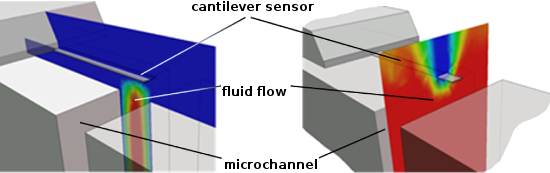
- measurements, the channel was fixed on the sample stage of the AFM and positioned such that fluid flow from its exit interacted with the cantilever as illustrated in Figure 1. The channel was aligned such that the free end of the cantilever was level with the edge of the channel and 100 μm above the channel
- cantilever studied. The highest pressure used was ≈3.5 kPa, resulting in a nitrogen velocity value of about ≈62 m/s in the channel mid-line [28], corresponding to a laminar, incompressible flow [36]. The forces applied to the cantilever by the fluid flow cause a static flexural bending [30]. The bending of
- microscope. Some of the cantilevers had a trapezoidal cross-section (see Figure 2), in which case both the width at the top and the bottom were determined. Determination of the force distribution and the conversion factors α, β, and γ To provide information about the interaction between the fluid flow




![[Graphic 28]](/bjnano/content/inline/2190-4286-7-43-i34.png?max-width=637&scale=1.18182) value for cantilever NCHV. The dashed line indicates the mean
value for cantilever NCHV. The dashed line indicates the mean ![[Graphic 29]](/bjnano/content/inline/2190-4286-7-43-i35.png?max-width=637&scale=1.18182) value for ...
value for ...
Single-molecule mechanics of protein-labelled DNA handles
Beilstein J. Nanotechnol. 2016, 7, 138–148, doi:10.3762/bjnano.7.16
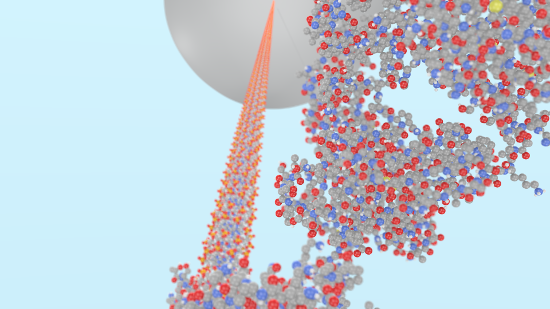
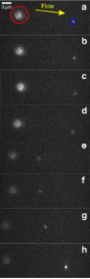
- approx. 2 min. For proof-of-concept that the PDH end remains freely accessible in liquids, the biotin end of the DH was labelled with streptavidin–Qdot conjugates. Then, they were anchored to anti-DIG beads (Figure 1f), and the position of individual Qdots under varying fluid flow velocities was
- monitored using an EMCCD camera (Andor Technology, Belfast, NI). Laminar fluid flow inside the microfluidic chamber constrained the free Qdot-modified end of the DNA within the image plane of the EMCCD camera (Figure 8). The distance between the bead surface and the position of the Qdot represented the
- fluid-flow dependent DNA extension, corresponding to the hydrodynamic drag experienced by the DNA molecule. The flow force induced stretching as presented here is consistent with the original experimental findings by Perkins et al. [15] and follows the theoretical description of Stigter et al. [16



Electroviscous effect on fluid drag in a microchannel with large zeta potential
Beilstein J. Nanotechnol. 2015, 6, 2207–2216, doi:10.3762/bjnano.6.226
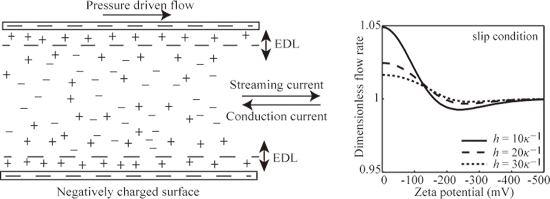
- /bjnano.6.226 Abstract The electroviscous effect has been widely studied to investigate the effect of surface charge-induced electric double layers (EDL) on the pressure-driven flow in a micro/nano channel. EDL has been reported to reduce the velocity of fluid flow and increase the fluid drag
- ]. Understanding the fundamental mechanisms of the micro/nano fluid flow has inspired wide scientific interest in order to accomplish the manipulation and transportation of micro/nano fluid flow in these micro/nano fluidic devices. Theoretical and experimental studies show that some interfacial properties, such as
- surface charge, boundary slip, nanobubble and surface roughness, which can be neglected in macroscale fluidics, are believed to significantly affect the micro/nano fluid flow [3][4][5][6][7][8][9][10][11][12][13]. When a droplet of certain liquid contacts with a solid surface, the solid–liquid interface


Hydrophobic interaction governs unspecific adhesion of staphylococci: a single cell force spectroscopy study
Beilstein J. Nanotechnol. 2014, 5, 1501–1512, doi:10.3762/bjnano.5.163
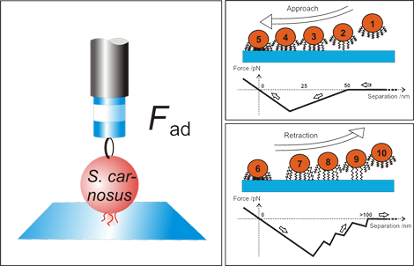
- corresponding binding partners are available. The adhesion process of microorganisms, such as S. carnosus, is usually characterized by using flow chambers [14]. Although flow chamber studies reproduce the natural adsorption process of microorganisms out of fluid flow, it is hard to determine quantitative


The study of surface wetting, nanobubbles and boundary slip with an applied voltage: A review
Beilstein J. Nanotechnol. 2014, 5, 1042–1065, doi:10.3762/bjnano.5.117
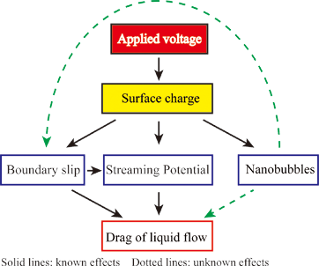
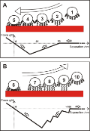
- The drag of fluid flow at the solid–liquid interface in the micro/nanoscale is an important issue in micro/nanofluidic systems. Drag depends on the surface wetting, nanobubbles, surface charge and boundary slip. Some researchers have focused on the relationship between these interface properties. In
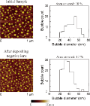
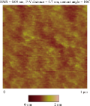
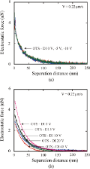
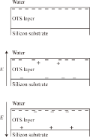
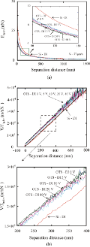
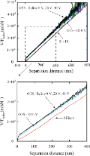
- force on the probe were measured on an octadecyltrichlorosilane (OTS) surface with applied voltage. The influence of the surface charge on the boundary slip and drag of fluid flow has been discussed. Finally, the influence of the applied voltage on the surface wetting, nanobubbles, surface charge
- various groups [10][12][15][23][24][25][26]. Most studies have a similar goal that is to find a method to affect the boundary slip condition by increasing the boundary slip length, which then reduces the drag of fluid flow. Recently, it is found that a higher hydrophobicity can provide a larger slip










Size-dependent characteristics of electrostatically actuated fluid-conveying carbon nanotubes based on modified couple stress theory
Beilstein J. Nanotechnol. 2013, 4, 771–780, doi:10.3762/bjnano.4.88
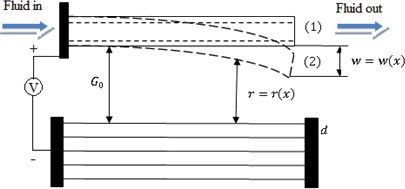
- 10.3762/bjnano.4.88 Abstract The paper presents the effects of fluid flow on the static and dynamic properties of carbon nanotubes that convey a viscous fluid. The mathematical model is based on the modified couple stress theory. The effects of various fluid parameters and boundary conditions on the pull
- ); electrostatic actuation; fluid flow; modified couple stress theory; Introduction Nanotechnology can be defined as the science of manipulating materials on an atomic or molecular scale [1]. Hence, it generally deals with investigating different aspects of the materials in atomic and molecular dimensions, which
- for drug delivery [22]. Because of the potential application of CNTs to convey fluids, it is obvious that the effects of fluid flow on the mechanical behaviors of CNTs should be scrutinized by including them in the governing equations of fluid dynamics. The papers on NEMS mentioned above and also


Analysis of fluid flow around a beating artificial cilium
Beilstein J. Nanotechnol. 2012, 3, 163–171, doi:10.3762/bjnano.3.16
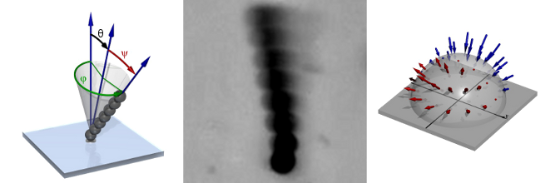
- generation of a fluid flow above a ciliated surface in multicellular ones. Following the biological example, externally driven artificial cilia have recently been successfully implemented as micropumps and mixers. However, biomimetic systems are useful not only in microfluidic applications, but can also
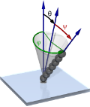
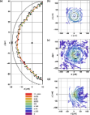
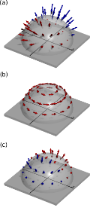
- superparamagnetic particles and driven along a tilted cone by a varying external magnetic field. Nonmagnetic tracer particles were used for monitoring the fluid flow generated by the cilium. The average flow velocity in the pumping direction was obtained as a function of different parameters, such as the rotation
- frequency, the asymmetry of the beat pattern, and the cilium length. We also calculated the velocity field around the beating cilium by using the analytical far-field expansion. The measured average flow velocity and the theoretical prediction show an excellent agreement. Keywords: biomimetics; fluid flow


Biomimetics inspired surfaces for drag reduction and oleophobicity/philicity
Beilstein J. Nanotechnol. 2011, 2, 66–84, doi:10.3762/bjnano.2.9
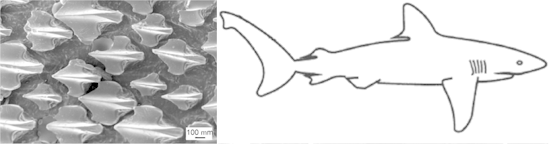
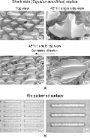
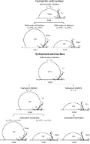
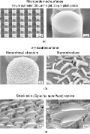
- a high contact angle and low contact angle hysteresis also exhibit low adhesion and drag reduction for fluid flow. An aquatic animal, such as a shark, is another model from nature for the reduction of drag in fluid flow. The artificial surfaces inspired from the shark skin and lotus leaf have been
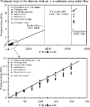
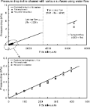
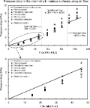
- superhydrophobic, self-cleaning, low adhesion, and drag reduction surfaces Drag reduction in fluid flow is of interest in various commercial applications. These include transportation vehicles and micro/nanofluidics based biosensor applications [3]. To reduce pressure drop and volume loss in micro/nanochannels
- inspired by the lotus leaf and shark skin and studied the influence of structure on pressure drop and fluid drag. One of the basic properties of interest in fluid flow is slip. The relative velocity between a solid wall and liquid is believed to be zero at the solid–liquid interface, which is the so called








Other Beilstein-Institut Open Science Activities



