


Search results
Search for "human serum albumin" in Full Text gives 34 result(s) in Beilstein Journal of Nanotechnology.
Review on nanoparticles and nanostructured materials: history, sources, toxicity and regulations
Beilstein J. Nanotechnol. 2018, 9, 1050–1074, doi:10.3762/bjnano.9.98

- powered by light on the market, representing the first major commercial use of dye-sensitized solar cells. In 2005, Abraxane™, which is a human serum albumin NP material containing paclitaxel, was manufactured, commercialized and released in the pharmaceutical market [41]. In 2014, there were about 1814


Comparison of four methods for the biofunctionalization of gold nanorods by the introduction of sulfhydryl groups to antibodies
Beilstein J. Nanotechnol. 2017, 8, 372–380, doi:10.3762/bjnano.8.39
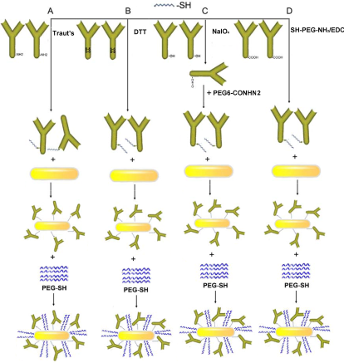
- modification with Traut’s reagent. These results are consistent with the findings that DTT modification introduces more sulfhydryl groups per mol human serum albumin (HSA) than treatment with Traut’s reagent [28]. The conjugating efficiency of antibody-to-nanosphere by Traut’s thiolation was low relative to


Au nanoparticle-based sensor for apomorphine detection in plasma
Beilstein J. Nanotechnol. 2015, 6, 2224–2232, doi:10.3762/bjnano.6.228
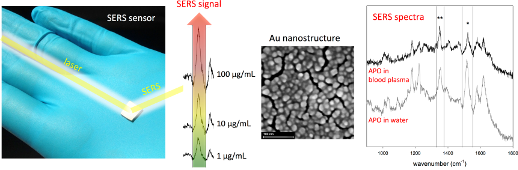
- APO in blood plasma, as shown in Figure 7B. The kinetics of APO adsorption onto the gold nanostructured surface are expected to be strongly affected by matrix effects. In particular, the presence of proteins, such as human serum albumin, an abundant plasma protein that binds a wide range of drugs


Protein corona – from molecular adsorption to physiological complexity
Beilstein J. Nanotechnol. 2015, 6, 857–873, doi:10.3762/bjnano.6.88

- revealed a decrease of the collision efficiency (i.e., the overall number of collisions divided by the number of collisions that form an agglomerate) with an increasing protein (human serum albumin, HSA) concentration (Figure 1a). Intriguingly, they found that their colloid was stable at a point where
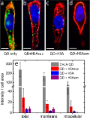
- the polymer shell), by live HeLa cells in the presence or absence of human transferrin (TF) and human serum albumin (HSA) in phosphate-buffered saline (PBS) medium. They studied the uptake of the NPs by quantitative confocal fluorescence microscopy. For comparison, they also studied the cellular
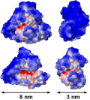
- in brackets. (d) Normalized Raman (d) and SERS (e) spectra of cystine (disulfide stretching mode region, alkaline solutions). Relative Gaussian areas for the six different S–S bond conformations are indicated in brackets. Adapted from [36]. Copyright 2014 Springer. Human serum albumin (HSA, PDB code




Coating with luminal gut-constituents alters adherence of nanoparticles to intestinal epithelial cells
Beilstein J. Nanotechnol. 2014, 5, 2308–2315, doi:10.3762/bjnano.5.239
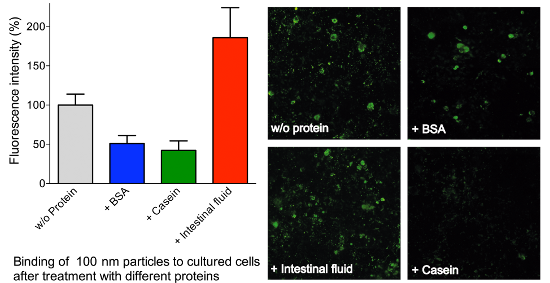
- ], and possible implications for the particle–cell interactions are considered. For example, it was shown that human serum albumin (HSA), BSA and fetal bovine serum can build a protein corona around NPs whereby the particles are stabilized against agglomeration and the colloid stability of the particle



Nanoencapsulation of ultra-small superparamagnetic particles of iron oxide into human serum albumin nanoparticles
Beilstein J. Nanotechnol. 2014, 5, 2259–2266, doi:10.3762/bjnano.5.235
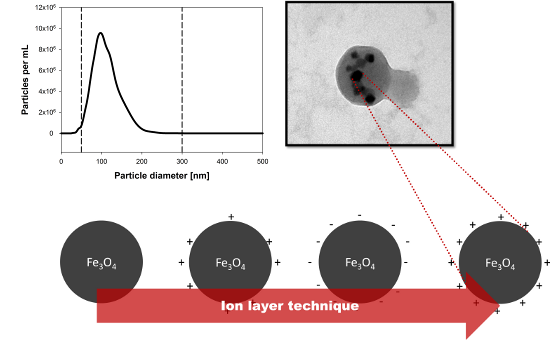
- Technische Universität Darmstadt, Technical Chemistry, D-64287 Darmstadt, Germany Merck KGaA, D-64287 Darmstadt, Germany 10.3762/bjnano.5.235 Abstract Human serum albumin nanoparticles have been utilized as drug delivery systems for a variety of medical applications. Since ultra-small superparamagnetic
- systemic exposition of patients with the carrier [6]. Human serum albumin (HSA) represents a promising candidate that binds a wide range of compounds with different physicochemical characteristics. In 2007, with Abraxane®, a first polymeric nanoparticle formulation consisting of this material has been
- time range. After freeze drying, only USPIO HSA hybrid particles prepared at an iron concentration of 15 µg/mg demonstrated significant agglomeration. Experimental Reagents and chemicals Human serum albumin (Fraction V) and glutaraldehyde 8% aqueous solution were purchased from Sigma (Steinheim


Effects of surface functionalization on the adsorption of human serum albumin onto nanoparticles – a fluorescence correlation spectroscopy study
Beilstein J. Nanotechnol. 2014, 5, 2036–2047, doi:10.3762/bjnano.5.212
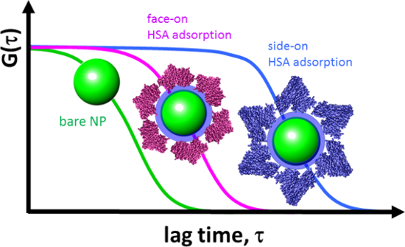
- Marburg, Renthof 7, 35037 Marburg, Germany, Department of Physics, University of Illinois at Urbana-Champaign, 1110 West Green Street, Urbana, IL 61801, USA 10.3762/bjnano.5.212 Abstract By using fluorescence correlation spectroscopy (FCS), we have studied the adsorption of human serum albumin (HSA) onto
- four orders of magnitude. These variations can be understood in terms of specific Coulombic interactions between the proteins and the NP surfaces. Keywords: fluorescence correlation spectroscopy; human serum albumin; nanoparticles; protein corona; quantum dots; Introduction In recent years, both
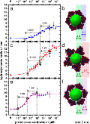
- reliable in our hands. In our original FCS study [45], we investigated the adsorption of human serum albumin (HSA) onto carboxyl-functionalized, polymer-encased iron platinum nanoparticles (Fe–Pt NPs) with a hydrodynamic radius, RH, of 5–6 nm. We prepared HSA solutions of different concentrations in




In vitro interaction of colloidal nanoparticles with mammalian cells: What have we learned thus far?
Beilstein J. Nanotechnol. 2014, 5, 1477–1490, doi:10.3762/bjnano.5.161
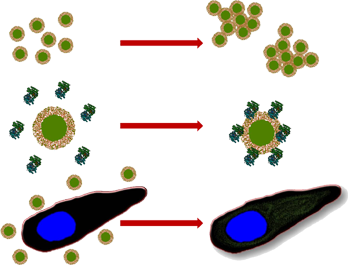
- fluorescence correlation spectroscopy (FCS), Röcker et al. investigated the adsorption of human serum albumin onto FePt NPs and found clear evidence that the proteins formed a monolayer on the surface of the NP [136]. Additional FCS studies by using other important serum proteins invariably confirmed the


Characterization of protein adsorption onto FePt nanoparticles using dual-focus fluorescence correlation spectroscopy
Beilstein J. Nanotechnol. 2011, 2, 374–383, doi:10.3762/bjnano.2.43
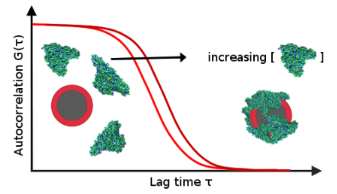
- correlation spectroscopy; human serum albumin; nanoparticle; protein adsorption; Introduction Recent years have seen enormous advances in the field of nanotechnology. A huge variety of nanoparticles (NPs), defined as objects with all three spatial dimensions in the range of 1–100 nm, has been developed, with
- understand the structural and dynamic properties of the protein corona at the molecular level. Recently, we have used quantitative fluorescence microscopy, especially fluorescence correlation spectroscopy (FCS), to study protein adsorption of human serum albumin (HSA) on polymer-coated FePt NPs with an



Other Beilstein-Institut Open Science Activities



