


Search results
Search for "hybrid organic-inorganic" in Full Text gives 29 result(s) in Beilstein Journal of Nanotechnology.
An insight into the mechanism of charge-transfer of hybrid polymer:ternary/quaternary chalcopyrite colloidal nanocrystals
Beilstein J. Nanotechnol. 2014, 5, 1235–1244, doi:10.3762/bjnano.5.137
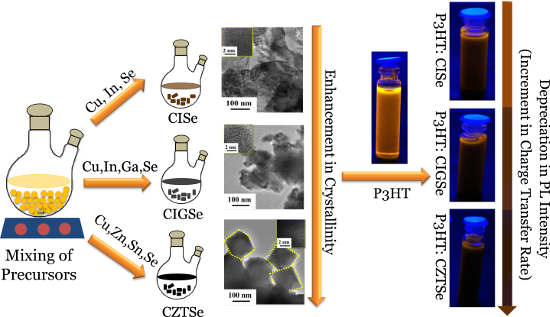
- attractive candidate for hybrid solar cells applications. Keywords: chalcopyrites; charge-transfer; hybrid organic-inorganic; nanocomposites; P3HT; Introduction Organic photovoltaic (OPV) devices composed of polymer matrices can be regarded as promising third-generation solar cells amongst emerging PV
- the polymer. The structural and optical properties of the resulting hybrid organic–inorganic composites were studied in detail. The mechanism of charge generation and separation across the polymer–chalcopyrite semiconductor interface has been depicted in consideration of the results obtained from
- ]. Model On the basis of the complementary results of TEM/XRD, Raman and PL we propose a model to explore the influence of the crystallinity of the inorganic components (CISe, CIGSe and CZTSe) on the efficiency of charge pair generation and separation at hybrid organic–inorganic semiconductor


Kelvin probe force microscopy of nanocrystalline TiO2 photoelectrodes
Beilstein J. Nanotechnol. 2013, 4, 418–428, doi:10.3762/bjnano.4.49
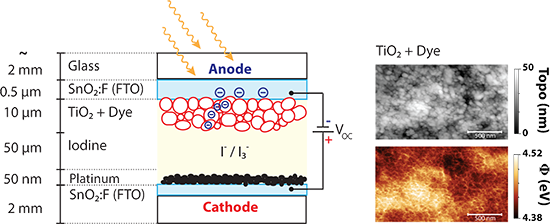
- ][10][11][12][13]. Recently, Yella et al. reported an efficiency of over 12% with a porphyrin-sensitized DSC and a cobalt(II/III) based redox electrolyte [14]. However, many details of the hybrid organic/inorganic interface and the influence of subsequent preparation steps on the device properties, e.g


Horizontal versus vertical charge and energy transfer in hybrid assemblies of semiconductor nanoparticles
Beilstein J. Nanotechnol. 2012, 3, 629–636, doi:10.3762/bjnano.3.72
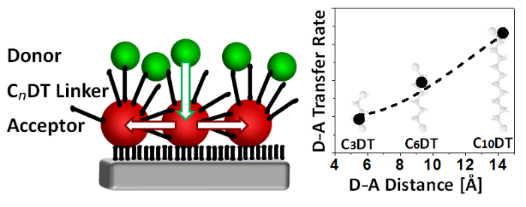
- result, surprising distance-dependent transfer rates from the donors to the acceptors were observed, in which the transfer rate increases with the donor–acceptor distance. The electron-transfer process in such hybrid organic–inorganic devices depends of course on the NPs, but also on the linker molecules


Distribution of functional groups in periodic mesoporous organosilica materials studied by small-angle neutron scattering with in situ adsorption of nitrogen
Beilstein J. Nanotechnol. 2012, 3, 428–437, doi:10.3762/bjnano.3.49
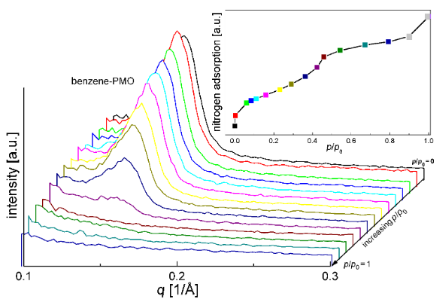
- -groups (silanol groups) present on the inner surface [3]. Therefore periodic mesoporous organosilicas (PMOs) have attracted much attention in scientific and technological research since their discovery in 1999 by three independent groups [5][6][7]. PMO materials directly form hybrid organic–inorganic


Other Beilstein-Institut Open Science Activities



