


Search results
Search for "inflammatory response" in Full Text gives 29 result(s) in Beilstein Journal of Nanotechnology.
Biocompatibility of cerium dioxide and silicon dioxide nanoparticles with endothelial cells
Beilstein J. Nanotechnol. 2014, 5, 1795–1807, doi:10.3762/bjnano.5.190
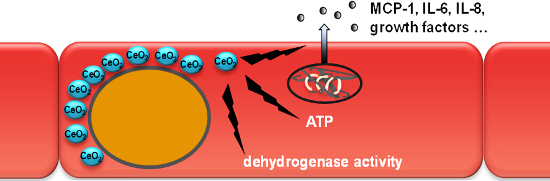
- -inflammatory response of exposed cells, and formation of reactive oxygen species (ROS). Furthermore, we also looked for effects of SiO2 nanoparticles on endothelial cells. Moreover, we considered if the nanoparticles’ effects on an immortalized cell line are comparable to a primary one. Results and Discussion
- nanoparticles on the cytokine release could theoretically be associated with the production of ROS. Additionally, the observed ROS generation correlates with the cytokine release of HMEC-1 after 24 h of incubation. Since this was not the case after 72 h, a short-term effect of ROS on the pro-inflammatory
- response machinery may be postulated. In HUVEC, no correlation between the ROS generation and the cytokine release was detectable. Hereto, other mechanisms seem to be responsible for these processes. Interestingly, the quantification of intracellular CeO2 nanoparticles (sample #A and #B) in HMEC-1, as was


In vitro and in vivo interactions of selected nanoparticles with rodent serum proteins and their consequences in biokinetics
Beilstein J. Nanotechnol. 2014, 5, 1699–1711, doi:10.3762/bjnano.5.180
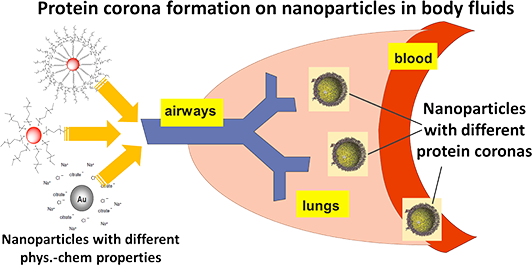
- doses, on toxicological responses of rat lungs determined in broncho-alveolar lavage fluids by using the same endpoints as in the ex vivo studies described above [22]. Remarkably, the rather consistent findings of increased pro-inflammatory response in an AgNP dose-dependent manner as determined by
- , mitochondrial changes did not change in between any of the groups of rats. Interestingly, the inflammatory response determined by TNF-α and IL-8 release increased significantly depending on the LPS dose in PCLS of rats that were exposed to suspensions containing 250 µg AgNP (Figure 8). It is quite striking that


The cell-type specific uptake of polymer-coated or micelle-embedded QDs and SPIOs does not provoke an acute pro-inflammatory response in the liver
Beilstein J. Nanotechnol. 2014, 5, 1432–1440, doi:10.3762/bjnano.5.155
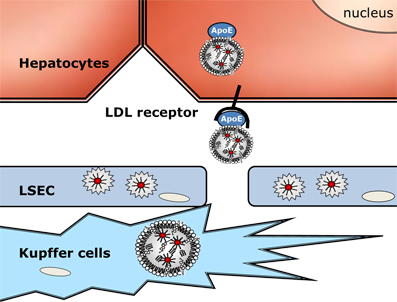
- [27][28] can induce a tolerance to internalized gut-derived substances and usually does not support pro-inflammatory T cell effector responses [28][29][30]. Thus, it is quite unlikely that nanocrystals internalized by LSEC provoke an acute pro-inflammatory response. In order to test this hypothesis


Mimicking exposures to acute and lifetime concentrations of inhaled silver nanoparticles by two different in vitro approaches
Beilstein J. Nanotechnol. 2014, 5, 1357–1370, doi:10.3762/bjnano.5.149
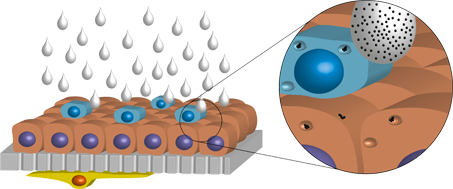
- highest concentrations under submerged conditions promoted a cytotoxic and pro-inflammatory response after 24 h. Interestingly, when cell cultures were co-incubated with lipopolysaccharide (LPS), no synergistic inflammatory effects were observed. By using two different exposure scenarios it has been shown
- (data not shown). Cytokine/chemokine secretion As described in [44], the release of the pro-inflammatory markers TNF-α and IL-8 was measured 4 and 24 h after exposure by enzyme linked immunosorbent assay (ELISA) to characterize the pro-inflammatory response of the cell culture lung model (Figure 5



Other Beilstein-Institut Open Science Activities



