


Search results
Search for "integrin" in Full Text gives 27 result(s) in Beilstein Journal of Nanotechnology.
Nanodiamond-DGEA peptide conjugates for enhanced delivery of doxorubicin to prostate cancer
Beilstein J. Nanotechnol. 2014, 5, 937–945, doi:10.3762/bjnano.5.107
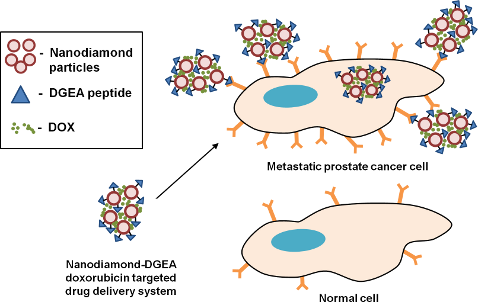
- tissues, the ND-DGEA conjugates were designed to distinguish between cells that overexpress α2β1 integrin, bone metastatic prostate cancers cells (PC3), and cells that do not, human mesenchymal stem cells (hMSC). Utilizing the ND-DGEA+DOX system, the efficacy of 1 µg/mL and 2 µg/mL DOX doses increased
- efficacy enhancement properties of NDs for targeted metastatic prostate cancer treatments has not been previously reported. Prostate cancers have been known to exhibit various aberrations, such as integrin α and β subunits, depending on the stage of progression. Integrin α and β subunits α6, β1, β3 and β6
- are up-regulated in metastatic cancers [29], while α2 is down-regulated initially then up-regulated as disease progresses [29][30]. High expression of the α2β1 integrin has been correlated with tumor progression in a number of cancers [31][32][33]. The α2β1 integrin is a receptor mainly for type I


Nanoglasses: a new kind of noncrystalline materials
Beilstein J. Nanotechnol. 2013, 4, 517–533, doi:10.3762/bjnano.4.61
- indicate that the lateral spacing of individual integrin receptor-ligand bonds determines the strength of cellular adhesion. For spacings larger than about 90 nm focal contact formation was found to be inhibited and detachment forces were significantly smaller than for spacings below 50 nm. This seems to
- be so because integrin clustering and adhesion-induced arginine-glycine-aspatic acid (RGD) ligands depend on the local order of the ligand arrangement on the substrate if the average ligand spacing is above 70 nm. Adhesion is “turned off“ by RGD patterning above 70 nm and “turned on” below this






Other Beilstein-Institut Open Science Activities



