Search results
Search for "lipid bilayer" in Full Text gives 36 result(s) in Beilstein Journal of Nanotechnology.
Wafer-scale bioactive substrate patterning by chemical lift-off lithography
Beilstein J. Nanotechnol. 2018, 9, 311–320, doi:10.3762/bjnano.9.31
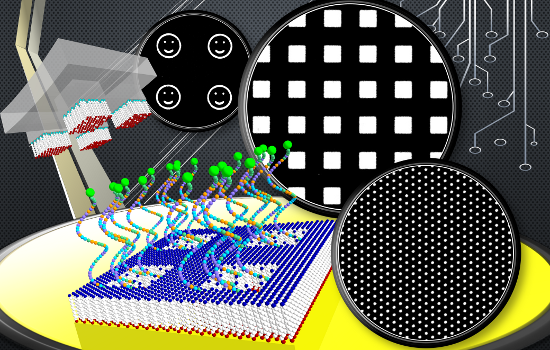
- reproduction, and high resolution control. Conventional strategies to fabricate bioactive substrates rely on the creation of different local molecular environments that are suitable for subsequent biological species attachment. For example, the supported lipid bilayer system has been widely used for many


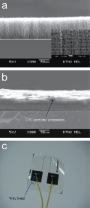
Surface-enhanced Raman scattering of self-assembled thiol monolayers and supported lipid membranes on thin anodic porous alumina
Beilstein J. Nanotechnol. 2017, 8, 74–81, doi:10.3762/bjnano.8.8
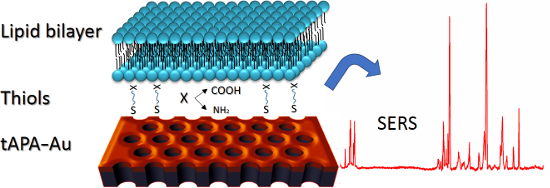
- ), and then with phospholipid vesicles of different composition to form a supported lipid bilayer (SLB). At each step, the SERS substrate functionality was assessed, demonstrating acceptable enhancement (≥100×). The chemisorption of thiols during the first step and the formation of SLB from the vesicles



On the pathway of cellular uptake: new insight into the interaction between the cell membrane and very small nanoparticles
Beilstein J. Nanotechnol. 2016, 7, 1296–1311, doi:10.3762/bjnano.7.121
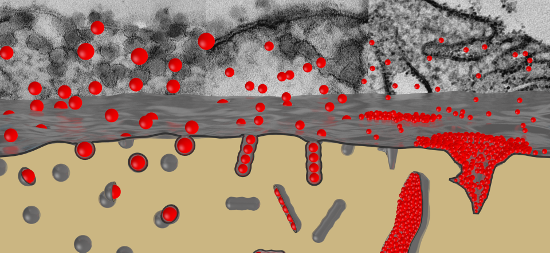
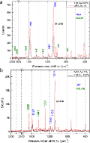
- assume that this large area coverage hinders the final vesicle pinch-off from the cell membrane. The additional silica layer on the cell membrane prevents the intimate membrane–membrane contact necessary for the coalescence of the membrane lipid bilayer at the point of pinch-off. Furthermore, the
- higher compared to the cell membrane. Nonetheless, it is remarkable that quite a little difference in NP size results in completely different uptake morphologies. From molecular dynamics simulations of two curvature imprinting particles on a lipid bilayer membrane we learn, that the membrane mediates




Reconstitution of the membrane protein OmpF into biomimetic block copolymer–phospholipid hybrid membranes
Beilstein J. Nanotechnol. 2016, 7, 881–892, doi:10.3762/bjnano.7.80
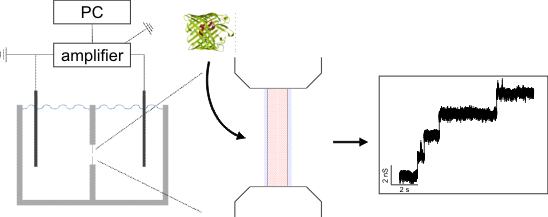
- more and more interest, as the properties of such assemblies can be steadily varied between the characteristics of a lipid bilayer and that of synthetic polymer membranes. By simply mixing lipids and amphiphilic polymers, a plethora of possible chemical and mechanical characteristics of polymeric
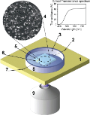
- a circular aperture with a diameter of 400 µm in the partitioning wall of a custom-built black lipid bilayer Teflon chamber. The volume of each compartment, separated by the partionining wall, was 5 mL [67]. PIPEO/DPhPC in chloroform (10 µL) was applied around the aperture of the chamber and allowed



Single pyrimidine discrimination during voltage-driven translocation of osmylated oligodeoxynucleotides via the α-hemolysin nanopore
Beilstein J. Nanotechnol. 2016, 7, 91–101, doi:10.3762/bjnano.7.11
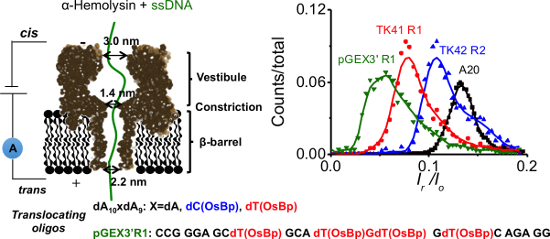
- , University of Utah. The KCl solution was used as the electrolyte to fill the solution reservoir and the GNM capillary. A voltage was applied across the GNM between two Ag/AgCl electrodes placed inside and outside of the capillary. A lipid bilayer was deposited across the GNM orifice as indicated by a
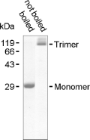
- resistance increase from ca. 10 MΩ (associated with the open GNM) to ca. 100 GΩ. A pressure of 20 to 40 mmHg was applied to the inside of the GNM capillary using a syringe, allowing the lipid bilayer to be functional for the protein channel reconstitution. Next, 0.2 µL of α-HL monomer solution at 1 mg/mL was



Intake of silica nanoparticles by giant lipid vesicles: influence of particle size and thermodynamic membrane state
Beilstein J. Nanotechnol. 2014, 5, 2468–2478, doi:10.3762/bjnano.5.256
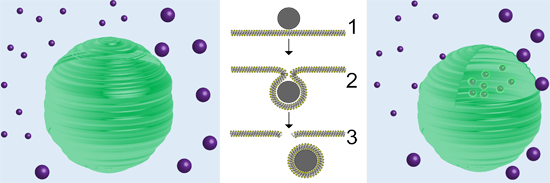
- particle and the membrane. As shown in [33], the interaction between a neutral (i.e., zwitterionic) lipid bilayer and negatively charged silica surface is repulsive in pure water but attractive in phosphate buffered saline. The authors also give a plausible theoretical explanation for this finding by


Nanobioarchitectures based on chlorophyll photopigment, artificial lipid bilayers and carbon nanotubes
Beilstein J. Nanotechnol. 2014, 5, 2316–2325, doi:10.3762/bjnano.5.240
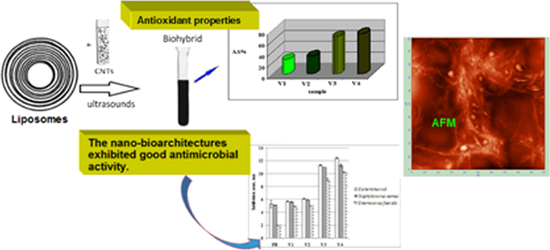
- biomimetic membranes (above 41 °C) exhibits low anisotropy and high fluorescence emission intensity due to an increase in the lipid bilayer mobility and hence the chlorophyll has the possibility to move and to minimize the energy transfer leading to fluorescence quenching. In the gel phase of the artificial


Carbon-based smart nanomaterials in biomedicine and neuroengineering
Beilstein J. Nanotechnol. 2014, 5, 1849–1863, doi:10.3762/bjnano.5.196
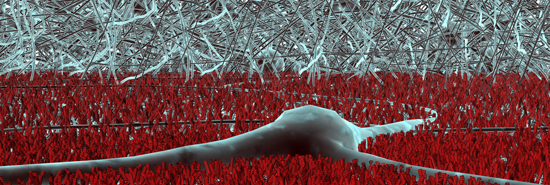
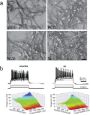
- the spontaneous extracellular electrical activity in a murine neuronal cell line, which yielded results in good agreement with recordings made by means of conventional MEAs (Figure 5). Single-spin NV-NDs embedded in an artificial lipid bilayer [136] and in a real cell membrane, in which there is a


Model systems for studying cell adhesion and biomimetic actin networks
Beilstein J. Nanotechnol. 2014, 5, 1193–1202, doi:10.3762/bjnano.5.131
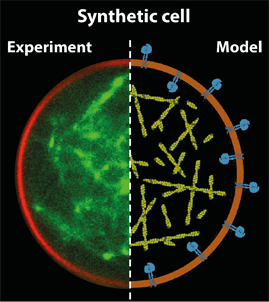
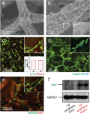
- actin networks and talin into model cells. Keywords: actin network; cell adhesion; giant unilamellar vesicle; integrin; lipid bilayer; synthetic cell; protein reconstitution; talin; Review Introduction Since Hooke first described a biological cell in 1665 tremendous progress has been made in
- found to quantify the binding energy of different integrin–ligand pairs under bioanalogue conditions [43]. This system was developed further to facilitate the mobility of the integrin receptors within the supported lipid bilayer. Thus, it was shown that integrin mobility controls the force-induced
- lipid bilayer, like the membrane of natural cells. With these attributes GUVs have gained increasing importance as bottom-up model systems in synthetic biology over the past years. GUVs can be used to study cellular functions and the interplay between various proteins, which are incorporated in the


Large-scale analysis of high-speed atomic force microscopy data sets using adaptive image processing
Beilstein J. Nanotechnol. 2012, 3, 747–758, doi:10.3762/bjnano.3.84
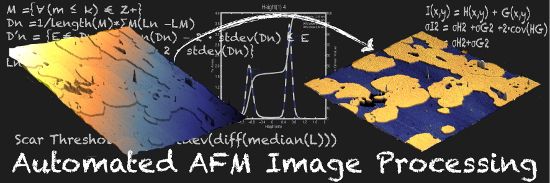
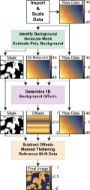
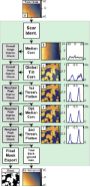
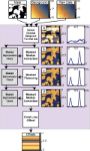
- routine on an example lipid bilayer of mixed composition are shown as the inputs and outputs of each major block. Each block will be discussed separately in detail. 1.1 Identify the background, generate a mask, estimate the polynomial background The purpose of this section is to identify the background
- in the image. Panel E shows the raw data of a mixed lipid bilayer on mica. Panel F shows the results of line-by-line second-order polynomial subtraction. Panel G shows 1-D artifact correction followed by 2-D second-order polynomial subtraction. Panel H shows the results of 1-D artifact correction
- fitting, are 2-D polynomial fits. 2-D polynomial fits can be performed by using either the whole figure for the fit, or only certain regions of the image determined by using thresholds. Figure 2 shows a comparison of different processing methods on a standard calibration grating as well as on a lipid




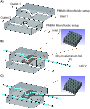
Microfluidic anodization of aluminum films for the fabrication of nanoporous lipid bilayer support structures
Beilstein J. Nanotechnol. 2011, 2, 104–109, doi:10.3762/bjnano.2.12
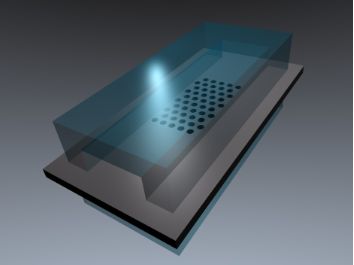
- monitored by impedance spectroscopy across the nanoporous alumina membrane in real-time. Our approach offers a simple and efficient methodology to investigate the activity of transmembrane proteins or ion diffusion across membrane bilayers. Keywords: anodization; lipid bilayer; microfluidics
- nanoporous membrane for lipid bilayer formation, the nanoporous alumina surface was first subjected to silanization. The silanization was carried out in the solution phase according to the method described by Steinle and coworkers [37][38] with slight modifications. Briefly, a 10% (v/v) solution of (3
- whole system was then cured at 60 °C for 60 min. The lipid bilayer on the modified nanoporous alumina surface was prepared by the method of liposomal fusion [39]. The liposomes were prepared from 1-palmitoyl-2-oleoyl-sn-glycero-3-phosphocholine (POPC, Avanti Polar Lipids, U.S.A.) by the following method