


Search results
Search for "macropinocytosis" in Full Text gives 31 result(s) in Beilstein Journal of Nanotechnology.
Caveolin-1 and CDC42 mediated endocytosis of silica-coated iron oxide nanoparticles in HeLa cells
Beilstein J. Nanotechnol. 2015, 6, 167–176, doi:10.3762/bjnano.6.16
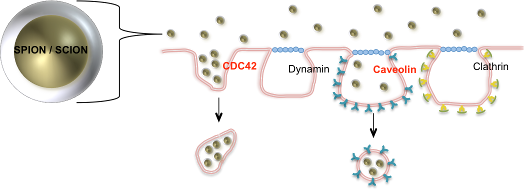
- [37] and mesoporous silica particles [40] exclusively through Clathrin mediated endocytosis and/or macropinocytosis. This discrepancy can be explained by the different physicochemical properties of the particles used. Especially in the field of iron-oxide nanoparticles more studies concerning the
- involved in many other cellular processes including macropinocytosis [45], therefore explaining its relevance in the uptake of polydisperse SPIONs. Depletion of PIP5Kα caused no significant effect. Conclusion This study shows for the first time, that Caveolin-1 and CDC42 play an important role in the


Mammalian cell growth on gold nanoparticle-decorated substrates is influenced by the nanoparticle coating
Beilstein J. Nanotechnol. 2014, 5, 2479–2488, doi:10.3762/bjnano.5.257
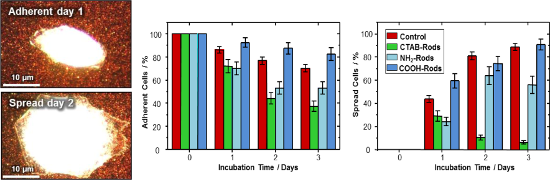
- with the negatively charged membrane [21][22], and to the sedimentation behavior of the particles which is related to their colloidal stability under physiological conditions [33]. The uptake was likely caused by non-specific endocytosis or macropinocytosis. Therefore, we expected an even stronger


Nanoparticle interactions with live cells: Quantitative fluorescence microscopy of nanoparticle size effects
Beilstein J. Nanotechnol. 2014, 5, 2388–2397, doi:10.3762/bjnano.5.248
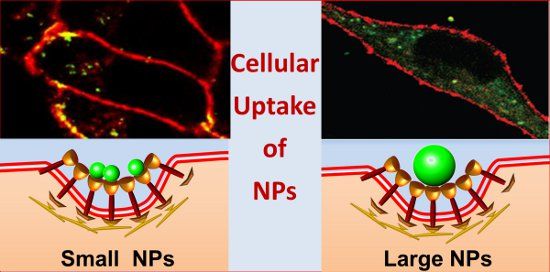
- on the specific uptake machinery involved, these are macropinocytosis, clathrin- and caveolae-mediated endocytosis, and mechanisms that involve neither clathrin nor caveolae. The exposed functional groups on an NP surface interact with cell surface receptors and may activate the cell’s uptake


Effect of silver nanoparticles on human mesenchymal stem cell differentiation
Beilstein J. Nanotechnol. 2014, 5, 2058–2069, doi:10.3762/bjnano.5.214
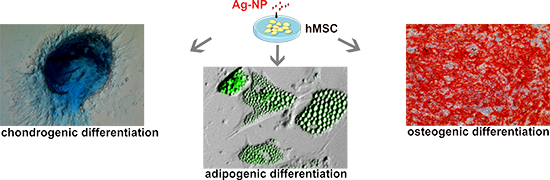
- through clathrin-dependent endocytosis and by macropinocytosis and that silver agglomerates were formed in the cytoplasm following the uptake of these nanoparticles [11]. There is a general consensus that dissolved silver ions are responsible for the majority of the biological effects on various cells and


PVP-coated, negatively charged silver nanoparticles: A multi-center study of their physicochemical characteristics, cell culture and in vivo experiments
Beilstein J. Nanotechnol. 2014, 5, 1944–1965, doi:10.3762/bjnano.5.205
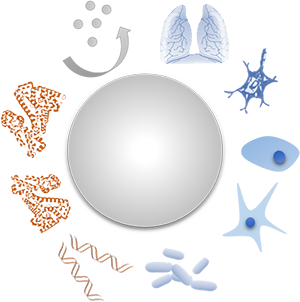
- such as macropinocytosis, clathrin- and caveolin-mediated endocytosis, and clathrin- and caveolin-independent endocytosis [81][82][83]. Other possible mechanisms such as receptor-mediated diffusion through membrane pores and passive uptake by van der Waals or steric interactions (summarized as adhesive
- interactions) have been suggested [84]. As we have reported, silver nanoparticles were mostly taken up by hMSC through clathrin-dependent endocytosis and macropinocytosis but not through caveolin-dependent endocytosis, as shown by flow cytometry (scattergram analysis) [77]. From the literature it is known that
- internalization of silver nanoparticles in astrocytes as in the cell types discussed above (Figure 11), inhibitors of macropinocytosis and endosomal trafficking (chloroquine and amiloride) at least partially lower the accumulation of silver nanoparticles [108]. Accumulated silver nanoparticles appear to be quite


Different endocytotic uptake mechanisms for nanoparticles in epithelial cells and macrophages
Beilstein J. Nanotechnol. 2014, 5, 1625–1636, doi:10.3762/bjnano.5.174
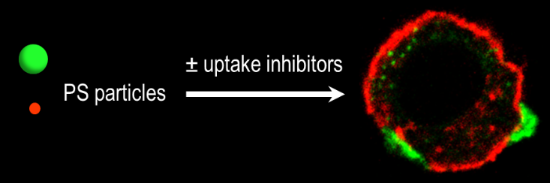
- mechanisms, that is, phagocytosis, macropinocytosis, clathrin- and caveolin-mediated endocytosis, were investigated using a mouse macrophage (J774A.1) and a human alveolar epithelial type II cell line (A549). In order to deduce the involved pathway in nanoparticle uptake, selected inhibitors specific for one
- suggested that macropinocytosis and phagocytosis, as well as clathrin-mediated endocytosis, play a crucial role. The uptake of 40 nm nanoparticles in alveolar epithelial A549 cells was inhibited after depletion of cholesterol in the plasma membrane (preventing caveolin-mediated endocytosis) and inhibition
- describes two different cellular uptake mechanisms: pinocytosis, which involves the uptake of fluids and molecules within small vesicles and phagocytosis, which is responsible for engulfing large particles (e.g., microorganisms and cell debris). Pinocytosis covers macropinocytosis, clathrin-mediated



Other Beilstein-Institut Open Science Activities



