


Search results
Search for "magnetic force microscopy" in Full Text gives 28 result(s) in Beilstein Journal of Nanotechnology.
Distinguishing magnetic and electrostatic interactions by a Kelvin probe force microscopy–magnetic force microscopy combination
Beilstein J. Nanotechnol. 2011, 2, 552–560, doi:10.3762/bjnano.2.59
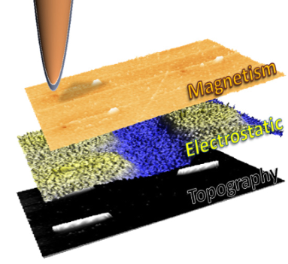
- , Spain 10.3762/bjnano.2.59 Abstract The most outstanding feature of scanning force microscopy (SFM) is its capability to detect various different short and long range interactions. In particular, magnetic force microscopy (MFM) is used to characterize the domain configuration in ferromagnetic materials
- ; Kelvin probe force microscopy; magnetic force microscopy; magnetic nanostructures; Introduction The most valuable asset of scanning force microscopy (SFM) is its versatility for studying a variety of interactions between the tip and the sample surface [1][2][3]. The SFM techniques can be used to detect
- every kind of force to the total force measured leads to serious problems for obtaining quantitative information from the measurements [4]. Among those SFM techniques, magnetic force microscopy (MFM) [5] was developed to characterize the domain configuration of ferromagnetic thin films, rather than the


Scanning probe microscopy and related methods
Beilstein J. Nanotechnol. 2010, 1, 155–157, doi:10.3762/bjnano.1.18

- Microscopy, FMM: Force Modulation Microscopy, ic-AFM: intermittent contact AFM, TMAFM: tapping mode AFM, nc-AFM: non-contact AFM, KPFM: Kelvin probe force microscopy, EFM: Electrostatic force microscopy, MFM: Magnetic force microscopy, MRFM: Magnetic resonance force microscopy, NSOM: Near-field scanning

Magnetic coupling mechanisms in particle/thin film composite systems
Beilstein J. Nanotechnol. 2010, 1, 101–107, doi:10.3762/bjnano.1.12
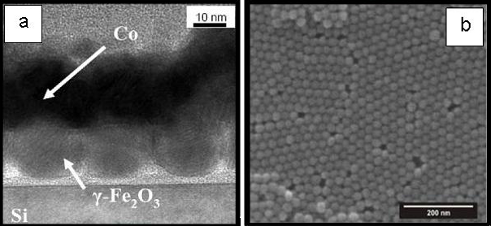
- magnetic force microscopy. Moreover, an exchange bias effect was found, which is likely to be due to oxygen exchange between the iron oxide and the Co layer, and thus forming of an antiferromagnetic CoO layer at the γ-Fe2O3/Co interface. Keywords: exchange bias; iron oxide nanoparticles; nanoparticle self
- F20 S-Twin instrument, atomic force and magnetic force microscopy (AFM, MFM) with an NT-MDT low temperature HV-Solver system. For cross sectional investigations of the composite film, TEM foils were extracted perpendicularly to the sample surface, by means of focused ion-beam technique, for which the


Other Beilstein-Institut Open Science Activities



