


Search results
Search for "molecular recognition" in Full Text gives 30 result(s) in Beilstein Journal of Nanotechnology.
Sequence-dependent electrical response of ssDNA-decorated carbon nanotube, field-effect transistors to dopamine
Beilstein J. Nanotechnol. 2014, 5, 2113–2121, doi:10.3762/bjnano.5.220
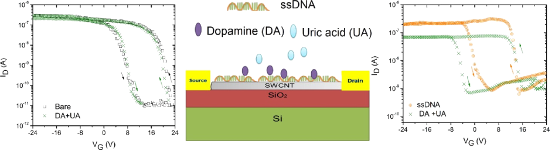
- different bases in ssDNA, it is necessary to investigate the effect of sequence on the FET-based molecular recognition of DA. SWCNT FETs were decorated with homo- and repeated-base ssDNA sequences, and the electrical response induced by DA in the presence and absence of UA was gauged in terms of the
- affinity and specificity of molecular recognition, whereas an electronic route promises faster detection [8][9]. In particular, single-stranded deoxyribonucleic acid (ssDNA) decoration on SWCNT has garnered tremendous attention because of its selectivity and sensitivity towards a wide range of analytes
- as a receptor capable of specific and selective binding with the target analyte. ssDNA-decorated, individually semiconducting SWCNTs in a field-effect transistor (FET) configuration merge the molecular recognition diversity of ssDNA with the excellent electronic properties of SWCNT to provide a fast


The oriented and patterned growth of fluorescent metal–organic frameworks onto functionalized surfaces
Beilstein J. Nanotechnol. 2012, 3, 570–578, doi:10.3762/bjnano.3.66
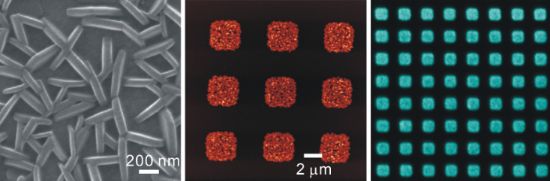
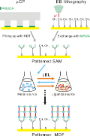
- surfaces, which are accessible by guest molecules. Based on this, MOFs have already demonstrated their potential for gas storage/separation [1], heterogeneous catalysis [2], molecular recognition [3], and sensing [4]. Some of these applications, such as gas storage, require the bulk preparation of the





Macromolecular shape and interactions in layer-by-layer assemblies within cylindrical nanopores
Beilstein J. Nanotechnol. 2012, 3, 475–484, doi:10.3762/bjnano.3.54
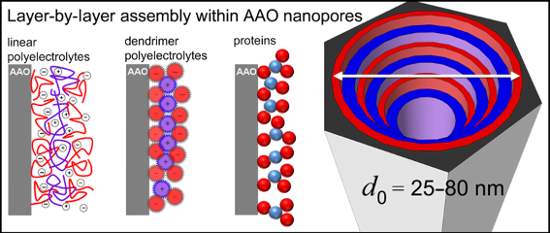
- adsorbing components, to generate multilayered structures. Different functional materials can be stepwise incorporated by LbL, within a single surface structure by electrostatic self-assembly [3][4], molecular-recognition pairs [5][6][7], or covalent-bond formation [8]. Homogeneous and heterogeneous layered
- molecular recognition of biotinylated-bovine serum albumin (b-BSA) by avidin. Avidin has four biotin-binding sites, whereas the b-BSA used has 13 biotin molecules per protein on average. Avidin with a mass of MW = 66–69 kDa, and which is positively charged at neutral pH, was first adsorbed onto the
- negatively charged surface, followed by b-BSA (MW = 67 kDa) adsorption through molecular recognition. Linear-polyelectrolytes (linear-PEs) self-assembled into multilayers by electrostatic interactions between 70 kDa poly(sodium 4-styrene sulfonate) (PSS) and 50–65 kDa poly(allyl amine) hydrochloride (PAH




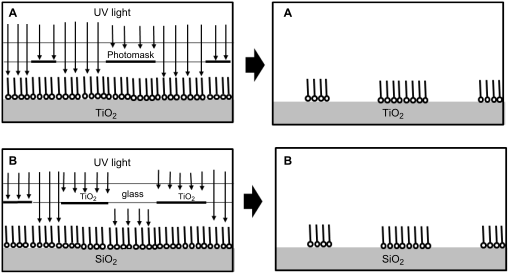
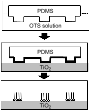
Self-assembled monolayers and titanium dioxide: From surface patterning to potential applications
Beilstein J. Nanotechnol. 2011, 2, 845–861, doi:10.3762/bjnano.2.94



Distance dependence of near-field fluorescence enhancement and quenching of single quantum dots
Beilstein J. Nanotechnol. 2011, 2, 645–652, doi:10.3762/bjnano.2.68
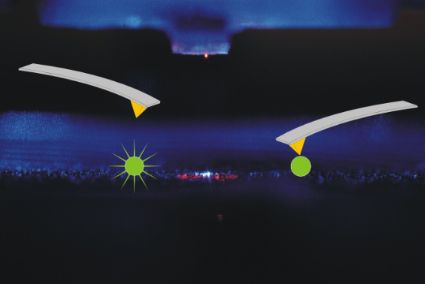
- of single molecules. The strong distance dependence of dipole–dipole coupling combined with the subnanometer resolution of AFM holds great promises to yield as yet unattainable information about the interplay of individual molecules, such as their molecular recognition mechanisms [19][20][21][22][23


Other Beilstein-Institut Open Science Activities



