


Search results
Search for "morphological characterization" in Full Text gives 39 result(s) in Beilstein Journal of Nanotechnology.
Robust nanobubble and nanodroplet segmentation in atomic force microscope images using the spherical Hough transform
Beilstein J. Nanotechnol. 2017, 8, 2572–2582, doi:10.3762/bjnano.8.257
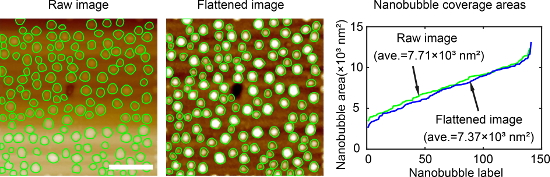
- potential for numerous applications. As a result, the automated segmentation and morphological characterization of NBs and NDs in atomic force microscope (AFM) images is highly awaited. The current segmentation methods suffer from the uneven background in AFM images due to thermal drift and hysteresis of
- . After that, the so-called contour expansion operation was applied to achieve optimized boundaries. The principle and the detailed procedure of the proposed method were presented, followed by the demonstration of the automated segmentation and morphological characterization. The result shows that the
- nanostructures on polymer [15] and highly oriented pyrolytic graphite (HOPG) surfaces [16]. In general, NBs and NDs are 100–800 nm in width and 10–100 nm in height. They are generally studied by atomic force microscopes (AFM) due to their high spatial measurement resolution. The morphological characterization of


Fabrication of black-gold coatings by glancing angle deposition with sputtering
Beilstein J. Nanotechnol. 2017, 8, 434–439, doi:10.3762/bjnano.8.46
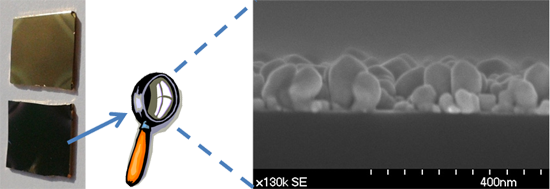
- with the substrate being parallel to the target, i.e., σ = 0°, the same power (100 W) and the equivalent deposition time to get the same amount of material per area as in the GLAD configuration. The morphological characterization has been obtained by field emission scanning electron microscopy (FESEM


Electric field induced structural colour tuning of a silver/titanium dioxide nanoparticle one-dimensional photonic crystal
Beilstein J. Nanotechnol. 2016, 7, 1404–1410, doi:10.3762/bjnano.7.131
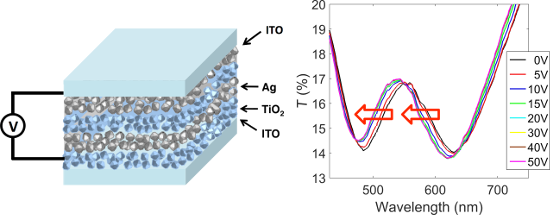
- crystal device. Transmission spectra simulated with the transfer matrix method for a Ag/TiO2 nanoparticle photonic crystal device with three different carrier densities. Supporting Information Supporting Information File 192: Morphological characterization of the sample with atomic force microscopy and




Improved lithium-ion battery anode capacity with a network of easily fabricated spindle-like carbon nanofibers
Beilstein J. Nanotechnol. 2016, 7, 1289–1295, doi:10.3762/bjnano.7.120
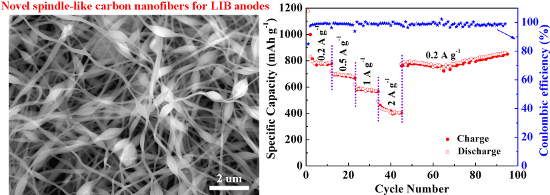
- PAN in 5 mL DMF, as well as dissolving 0.05 g C3N3(NH2)3 and 0.4 g PAN in another 5 mL DMF, respectively. Characterization of the carbon network The microstructural and morphological characterization of the as-fabricated carbon networks were conducted by field-emission scanning electron microscopy (FE


Gold nanoparticles covalently assembled onto vesicle structures as possible biosensing platform
Beilstein J. Nanotechnol. 2016, 7, 655–663, doi:10.3762/bjnano.7.58
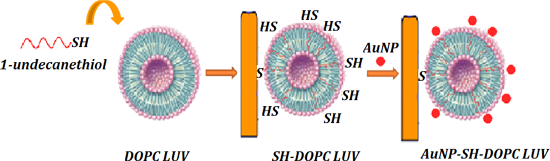
- sensible to the conditions under which they are formed. As the irradiation time modifies the nanoparticle morphology we decided to irradiate for longer time, in this case, 13 min. Some techniques, such as UV–vis spectroscopy and TEM were used to perform the morphological characterization of the AuNPs


Nanofibers for drug delivery – incorporation and release of model molecules, influence of molecular weight and polymer structure
Beilstein J. Nanotechnol. 2015, 6, 1939–1945, doi:10.3762/bjnano.6.198
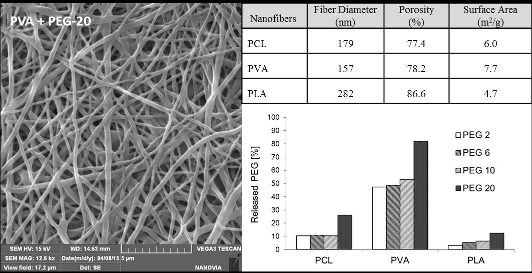
- not noticeably influence the nanofiber structure. According to the results of morphological characterization, the nanofibrous structures remained similar to those of nanofibers without model molecules, even for nanofibers that contained PEG 20 (Figure 2d–f). Clusters or other artifacts were not
- possible. However, the morphological characterization revealed several differences in the parameters of resultant samples (Table 1). The thinnest fibers with a mean fiber diameter 157 nm were prepared from PVA, and the thickness of PCL nanofibers (179 nm) was almost similar to this value. PLA fibers were
- . Morphological characterization of nanofibrous carriers. Acknowledgement The financial support of the Ministry of Education, Youth and Sports of the Czech Republic (grant No. EE2.3.30.0029), the Grant Agency of the Czech Republic (grant No. 13-00939S), the Charles University in Prague (project no. 307115 and



Fulleropeptide esters as potential self-assembled antioxidants
Beilstein J. Nanotechnol. 2015, 6, 1065–1071, doi:10.3762/bjnano.6.107
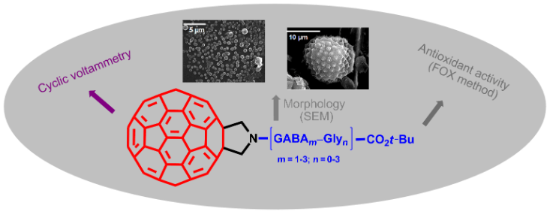
- the subject of interest of Nakanishi's research group [12][13]. Although the morphological characterization of the self-organized fulleropeptide nanoparticles has not been extensively studied thus far, the formation of ordered superstructures under controllable conditions through the process of self
- , peptide, and steroid units [25], which possess in vitro antioxidant activity. Additionally, morphological characterization of self-organized structures of fullerene–steroid [26] and fullerene–peptide–steroid hybrids [25] in solution and in the solid state was studied by SEM. In our previous work [27], we


Automatic morphological characterization of nanobubbles with a novel image segmentation method and its application in the study of nanobubble coalescence
Beilstein J. Nanotechnol. 2015, 6, 952–963, doi:10.3762/bjnano.6.98
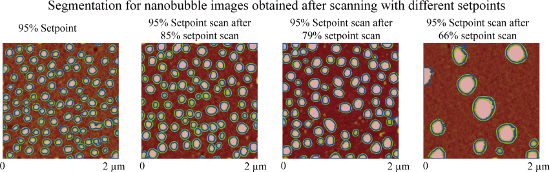
- Engineering, Harbin Institute of Technology, Harbin, 150001, P.R. China 10.3762/bjnano.6.98 Abstract Nanobubbles (NBs) on hydrophobic surfaces in aqueous solvents have shown great potential in numerous applications. In this study, the morphological characterization of NBs in AFM images was carried out with
- largest volume at 25 °C [35]. They also found that the contact angle of the NB was a function of its radius of curvature. The NB properties, including diameter, height, contact angle, radius of curvature, density and covered area, are normally studied through morphological characterization from AFM images
- selected cross sections, the NB diameter and height can be directly measured. By fitting the cross sections as arcs, the NB contact angle and radius of curvature can be obtained [36][37][38][39]. The morphological characterization of NBs suffers from several difficulties. First, NB image segmentation is


Applications of three-dimensional carbon nanotube networks
Beilstein J. Nanotechnol. 2015, 6, 792–798, doi:10.3762/bjnano.6.82
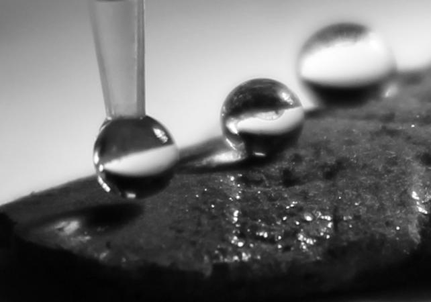
- to the synthesis process induces the formation of pentagonal and heptagonal carbon rings [15][16] that favors the bent geometry of the nanostructures. No structural differences are observed along the whole sample within this morphological characterization. In the case of the sample reported in Figure


Oxygen-plasma-modified biomimetic nanofibrous scaffolds for enhanced compatibility of cardiovascular implants
Beilstein J. Nanotechnol. 2015, 6, 254–262, doi:10.3762/bjnano.6.24
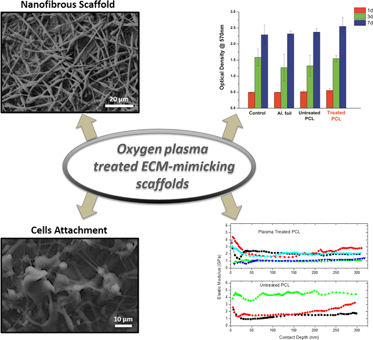
- evaluate the influence of the plasma treatment on cell attachment, morphology and viability. Results and Discussion Morphological characterization of the plasma-treated scaffolds Electrospinning is a versatile and well-established technique broadly applied for the fabrication of nanofibrous meshes as
- Morphological characterization SEM: The morphological analysis of the PCL scaffolds was carried out by using scanning electron microscopy (SEM, NEON40, Carl Zeiss). In order to visualize and evaluate the morphological characteristics of the investigated materials, secondary electron detector was used. AFM


Nanobioarchitectures based on chlorophyll photopigment, artificial lipid bilayers and carbon nanotubes
Beilstein J. Nanotechnol. 2014, 5, 2316–2325, doi:10.3762/bjnano.5.240
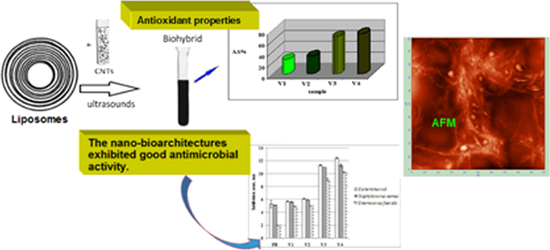
- their small size as compared to the samples without cholesterol (see Figure 2). This leads to fluorescence quenching due to the efficient energy transfer between chlorophyll molecules, which are closer in small vesicles. Morphological characterization of biohybrid architectures Figure 6 shows a partial


Photodetectors based on carbon nanotubes deposited by using a spray technique on semi-insulating gallium arsenide
Beilstein J. Nanotechnol. 2014, 5, 1999–2006, doi:10.3762/bjnano.5.208
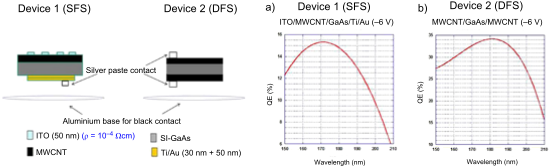
- comparable with those obtained for similar detectors with CNTs deposited by CVD [7][13][14][15]. In this work results from a photodetector based on CNTs spray-deposited on semi-insulating gallium arsenide (SI GaAs) are reported. In order to perform the morphological characterization of the resulting films


Scale effects of nanomechanical properties and deformation behavior of Au nanoparticle and thin film using depth sensing nanoindentation
Beilstein J. Nanotechnol. 2014, 5, 822–836, doi:10.3762/bjnano.5.94
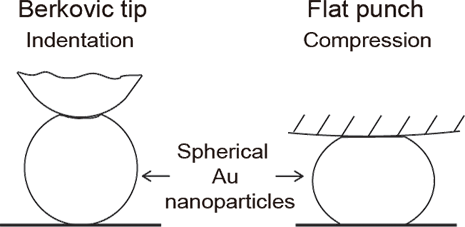
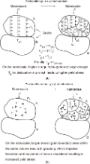
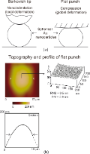
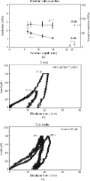
- presented for low, intermediate and high loads. Morphological characterization, before and after deformation, is also presented. Finally load–displacement curves for repeat compression tests using the flat punch are presented. Nanoindentation with a Berkovich tip – Indentation of thin films Indentation with






Morphological characterization of fullerene–androsterone conjugates
Beilstein J. Nanotechnol. 2014, 5, 374–379, doi:10.3762/bjnano.5.43
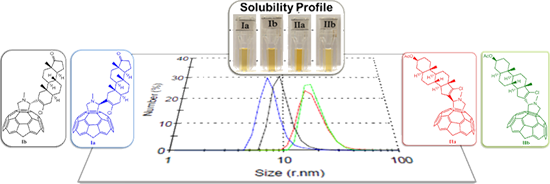
- report on the morphological characterization of four fullerene–androsterone conjugates in water. The morphology and particle size of the C60–androsterone hybrids in aqueous solution were determined by transmission electron microscopy (TEM) and dynamic light scattering (DLS). Results and Discussion The





