


Search results
Search for "primary particles" in Full Text gives 29 result(s) in Beilstein Journal of Nanotechnology.
The surface properties of nanoparticles determine the agglomeration state and the size of the particles under physiological conditions
Beilstein J. Nanotechnol. 2014, 5, 1774–1786, doi:10.3762/bjnano.5.188
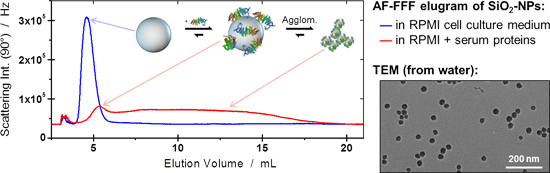
- industrial scale as well. By pyrolysis of, for example, silicon tetrachloride, primary particles with diameters less than 50 nm are obtained. These merge irreversibly into aggregates with diameters between 250 nm and a few tens of micrometers [58][59]. 3. The third synthesis route involves the hydrolysis and


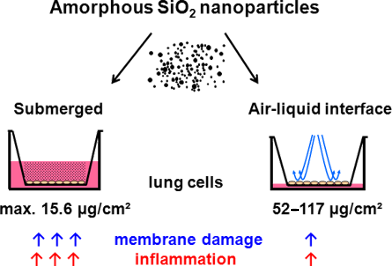
Silica nanoparticles are less toxic to human lung cells when deposited at the air–liquid interface compared to conventional submerged exposure
Beilstein J. Nanotechnol. 2014, 5, 1590–1602, doi:10.3762/bjnano.5.171
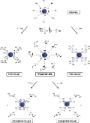
- each experiment by using a transmission electron microscope (Zeiss 109T, Oberkochen). The deposited particles were detected and analysed regarding their number and size with a custom-made software. For the calculation of mass doses spherical primary particles with a density of 2 g·cm−3 were assumed


Current state of laser synthesis of metal and alloy nanoparticles as ligand-free reference materials for nano-toxicological assays
Beilstein J. Nanotechnol. 2014, 5, 1523–1541, doi:10.3762/bjnano.5.165
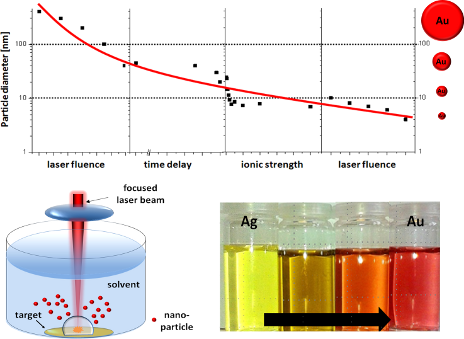
- these effects are anion specific and do not occur in the presence of hard anions like F− which destabilizes gold colloids even at low salinities. This size quenching effect has been attributed to the adsorption of anions to primary particles during particle formation, which electrostatically stabilizes
- stability will increase upon dilution. Based on the above mentioned three determining factors it may be concluded that ligand-free colloids may only be used as primary particles in biological assays when they are highly diluted, while at higher concentrations mainly aggregates have to be considered. However


Morphological characterization of fullerene–androsterone conjugates
Beilstein J. Nanotechnol. 2014, 5, 374–379, doi:10.3762/bjnano.5.43
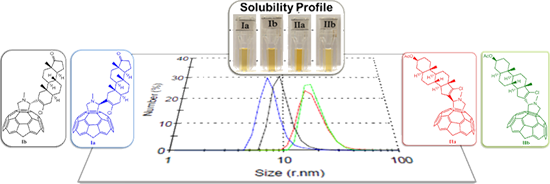
- dynamic light scattering (DLS) measures the hydrodynamic diameter of the particle including the solvation layers, while TEM gives the most direct information about the size distribution and shapes of the primary particles. DLS and TEM have different basis and can lead to discrepancies in sizing


Other Beilstein-Institut Open Science Activities



