


Search results
Search for "pump–probe" in Full Text gives 28 result(s) in Beilstein Journal of Nanotechnology.
k-space imaging of the eigenmodes of sharp gold tapers for scanning near-field optical microscopy
Beilstein J. Nanotechnol. 2013, 4, 603–610, doi:10.3762/bjnano.4.67
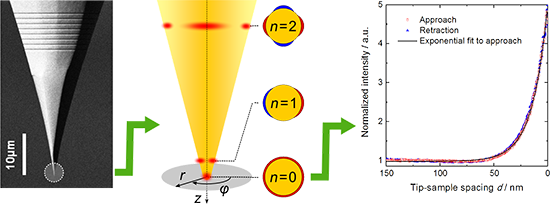
- several tens of microns on the surface of a gold taper [11]. These results have been confirmed by three-dimensional finite difference time domain (FDTD) simulations [11]. These theoretical investigations and experimental demonstrations suggest that pump–probe studies employing adiabatic nanofocusing are
- at the taper apex. We think that this is an important step toward ultrafast pump–probe spectroscopy on the nanoscale. Specifically, we show that we can differentiate between the zeroth and first order mode, which is generally difficult when using conventional far field imaging techniques. Eigenmodes


Femtosecond-resolved ablation dynamics of Si in the near field of a small dielectric particle
Beilstein J. Nanotechnol. 2013, 4, 501–509, doi:10.3762/bjnano.4.59
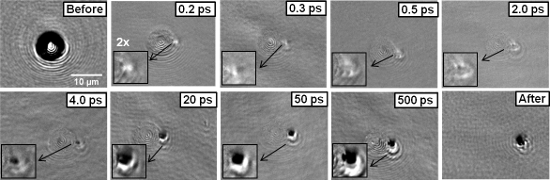
- irradiating the samples and acquiring the fs-resolved surface reflectivity images. The pump-probe microscope uses a single 120 fs pump pulse at 800 nm, which was selected by using an electro-mechanical shutter. The pump beam (s-polarized) is focused at an angle of incidence of 54° onto the sample surface to a


Femtosecond time-resolved photodissociation dynamics of methyl halide molecules on ultrathin gold films
Beilstein J. Nanotechnol. 2011, 2, 618–627, doi:10.3762/bjnano.2.65
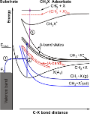
- chloride, adsorbed on a metal surface was investigated in real time by means of femtosecond-laser pump–probe mass spectrometry. A weakly interacting gold surface was employed as substrate because the intact adsorption of the methyl halide molecules was desired prior to photoexcitation. The gold surface was
- . However, neither photodissociation products nor the parent molecule were detected, independent on the pump–probe delay time. Similar results were reported by White and coworkers for methyl iodide adsorbed on Pt(111) [28][29][30][31]. In their work, methyl iodide molecules that were adsorbed on the metal
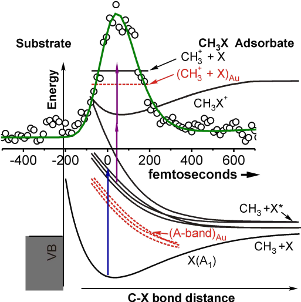
- cation signal intensity as a function of the pump–probe delay. The result is shown in Figure 5. The CD3+ transient signal consists of a peak structure with a maximum at 50 fs. The interpretation of this transient is based on earlier experiments with methyl iodide on an insulating magnesia surface and on


Other Beilstein-Institut Open Science Activities



