


Search results
Search for "responsivity" in Full Text gives 28 result(s) in Beilstein Journal of Nanotechnology.
Photodetectors based on carbon nanotubes deposited by using a spray technique on semi-insulating gallium arsenide
Beilstein J. Nanotechnol. 2014, 5, 1999–2006, doi:10.3762/bjnano.5.208
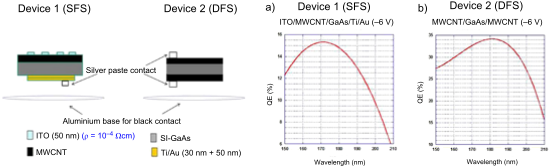
- so far, in Figure 7 [7] the expected responsivity of a gallium arsenide photodetector and, for comparison, a photodetector based on CNTs are reported. It is clear from the figure that the response in the UV of the CNTs/GaAs detector is due to the absorption of the CNTs in this region, to which, in
- results obtained for the SFS. The I–V measurements under illumination evidence, in both configurations, the contribution of the responsivity of the CNTs in the UV as photoactive layer to the detector performance. Furthernore, in the vis–NIR spectral range photocurrent appears to be more field-dependent in
- DFS b). Absolute quantum efficiency trend in the UV range, calculated at a bias voltage of −6 V for the devices SFS a) and DFS b). Responsivity trend of GaAs and CNTs based photodetectors. Normalized photocurrent spectra measured at: (a) negative voltages, (b) positive voltages applied to the ITO top


Dynamic calibration of higher eigenmode parameters of a cantilever in atomic force microscopy by using tip–surface interactions
Beilstein J. Nanotechnol. 2014, 5, 1899–1904, doi:10.3762/bjnano.5.200

- Division, Los Alamos National Laboratory, Los Alamos, NM 87545, USA 10.3762/bjnano.5.200 Abstract We present a theoretical framework for the dynamic calibration of the higher eigenmode parameters (stiffness and optical lever inverse responsivity) of a cantilever. The method is based on the tip–surface
- lever inverse responsivity, Vn is the measured voltage (corresponding to the eigencoordinate zn = αnVn, where total tip deflection is ), is the linear transfer function of a harmonic oscillator with the resonant frequency ωn and quality factor Qn, F is a nonlinear tip–surface force and fn is a drive
- in the different detected voltages, V1 ≠ V2. In the case of small deflections, zn is proportional to Vn with some coefficient αn called optical lever inverse responsivity. The tip–surface force (Equation 6) used in the simulations. The white dashed line corresponds to a phase space trajectory of the


![[Graphic 25]](/bjnano/content/inline/2190-4286-5-200-i35.png?max-width=637&scale=1.18182) , using Equation 9 for two different cantilevers: ...
, using Equation 9 for two different cantilevers: ...
Ultraviolet photodetection of flexible ZnO nanowire sheets in polydimethylsiloxane polymer
Beilstein J. Nanotechnol. 2012, 3, 353–359, doi:10.3762/bjnano.3.41
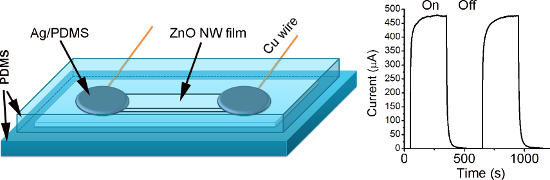
- photodetectors based on ZnO films or nanocrystals have been reported. It has been demonstrated that ZnO nanowires have high internal photoconduction gain and much stronger responsivity under UV-light illumination compared to the bulk film [3]. The UV photoresponse mechanism of ZnO nanowires is dominated by the
- adsorption and desorption of oxygen molecules [4]. In vacuum, ZnO nanowires show a prolonged UV photoresponse time and lowered responsivity [5]. So far, many UV photosensors have been made from ZnO one-dimensional nanostructures with various configurations, for sensing elements, such as single-nanowire
- nanowire film can be enhanced by PDMS coating. The responsivity of the device, defined as the photocurrent per unit of incident optical power, is determined by the UV photoconductivity of the ZnO nanowires. From the I–V curves we can deduce that the PDMS coating over ZnO nanowires results in an


Other Beilstein-Institut Open Science Activities



