


Search results
Search for "ripples" in Full Text gives 30 result(s) in Beilstein Journal of Nanotechnology.
Electronic and transport properties of kinked graphene
Beilstein J. Nanotechnol. 2013, 4, 103–110, doi:10.3762/bjnano.4.12
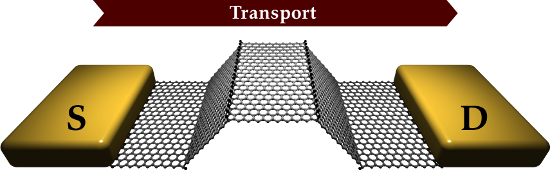
- der Waals (vdW) interaction with the substrate is of importance. The substrate interactions, which make graphene cling to small features, may be exploited by manufacturing nanostructures in the substrate. Periodic steps in a Cu substrate has been used to induce “wrinkles” or ripples in graphene with
- geometry of hydrogenated ripple structures in unsupported, strain-induced, graphene ripples [24][25][26]. However, to the best of our knowledge, no studies have addressed the reactivity of bends or the transport through hydrogenated ripples, or discussed the possibility of stabilising nonplanar structures


Pure hydrogen low-temperature plasma exposure of HOPG and graphene: Graphane formation?
Beilstein J. Nanotechnol. 2012, 3, 852–859, doi:10.3762/bjnano.3.96
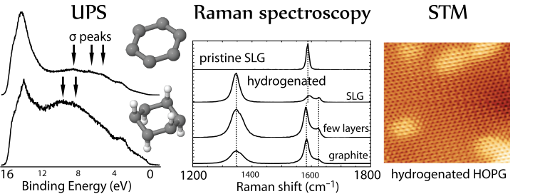
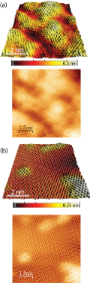
- surface still consists of a hexagonal pattern but on a highly corrugated plane (Figure 4a). Soft annealing leads to a flatter surface; however, it still has a corrugation in the form of ripples and valleys at certain points (Figure 4b). This surface corrugation matches well with the theoretical
- calculation of a suspended graphane layer, where it is estimated that this layer should be corrugated in the form of ripples with an amplitude of a few hundred picometers [27]. The hexagonal ring patterns in Figure 5 appear in different distorted forms. Our STM images are similar to those obtained locally



Graphite, graphene on SiC, and graphene nanoribbons: Calculated images with a numerical FM-AFM
Beilstein J. Nanotechnol. 2012, 3, 301–311, doi:10.3762/bjnano.3.34
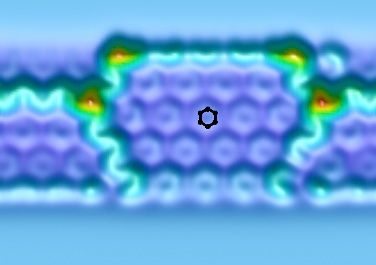
- an approach above an atom in the surface plane. This shift can occur due to the local relaxation of the carbon atom network, as is the case for the graphene ripples. To go further, one needs to estimate the actual influence of the tip and of the temperature at T = 4.9 K in the free-atoms mode. By
- ripples of a graphene sheet relaxed on a silicon carbide substrate, and (iii) a corrugated transition of a graphene nanoribbon supported by a SiC surface. Improvements remain to be made for the prospective study of single molecule imaging and/or manipulation processes and related physical problems, such


The description of friction of silicon MEMS with surface roughness: virtues and limitations of a stochastic Prandtl–Tomlinson model and the simulation of vibration-induced friction reduction
Beilstein J. Nanotechnol. 2010, 1, 163–171, doi:10.3762/bjnano.1.20
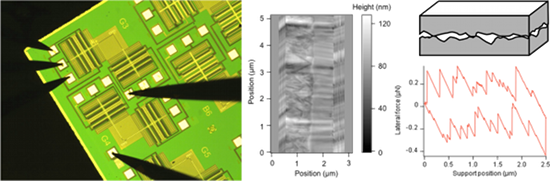
- that we would associate in the traditional Prandtl–Tomlinson model with ‘superlubricity’. This is the case even though we have corrected for the 10 nN measured adhesion (adhesion measurements with the MEMS tribometer are detailed in [25]). To investigate the effect of the long length scale ripples in
- force value and are shown with the green open triangles. There is no significant difference between the exponential and the ‘real’ autocorrelation simulations, and hence the effect of the ripples is negligible. Because we have carried out MEMS measurements resembling force–distance curves (as described
- Rxx(x) of a pristine sidewall surface measured with AFM, and theoretical exponential fit with a correlation length of 83 nm. The standard deviation on the height is 10.3 nm and the distribution is almost Gaussian. The long-range order is caused by the larger scale ripples. The result is that only one


A collisional model for AFM manipulation of rigid nanoparticles
Beilstein J. Nanotechnol. 2010, 1, 158–162, doi:10.3762/bjnano.1.19
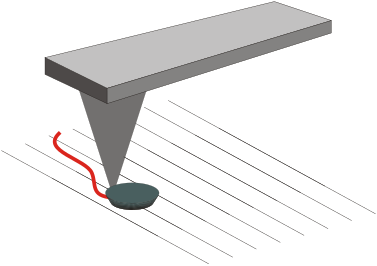
- scratches the polymer surface while scanning [11]. Linear and ‘travelling’ circular ripples were formed using a raster or a circular scan path, respectively. In the same way, a desired configuration of nanoparticles could be obtained by a proper choice of the scan pattern. Conclusion In conclusion, we have


Other Beilstein-Institut Open Science Activities



