


Search results
Search for "scanning tunnelling microscopy (STM)" in Full Text gives 32 result(s) in Beilstein Journal of Nanotechnology.
Revealing thermal effects in the electronic transport through irradiated atomic metal point contacts
Beilstein J. Nanotechnol. 2012, 3, 703–711, doi:10.3762/bjnano.3.80
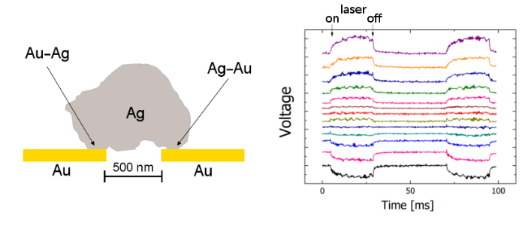
- expansion on a laser-irradiated metallic nanocontact has been demonstrated already some time ago in scanning tunnelling microscopy (STM) experiments [19][20]. Upon irradiating the STM tip with a short laser pulse, the junction resistance was observed to be drastically reduced due to the expansion of the tip


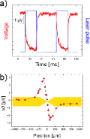

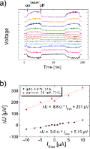


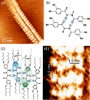
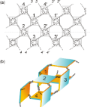
Dimer/tetramer motifs determine amphiphilic hydrazine fibril structures on graphite
Beilstein J. Nanotechnol. 2012, 3, 658–666, doi:10.3762/bjnano.3.75
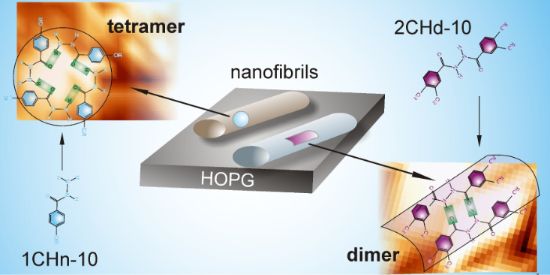
- –graphite interface by self-assembly of custom-designed symmetric and asymmetric amphiphilic benzamide derivatives bearing C10 aliphatic chains. Scanning tunnelling microscopy (STM) studies reveal geometry-dependent internal structures for the elementary fibrils of the two molecules that are distinctly
- (fibres) in bulk columnar mesophases depends mostly on X-ray techniques, which suffice for many purposes [7][10][11]. However, information in real space, as provided by scanning tunnelling microscopy (STM), offers unparalleled advantages to the synthesis chemist who strives to functionalize fibrils that
- architecture on an electrically conducting substrate in real space, scanning tunnelling microscopy (STM) is the experimental technique of choice. Although STM has been highly successful in atomic/submolecular probing of planar structures [17][18] and their dynamics [19], when it comes to one-dimensional




Quantitative multichannel NC-AFM data analysis of graphene growth on SiC(0001)
Beilstein J. Nanotechnol. 2012, 3, 179–185, doi:10.3762/bjnano.3.19
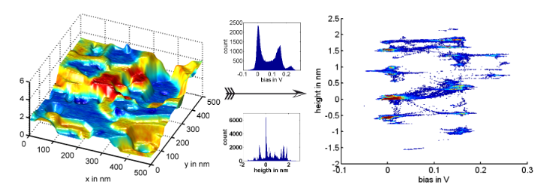
- . Towards this goal, the graphene layer thickness has been determined by various methods including scanning tunnelling microscopy (STM) [4], Raman spectroscopy [5], low-energy electron microscopy [6][7], transmission electron microscopy [8], and atomic force microscopy (AFM) [9][10]. AFM also allows the



STM visualisation of counterions and the effect of charges on self-assembled monolayers of macrocycles
Beilstein J. Nanotechnol. 2011, 2, 674–680, doi:10.3762/bjnano.2.72
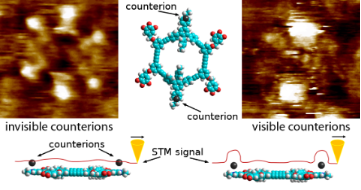
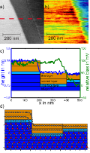
- localisation of counterions within self-assembled monolayers can be achieved with scanning tunnelling microscopy (STM). The presence of charges on the studied shape-persistent macrocycles is shown to have a profound effect on the self-assembly process at the liquid–solid interface. Furthermore, preferential
- patterns with a wide range of symmetries and periodicities [1][2][3][4], with scanning tunnelling microscopy (STM) [7] being a primary characterisation tool. However, combining the ordering of self-organised, physisorbed monolayers with an additional functionality remains an important challenge. In


Towards a scalable and accurate quantum approach for describing vibrations of molecule–metal interfaces
Beilstein J. Nanotechnol. 2011, 2, 427–447, doi:10.3762/bjnano.2.48
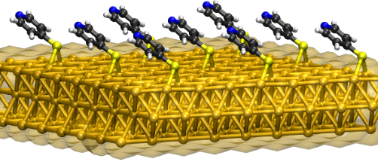
- characterisation is the use of scanning tunnelling microscopy (STM) to record single-molecule spectra. This relies on the technique of inelastic electron tunnelling spectroscopy (IETS), developed in the mid-1960s [2], and performs measurements on a single molecule using an STM tip as a contact instead of a


Intermolecular vs molecule–substrate interactions: A combined STM and theoretical study of supramolecular phases on graphene/Ru(0001)
Beilstein J. Nanotechnol. 2011, 2, 365–373, doi:10.3762/bjnano.2.42
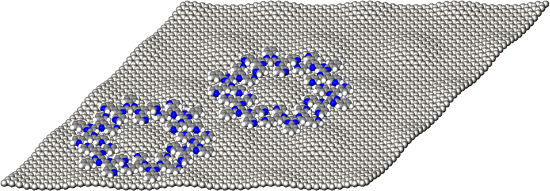
- intermolecular interactions and long-range lateral variations in the substrate–adsorbate interaction was studied by scanning tunnelling microscopy (STM) and force field based calculations, by comparing the phase formation of (sub-) monolayers of the organic molecules (i) 2-phenyl-4,6-bis(6-(pyridin-3-yl)-4


Scanning probe microscopy and related methods
Beilstein J. Nanotechnol. 2010, 1, 155–157, doi:10.3762/bjnano.1.18

- Ernst Meyer Department of Physics, University of Basel, Klingelbergstr. 82, CH-4056 Basel 10.3762/bjnano.1.18 Since the invention of scanning tunnelling microscopy (STM) [1] and atomic force microscopy (AFM) [2], a new class of local probe microscopes has entered the laboratories around the world

Other Beilstein-Institut Open Science Activities



