


Search results
Search for "silk" in Full Text gives 34 result(s) in Beilstein Journal of Nanotechnology.
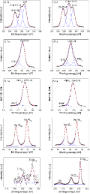
Bombyx mori silk/titania/gold hybrid materials for photocatalytic water splitting: combining renewable raw materials with clean fuels
Beilstein J. Nanotechnol. 2018, 9, 187–204, doi:10.3762/bjnano.9.21
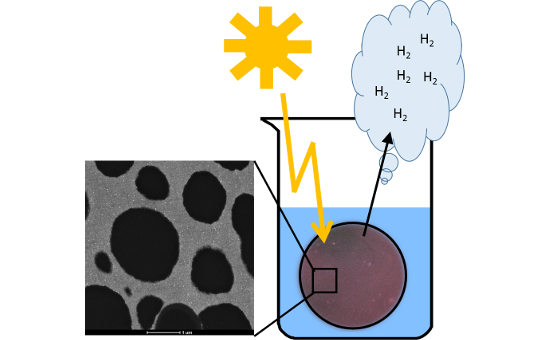
- Giessen, Germany Department of Chemistry and CQ-VR, University of Trás-os-Montes e Alto Douro, Pt-5001-801 Vila Real, Portugal 10.3762/bjnano.9.21 Abstract The synthesis, structure, and photocatalytic water splitting performance of two new titania (TiO2)/gold(Au)/Bombyx mori silk hybrid materials are
- materials are effective water splitting catalysts and produce up to 30 mmol of hydrogen per 24 h. Overall the article demonstrates that the combination of a renewable and robust scaffold such as B. mori silk with a photoactive material provides a promising approach to new monolithic photocatalysts that can
- easily be recycled and show great potential for application in lightweight devices for green fuel production. Keywords: Bombyx mori silk; gold; photocatalytic water splitting; titania; Introduction Fossil fuel availability is one of the pressing issues today. Especially in light of a growing world


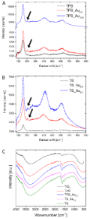


Nanoantenna-assisted plasmonic enhancement of IR absorption of vibrational modes of organic molecules
Beilstein J. Nanotechnol. 2017, 8, 975–981, doi:10.3762/bjnano.8.99
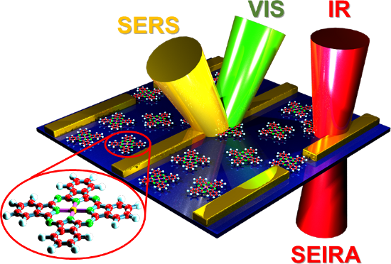
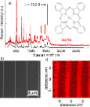
- enhancement up to 1014 can be achieved. Although SEIRA is a relatively new tool for detection of organic and biological substances, it is found to be very effective for probing extremely low concentrations. Adato et al. demonstrated detection of 3 × 10⁻¹⁹ moles of silk protein for the entire nanoantenna array



Functional diversity of resilin in Arthropoda
Beilstein J. Nanotechnol. 2016, 7, 1241–1259, doi:10.3762/bjnano.7.115
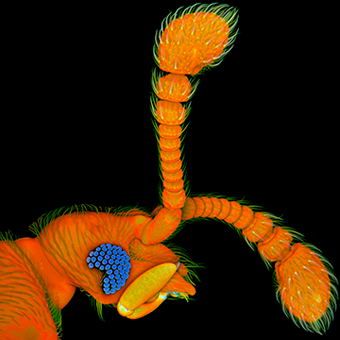
- [1]. They feature a great diversity including well-known examples such as elastin, titin and fibrillin present in vertebrate muscles and connective tissues, byssus and abductin of bivalve molluscs and gluten of wheat [1]. Besides spider silk proteins, resilin is certainly the best-known among the


Multifunctional layered magnetic composites
Beilstein J. Nanotechnol. 2015, 6, 134–148, doi:10.3762/bjnano.6.13
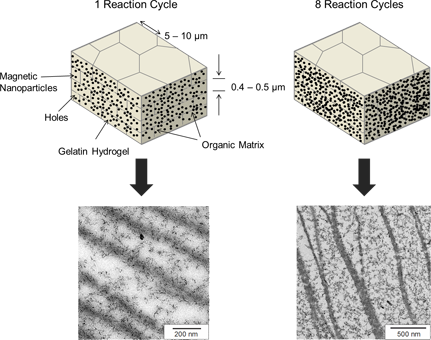
- that are found in hard coatings or in the field of construction. We used the organic nacre matrix of the shell Haliotis laevigata, which is insoluble in acetic acid, as a confined reaction environment. Within this organic matrix we infiltrated gelatin to mimic the silk gel precursor inside the chitin





Aquatic versus terrestrial attachment: Water makes a difference
Beilstein J. Nanotechnol. 2014, 5, 2424–2439, doi:10.3762/bjnano.5.252
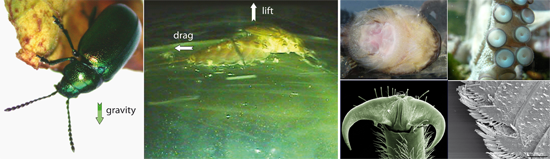
- their secretion [22]. They are also able to secrete a sticky thread that helps them to reattach themselves again if swept away [55]. Some cased caddis larvae anchor their cases more or less permanently to the substrate with silk [56]. The invasive zebra mussel has become abundant on rocks and man-made
- such as Chironomidae, Diamesinae, Simuliidae and Deuterophlebiidae [79]. While the hook circlets of the Simuliidae are only engaged in secreted silk mats, those of the Deuterophlebiidae are used directly on the stones. In contrast to the clamp mechanism, in the spacer principle the hooks press


Protein-coated pH-responsive gold nanoparticles: Microwave-assisted synthesis and surface charge-dependent anticancer activity
Beilstein J. Nanotechnol. 2014, 5, 1452–1462, doi:10.3762/bjnano.5.158
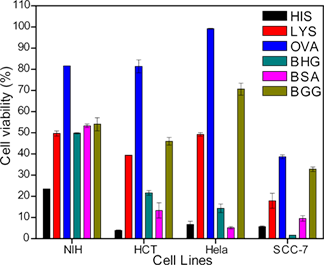
- ]. Biomolecules have been reported to interact with gold salts and reduce them into metallic gold, acting both as a reductant and stabilizer [12][17][18][19][20][21]. Proteins, such as bovine serum albumin, silk fibroin protein, chicken egg white lysozyme, α-amylase, green fluorescent protein and apoferritin have


Molecular dynamics simulations of mechanical failure in polymorphic arrangements of amyloid fibrils containing structural defects
Beilstein J. Nanotechnol. 2013, 4, 429–440, doi:10.3762/bjnano.4.50
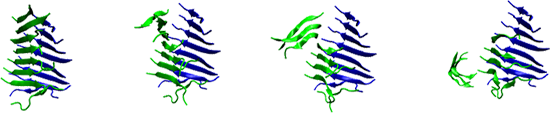
- ], investigated fibril failure under tensile loading [21], revealed that geometrical confinement of β-sheets in spider silk leads to mechanical enhancement [22], and highlighted the role played by the peptide sequence on the mechanical resistance of amylin-derived fibrils [23]. In this work, three polymorphs of


High-resolution nanomechanical analysis of suspended electrospun silk fibers with the torsional harmonic atomic force microscope
Beilstein J. Nanotechnol. 2013, 4, 243–248, doi:10.3762/bjnano.4.25
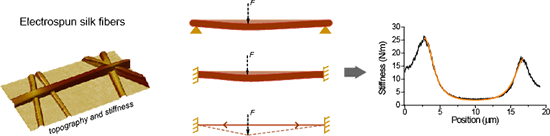
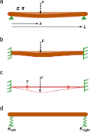
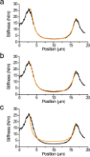
- the influence of tension and bending modulus on the response of the suspended structures. Here we report mechanical measurements on electrospun silk fibers with various treatments that allow discriminating among the different mechanisms that determine the mechanical behavior of these complex
- structures. In particular we were able to identify the role of tension and boundary conditions (pinned versus clamped) in determining the mechanical response of electrospun silk fibers. Our findings show that high-resolution mechanical imaging with torsional harmonic atomic force microscopy provides a
- reliable method to investigate the mechanics of materials with complex geometries. Keywords: atomic force microscopy; nanomechanical characterization; silk fibers; tissue scaffolds; torsional harmonic cantilevers; Introduction Dynamic atomic force microscopy (AFM) methods provide opportunities for high


Self-organizing bioinspired oligothiophene–oligopeptide hybrids
Beilstein J. Nanotechnol. 2011, 2, 525–544, doi:10.3762/bjnano.2.57
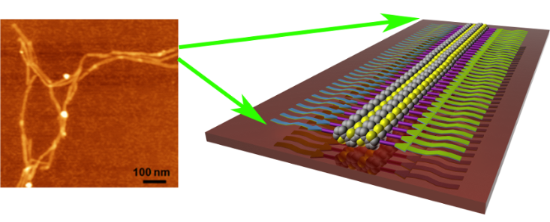
- of fibril formation. Future work should be aimed towards the development of new ways for the formation of semiconducting fiber-like supramolecular structures with mechanical properties mimicking those of natural materials such as silk or amyloid fibers. The idea is to obtain conductive materials with




Other Beilstein-Institut Open Science Activities



