


Search results
Search for "silver NPs" in Full Text gives 31 result(s) in Beilstein Journal of Nanotechnology.
Protein corona – from molecular adsorption to physiological complexity
Beilstein J. Nanotechnol. 2015, 6, 857–873, doi:10.3762/bjnano.6.88
- silver NPs it was shown that their cytotoxicity is predominantly caused by the release of silver ions even when polymer coatings were applied [25][113][153]. The somewhat independent modes of action of the NP surface and the core need therefore to be considered in detail to assess the biological impact



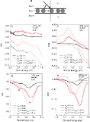
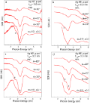
Influence of size, shape and core–shell interface on surface plasmon resonance in Ag and Ag@MgO nanoparticle films deposited on Si/SiOx
Beilstein J. Nanotechnol. 2015, 6, 404–413, doi:10.3762/bjnano.6.40
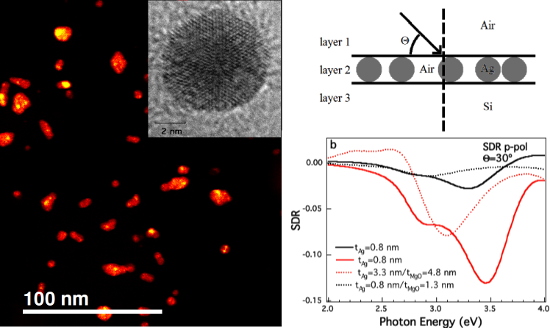
- optical behaviour of the substrate is determined by Si only, that is, that the contribution of a possible top Si oxide layer is negligible (see Supporting Information File 1). This hypothesis is reinforced by the low value of the thickness of the oxide layer estimated by XPS. The silver NPs are modelled



Nanoparticle interactions with live cells: Quantitative fluorescence microscopy of nanoparticle size effects
Beilstein J. Nanotechnol. 2014, 5, 2388–2397, doi:10.3762/bjnano.5.248
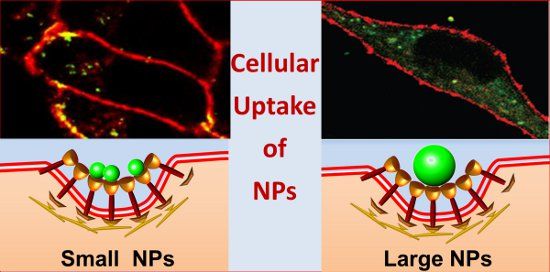
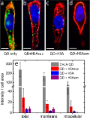
- clathrin-dependent pathways. In agreement with our results, other studies also showed that clathrin-dependent uptake plays an important role in the internalization of nanoparticles, e.g., silver NPs (diameter: 50 nm) [42] and polystyrene NPS (diameter: 40 nm) [43]. The presence of dynasore also reduced the


Localized surface plasmon resonances in nanostructures to enhance nonlinear vibrational spectroscopies: towards an astonishing molecular sensitivity
Beilstein J. Nanotechnol. 2014, 5, 2275–2292, doi:10.3762/bjnano.5.237
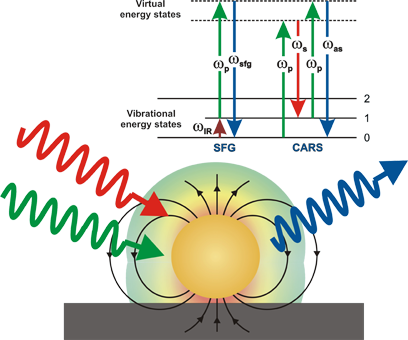
- nanoparticles directly into the liquid [79]. Although the phase matching condition was not fulfilled, the average particle spacing had been adjusted such as to be smaller than the coherence length, while the pump wavelength was matching the localized surface plasmon resonance of the silver NPs. In this first




The surface properties of nanoparticles determine the agglomeration state and the size of the particles under physiological conditions
Beilstein J. Nanotechnol. 2014, 5, 1774–1786, doi:10.3762/bjnano.5.188
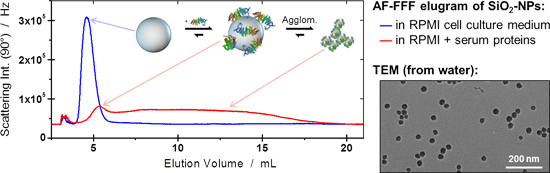
- hydrodynamic radius of 57 nm and 69 nm for the aggregate component. As these sizes are not superposed by the scattering signal of proteins, this observation gives evidence of a reduced diameter for the samples PEG@POS-NH2Q1 and PEG@POS-NH2Q2 in presence of proteins. For silver NPs, an additional sterical


Synthesis of embedded Au nanostructures by ion irradiation: influence of ion induced viscous flow and sputtering
Beilstein J. Nanotechnol. 2014, 5, 105–110, doi:10.3762/bjnano.5.10
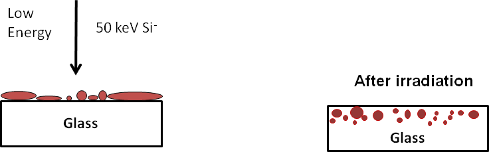
- this problem. Stepanov et al. [22] have shown that the implantation of 60 keV Ag ions with fluences of (2–4) × 1016 ions/cm2 leads to the formation of silver NPs in glass near room temperature. It has been shown that Au atoms get buried [10] during the ion beam irradiation of thin films. Ion beam


Other Beilstein-Institut Open Science Activities



