


Search results
Search for "specific heat" in Full Text gives 31 result(s) in Beilstein Journal of Nanotechnology.
Structural, optical, opto-thermal and thermal properties of ZnS–PVA nanofluids synthesized through a radiolytic approach
Beilstein J. Nanotechnol. 2015, 6, 529–536, doi:10.3762/bjnano.6.55
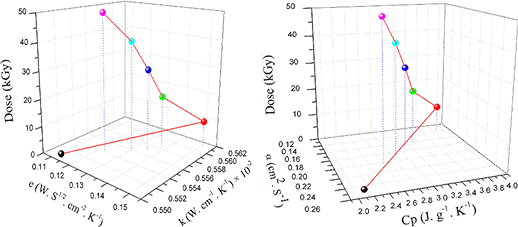
- effusivity of the samples, from which, for the first time, the values of specific heat and thermal diffusivity of the samples were then calculated. Keywords: Fourier transform infrared spectroscopy (FTIR); specific heat; thermal conductivity; thermal effusivity; ZnS nanoparticles; Introduction Over the
- technique for these measurements. It has the advantage of being a non-radiative de-excitation process following the absorption of light [17][18]. The aforementioned methods consequently provide the possibility for calculating specific heat (Cp) and thermal diffusivity (α). In this work, structural, optical
- nanofluids in which thermal diffusivity and specific heat of nanofluids were calculated by using formerly known values of thermal conductivity and effusivity, which were acquired by using transient hot wire (THW) and photoacoustic methods. Results and Discussion According to [19], the interaction of gamma


Synthesis of Pt nanoparticles and their burrowing into Si due to synergistic effects of ion beam energy losses
Beilstein J. Nanotechnol. 2014, 5, 1864–1872, doi:10.3762/bjnano.5.197
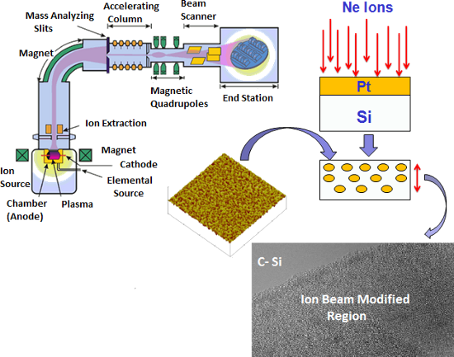
- /cm2 in a sample of 1 cm2 area) and the specific heat of silicon (710 J/kg∙K), we expected the target temperature to be at ≈500 K at the end of the irradiation [39]. The radiation and the heat conduction losses were not considered in the calculation. The diffusivity (D) of Pt in silicon at 500 K is ≈3
- combination is 846/ion (TRIM calculations). Using the thermal properties of silicon (a specific heat of 710 J/kg∙K and a thermal conductivity of 150 W/m∙K) and electronic energy deposited by the ions in silicon, we expect a spike temperature of about ≈2540 K (within 1 ps and 1 nm away from the ion track) [44

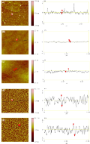


A study on the consequence of swift heavy ion irradiation of Zn–silica nanocomposite thin films: electronic sputtering
Beilstein J. Nanotechnol. 2014, 5, 1691–1698, doi:10.3762/bjnano.5.179
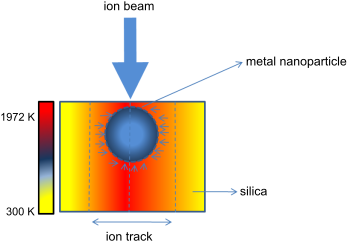
- coupling factor (g) is given as [9] where De is the thermal diffusivity and Ce is the specific heat of the electronic system, λ is the mean free path of the excited electrons of the target. In the case of metals g is weak compared to insulators such as silica [40]. When a bulk metal is irradiated with SHI


Nanoscale particles in technological processes of beneficiation
Beilstein J. Nanotechnol. 2014, 5, 458–465, doi:10.3762/bjnano.5.53
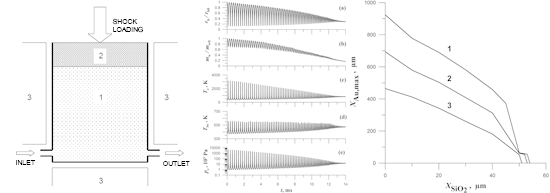
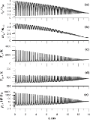
- the van der Waals gas, cv is the specific heat capacity for a constant volume, eint(T) is the energy of the unit of gas mass related to the internal degrees of freedom of molecules, R = k/M is the universal gas constant, M is the molecule mass, and k is Boltzmann constant. The liquid temperature
- variations are determined by the set of thermal conductivity equations: where ml is the Lagrangian (mass) coordinate in the region of the presence of the liquid. Tl, cl(Tl), and λl(Tl) are the temperature, the specific heat capacity, and the coefficient of the thermal conductivity of the liquid, respectively


Mapping of plasmonic resonances in nanotriangles
Beilstein J. Nanotechnol. 2013, 4, 588–602, doi:10.3762/bjnano.4.66
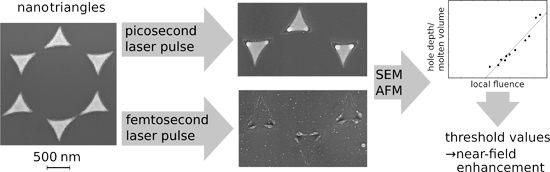
- conductivity; cp: specific heat capacity; ρ: mass density). For higher intensities, larger parts of the triangles melt. In analogous to fs pulses there is an intensity regime where the nanostructures are removed by the laser irradiation without causing major damage on the Si substrate surface. The removal


Mechanical and thermal properties of bacterial-cellulose-fibre-reinforced Mater-Bi® bionanocomposite
Beilstein J. Nanotechnol. 2013, 4, 325–329, doi:10.3762/bjnano.4.37
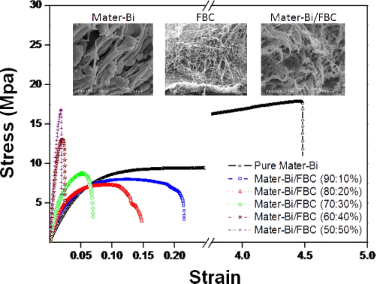
- . The average sample weights of approximately 15.0–17.5 mg were placed in the aluminium crucible. Heating rates of 20 °C min−1 were used in the temperature range 20–400 °C. The crystallinity (Tc) and melting temperature (Tm) were recorded as the inflection point of the increment of specific heat and as


Other Beilstein-Institut Open Science Activities



