


Search results
Search for "stick–slip" in Full Text gives 30 result(s) in Beilstein Journal of Nanotechnology.
Friction behavior of a microstructured polymer surface inspired by snake skin
Beilstein J. Nanotechnol. 2014, 5, 83–97, doi:10.3762/bjnano.5.8
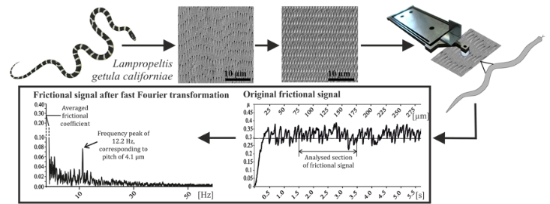
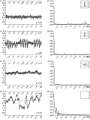
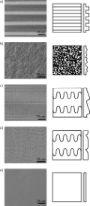
- other peaks resulting from periodic stick-slip behavior. The data showed that the specific ventral surface ornamentation of snakes does not only reduce the frictional coefficient and generate anisotropic frictional properties, but also reduces stick-slip vibrations during sliding, which might be an
- adaptation to reduce wear. Based on this extensive comparative study of different microstructured polymer samples, it was experimentally demonstrated that the friction-induced stick-slip behavior does not solely depend on the frictional coefficient of the contact pair. Keywords: fast Fourier transformation
- ; friction; polymer; snake inspired; stick-slip; Introduction The absence of extremities in snakes has strong tribological consequences for the material of their skin. The ventral body side of the snake is in continuous contact with the substrate. Therefore ventral scales must have optimized frictional




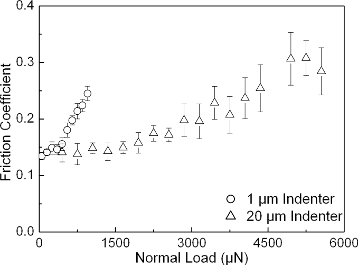
Effect of normal load and roughness on the nanoscale friction coefficient in the elastic and plastic contact regime
Beilstein J. Nanotechnol. 2013, 4, 66–71, doi:10.3762/bjnano.4.7
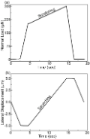
- normal load of the instrument, i.e., 10 mN, or the first segment that featured a maximum lateral-load difference larger than its segment size. The latter case usually can be attributed to some stick–slip event, which will contain a strong influence of the properties of the transducers spring setup


Manipulation of gold colloidal nanoparticles with atomic force microscopy in dynamic mode: influence of particle–substrate chemistry and morphology, and of operating conditions
Beilstein J. Nanotechnol. 2011, 2, 85–98, doi:10.3762/bjnano.2.10
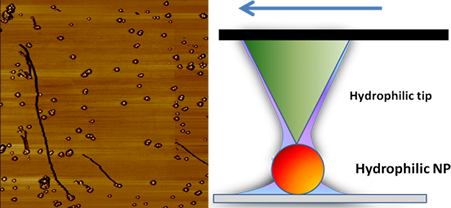
- different types of particle motion during manipulation, such as sliding, rolling, stick-slip and spinning, is crucial since the mode of motion of particles determines the energy loss and wear in the contacting surfaces. In this paper, the sensitivity of those critical parameters on the mobility of gold


The description of friction of silicon MEMS with surface roughness: virtues and limitations of a stochastic Prandtl–Tomlinson model and the simulation of vibration-induced friction reduction
Beilstein J. Nanotechnol. 2010, 1, 163–171, doi:10.3762/bjnano.1.20
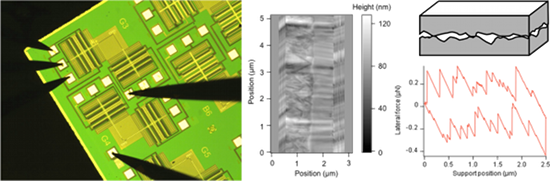
- with individual atoms or a small part of a crystal lattice on the Ångstrom scale. It was found that regular, repeatable stick-slip behaviour of a contacting highest point (asperity) over the lattice of the other surface forms the very basis of the frictional processes as previously described [2][3]. To
- physically describe the stick-slip behaviour observed, the theories of Prandtl [4] and Tomlinson [5] were used [6][7]. This Prandtl–Tomlinson model has proven to be remarkably effective in describing atomic-scale friction. Further research on atomic-scale friction has resulted in a wealth of information on
- and wear problems [12]. The question is now how to describe friction on the larger scale of actual MEMS devices, which pair micrometer features and nanometer-scale surface roughness with nano- to micro-Newton forces. This friction is characterized by irregular, but repeatable, stick-slip motion. Can


Scanning probe microscopy and related methods
Beilstein J. Nanotechnol. 2010, 1, 155–157, doi:10.3762/bjnano.1.18

- studied in great detail, where the main mechanism is related to atomic instabilities, which lead to the characteristic stick slip behaviour. The loading and velocitiy dependence were interpreted in terms of a thermally activated Prandtl–Tomlinson-model [5][6]. The transition into the superlubricity regime

Other Beilstein-Institut Open Science Activities



