


Search results
Search for "surface wettability" in Full Text gives 29 result(s) in Beilstein Journal of Nanotechnology.
Nanostructured surfaces by supramolecular self-assembly of linear oligosilsesquioxanes with biocompatible side groups
Beilstein J. Nanotechnol. 2015, 6, 2377–2387, doi:10.3762/bjnano.6.244
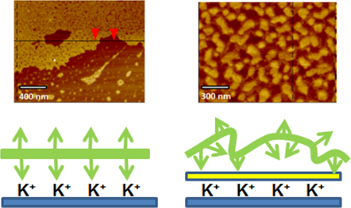
- underlying matrix. For example, surfaces carrying COOH groups were applied for studies on the effect of surface wettability on protein adsorption and adhesion of human umbilical vein endothelial cells (HUVECs) and HeLa cells [3], human fibroblasts [14], human mesenchymal stem cells [15][22], corneal
- structures by COOH groups, which was recently reported as the cause for the decrease of surface wettability [38]. The extent of the surface-guided organization of P1 directs its arrangement on the support and changes of the surface energy (Figure 10b,c). P2, in spite of the apparent lack of lamellar




Formation of stable Si–O–C submonolayers on hydrogen-terminated silicon(111) under low-temperature conditions
Beilstein J. Nanotechnol. 2015, 6, 19–26, doi:10.3762/bjnano.6.3
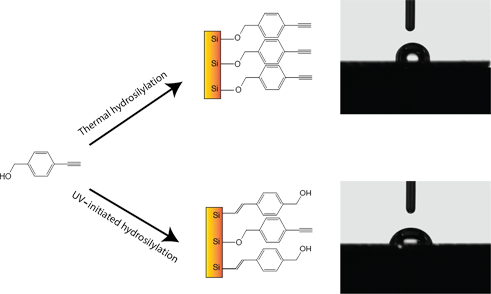
- sensible explanation for this was that both Si–O–C and Si–C linkages were formed on the surface, thus creating a patchy surface with an intimate mixture of moieties exposing hydroxy or alkyne groups. This would certainly reduce the surface wettability as reported in previous reports on heterogeneous


The study of surface wetting, nanobubbles and boundary slip with an applied voltage: A review
Beilstein J. Nanotechnol. 2014, 5, 1042–1065, doi:10.3762/bjnano.5.117
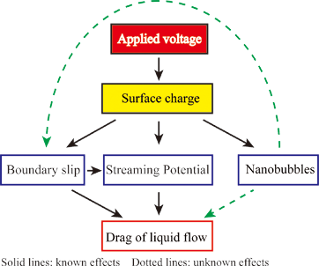
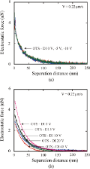
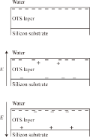
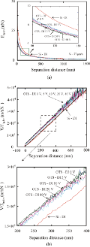
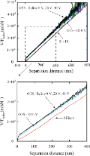
- this review, the influence of an applied voltage on the surface wettability, nanobubbles, surface charge density and slip length are discussed. The contact angle (CA) and contact angle hysteresis (CAH) of a droplet of deionized (DI) water on a hydrophobic polystyrene (PS) surface were measured with
- liquid, surface wetting, surface charge, nanobubbles and boundary slip are believed to affect the drag of liquid flow [3][4][5][6][7][8][9][10]. By applying a voltage to the system, the surface wettability can be changed, known as electrowetting, and the surface charge density can be changed as well [11
- ]. Nanobubbles and boundary slip are believed to have a strong influence on surface wettability and surface charge [12][13][14][15][16][17]. It can be inferred that when a voltage is applied, the surface wettability, surface charge, nanobubbles and boundary slip will be changed, which causes the change in the










Approaches to nanostructure control and functionalizations of polymer@silica hybrid nanograss generated by biomimetic silica mineralization on a self-assembled polyamine layer
Beilstein J. Nanotechnol. 2011, 2, 760–773, doi:10.3762/bjnano.2.84
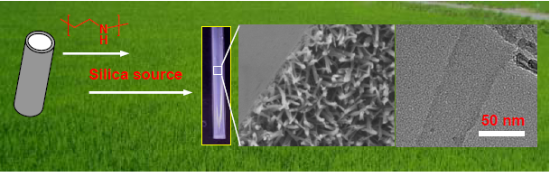
- , nanostructured thin films on substrates with tunable nanostructure and surface morphology are of great importance for various applications, such as photoelectronics [1], high-efficiency sensing and bioanalysis [2][3], protein adsorption [4], cell growth [5], surface wettability control [6] and liquid
- synthesis of functional silica-based nanosurfaces. Silica@titania composite nanograss and photoresponsive surface wettability Finally, we attempted using LPEI in hybrid nanograss as a catalyst for titania deposition, with the aim to synthesize a silica@titania composite nanosurface after high-temperature
- ambient conditions, exhibits photoresponsive surface wettability through hydrophobic modification and light irradiation [44]. However, this surface failed to be superhydrophobic (i.e., water contact angle >150°) probably due to the relatively low surface roughness. In this work, by depositing the titania


Other Beilstein-Institut Open Science Activities



