


Search results
Search for "symmetry-breaking" in Full Text gives 30 result(s) in Beilstein Journal of Nanotechnology.
Enhanced fullerene–Au(111) coupling in (2√3 × 2√3)R30° superstructures with intermolecular interactions
Beilstein J. Nanotechnol. 2015, 6, 1421–1431, doi:10.3762/bjnano.6.147

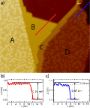
- bond in combination with Au adatoms. Most interestingly, a symmetry breaking is observed in this u-R30° structure due to the adsorption of C60 molecules with the 5:6 C–C bond (with one mirror plane as symmetry element) on a surface position with a C3-axis as symmetry element. With respect to the C60
- the Fermi energy of the metal, like observed here. Furthermore, a newly created adatom–C60 unit may be polar and therefore, would give rise to intermolecular dipol–dipol interactions. These polar interactions in combination with the symmetry breaking are assumed to result in the formation of a polar
- adatoms. The observed symmetry breaking causes the lifting of the degeneracy of the LUMO and LUMO+1 orbitals in the differential conductance spectra. In addition, hybrid fullerene–metal states are identified and attributed to partly covalent interactions between adatoms on the Au(111) surface and C60



Nanoparticle shapes by using Wulff constructions and first-principles calculations
Beilstein J. Nanotechnol. 2015, 6, 361–368, doi:10.3762/bjnano.6.35
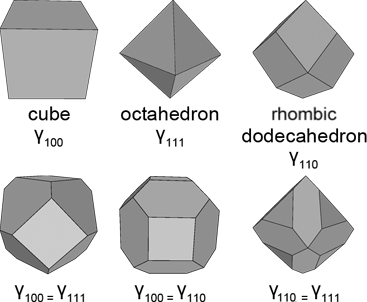
- , experimentally it has been found that objects such as nanorods can be systematically produced with an adequate selection of the solution growth. In that case the symmetry breaking appears very early in the formation of the seed as then some of the facets (but not all those equivalent by symmetry) can be blocked



Quasi-1D physics in metal-organic frameworks: MIL-47(V) from first principles
Beilstein J. Nanotechnol. 2014, 5, 1738–1748, doi:10.3762/bjnano.5.184
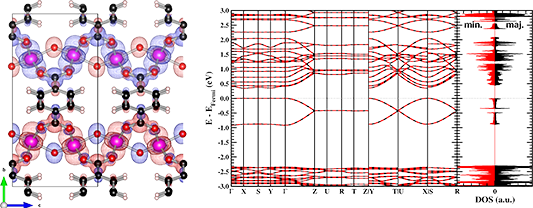
- MIL-47(V) structure is the symmetry breaking in the V-chain. Whereas for the as-synthesized version all V atoms are positioned on a straight line, the V atoms exhibit a zig-zag configuration in the b–c-plane of the calculated structure. Although the separation in the b-direction (bVV) is rather small
- in absolute value (cf. Table 2), the resulting improvement in energy due to this symmetry breaking is about 300 meV for the 72-atom unit cell used. A more detailed investigation of the crystal geometry, presented in Table 2, shows that the vanadium–oxygen chains present almost identical bond lengths


Sublattice asymmetry of impurity doping in graphene: A review
Beilstein J. Nanotechnol. 2014, 5, 1210–1217, doi:10.3762/bjnano.5.133
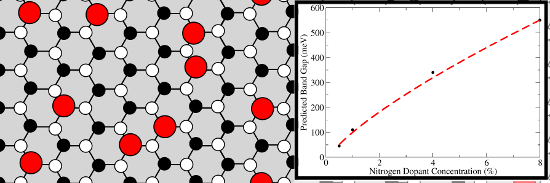
- segregation effect It is clear that any degree of asymmetry between the two equivalent sublattices is the result of a symmetry breaking operation. Current theoretical attempts to explain the sublattice asymmetry in the nitrogen doping seen in the experiments discussed in the previous section suggest that the
- effect comes from either the energetically preferable positioning of nitrogen on the graphene edge during the growth process [41][42], where the symmetry breaking effect is the edge structure, or from inter-impurity interactions in the impurity ensemble [39][43] where the symmetry is broken by the
- that the electrons in the former kind of device will be subjected to less scattering leading to an increase in the quantum conductance, closer to that of the pristine system when subjected to a positive bias. It should also be noted that that symmetry breaking in nanoribbons occurs via edge effects and


Dye-doped spheres with plasmonic semi-shells: Lasing modes and scattering at realistic gain levels
Beilstein J. Nanotechnol. 2013, 4, 974–987, doi:10.3762/bjnano.4.110
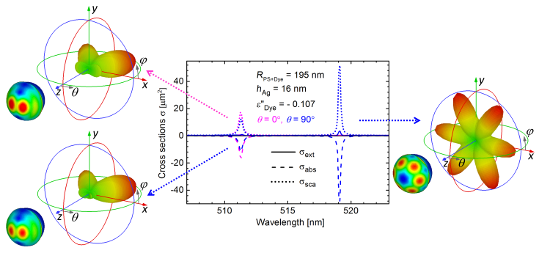
- -shell modes by slowly opening the closed shell. Labeling is hence carried out by using the multipolar and azimuthal numbers (l,m) [7][11]. While in a spherically symmetric shell, each multipolar mode is (2l+1) times degenerate, the symmetry breaking that is introduced by opening a hole in the shell not
- this experimental study were, however, fully spherically symmetric. Very recently, it has been proposed that symmetry breaking might have advantages because a low gain threshold is required [50] and the coherent emission becomes directional [51]. In both theoretical papers, a geometry was assumed, in




Other Beilstein-Institut Open Science Activities



