


Search results
Search for "thiourea" in Full Text gives 28 result(s) in Beilstein Journal of Nanotechnology.
Liquid fuel cells
Beilstein J. Nanotechnol. 2014, 5, 1399–1418, doi:10.3762/bjnano.5.153
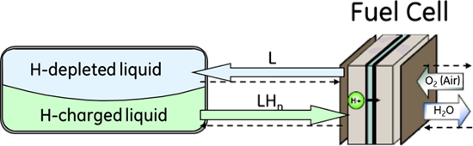
- towards hydrolysis turned out to be more efficient catalysts than platinum. Thiourea, a known hydrogen evolution inhibitor, was also used as an additive to increase the coulombic efficiency [181]. Nanoporous gold electrodes prepared by extracting Ag from an AgAu alloy catalyze the oxidation of AB at a

Template based precursor route for the synthesis of CuInSe2 nanorod arrays for potential solar cell applications
Beilstein J. Nanotechnol. 2013, 4, 868–874, doi:10.3762/bjnano.4.98
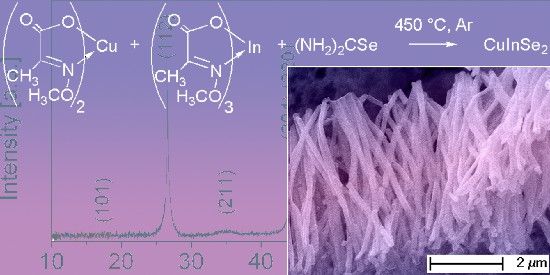
- indirectly confirmed the flexibility of the solution route in preparation of semiconductors with controlled elemental composition. We recently successfully demonstrated electroless deposition of molecular precursors (Cu- and In-oximato complexes and thiourea) into track-etched polycarbonate templates and the
- synthesis of stoichiometric ternary CuInS2 nanorod arrays [9]. In the present work, we extend our method to the photochemically even more active CuInSe2 material and demonstrate the synthesis of uniform polycrystalline CuInSe2 nanorod arrays. Selenourea was used as a Se source analogous to thiourea in our


Junction formation of Cu3BiS3 investigated by Kelvin probe force microscopy and surface photovoltage measurements
Beilstein J. Nanotechnol. 2012, 3, 277–284, doi:10.3762/bjnano.3.31
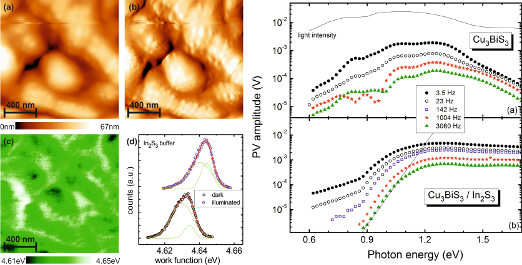
- solution containing thiourea (Scharlau) and cadmium chloride (CdCl2) (Merck) as sources of S2− and Cd2+, respectively. The thickness of the films was ~80 nm, as measured with a Veeco Dektak 150 surface profiler. For specific experimental conditions see [22]. ZnS films were grown by coevaporation of


Other Beilstein-Institut Open Science Activities



