


Search results
Search for "zirconium" in Full Text gives 33 result(s) in Beilstein Journal of Nanotechnology.
Template-directed synthesis and characterization of microstructured ceramic Ce/ZrO2@SiO2 composite tubes
Beilstein J. Nanotechnol. 2014, 5, 1152–1159, doi:10.3762/bjnano.5.126
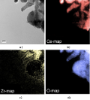
- zirconium are found on the surface of the spherical Stoeber particles, which indicates that, primarily, the intersticial volume between the silica particles is filled (see Figure 3 TEM and Figure 6 EFTEM). This fact becomes especially obvious when comparing the EFTEM Zr- and O-maps (Figure 6c,d). In order
- composition Ce0.13/Zr0.87O2 in the dimples between individual silica spheres the corresponding intensity maxima of these elements are found between the spheres. In contrast, the zirconium and oxygen peak intensities have their respective minima between the spheres. This corroborates in an analytical way what
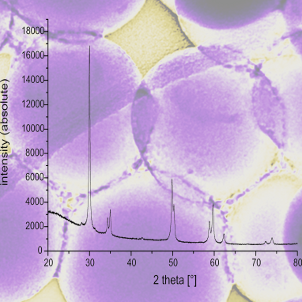
- has been assumed by HSEM and in HRTEM. Moreover, the intensity of cerium compared to zirconium in the elemental EDX scan is significantly lower, which reflects the phase composition as found by PXRD and Raman spectroscopy. Conclusion A template-directed synthesis was employed for the synthesis of




Organic and inorganic–organic thin film structures by molecular layer deposition: A review
Beilstein J. Nanotechnol. 2014, 5, 1104–1136, doi:10.3762/bjnano.5.123
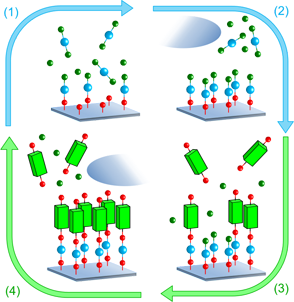
- (Zn(C2H5)2, DEZ), titanium tetrachloride (TiCl4) and zirconium tert-butoxide (Zr(CH4H9O)4, ZTB) as the inorganic precursors the growth processes have yielded r values of 0.6 0.1, 0.6 and 0.2, respectively [12][51][52][53][54]. In case of the aromatic precursor benzene-1,4-diol (hydroquinone, HQ), r
- ., about 8 GPa and about 0.25 GPa, respectively [53]. Zircone thin films have been fabricated by using EG together with zirconium tert-butoxide (ZTB) [54][87]. The depositions were carried out in the temperature range of 105–195 °C. The GPC decreased with increasing deposition temperature, from 1.6 to 0.3




Dry friction of microstructured polymer surfaces inspired by snake skin
Beilstein J. Nanotechnol. 2014, 5, 1091–1103, doi:10.3762/bjnano.5.122

- originated from moulds of polishing paper (FibrMet Discs, Buehler GmbH, Düsseldorf, Germany) with different grain sizes (Ra: 0.3 µm, 1 µm, 3 µm, 9 µm, and 12 µm) (Figure 3b). The master for the third type of surfaces was produced from zirconium oxide surface microstructured by femtosecond laser ablation


Characterization and photocatalytic study of tantalum oxide nanoparticles prepared by the hydrolysis of tantalum oxo-ethoxide Ta8(μ3-O)2(μ-O)8(μ-OEt)6(OEt)14
Beilstein J. Nanotechnol. 2014, 5, 1082–1090, doi:10.3762/bjnano.5.121
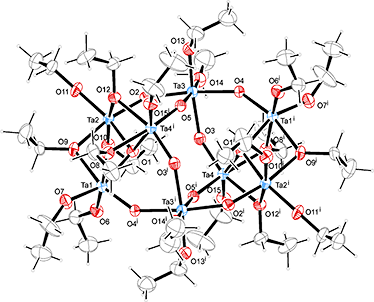
- then forms the oxo derivative in a condensation step (Equation 1 and Equation 2). The investigation of the hydrolysis of titanium alkoxides showed that the reactions were very fast. Therefore the initial hydroxo compounds were not isolated [10]. Similar results were obtained for alkoxides of zirconium


Functionalized nanostructures for enhanced photocatalytic performance under solar light
Beilstein J. Nanotechnol. 2014, 5, 994–1004, doi:10.3762/bjnano.5.113
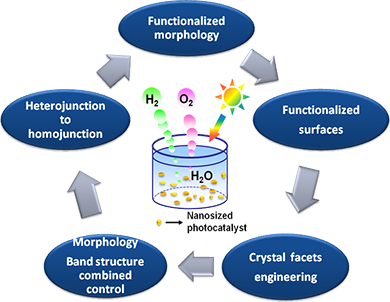
- band structure of the solid solution was similarly affected. Mesoporous zirconium–titanium mixed phosphates (ZTP) is also a photocatalyst of interest as they not only show both cation- and anion-exchange capacity, but also can split pure water for hydrogen production under UV light irradiation [59


Confinement dependence of electro-catalysts for hydrogen evolution from water splitting
Beilstein J. Nanotechnol. 2014, 5, 195–201, doi:10.3762/bjnano.5.21
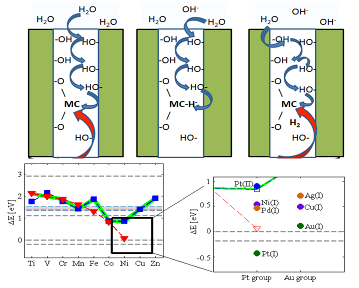
- assembly for the cathode process during water splitting. A computational model was designed to determine how alloying elements control the fraction of H2 released during zirconium oxidation by water relative to the amount of hydrogen picked up by the corroding alloy. This model is utilized to determine the
- descriptor for the electro-catalytic hydrogen evolution reaction (HER). It offers a complementary perspective on a recent study addressing the oxidation of zirconium alloys by water [4][5]. The overall reaction is taken to occur by water utilizing hydrolysis to penetrate the oxide scale along hydroxylated
- grain boundaries, see Figure 1a, These hydroxide ions subsequently react with transition metal decorated sites (see Figure 1a) and zirconium metal to produce ZrO2 in conjunction with transient transition metal associated hydride-proton (hydroxide) pairs (see Figure 1b) to restore the ZrO2 grain boundary


Novel composite Zr/PBI-O-PhT membranes for HT-PEFC applications
Beilstein J. Nanotechnol. 2013, 4, 481–492, doi:10.3762/bjnano.4.57
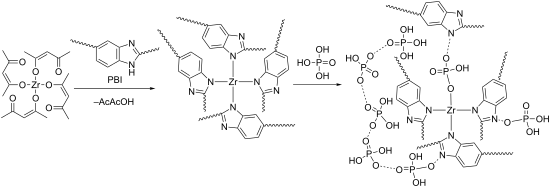
- amounts of added Zr were prepared. It was shown in a model reaction between zirconium acetylacetonate (Zr(acac)4) and benzimidazole (BI) that Zr-atoms are capable to form chemical bonds with BI. Thus, Zr may be used as a crosslinking agent for PBI membranes. The obtained Zr/PBI-O-PhT composite membranes
- reduced conductivity due to an excessively high degree of crosslinking. Keywords: composite; high temperature polymer-electrolyte fuel cells (HT-PEFC); impedance spectroscopy; polybenzimidazole (PBI); zirconium; Introduction Polymer-electrolyte fuel cells (PEFC) based on polybenzimidazole (PBI
- compounds (zirconium pyrophosphate [15], zirconium tricarboxybutylphosphonate [16][17]) were introduced into PBI membranes. According to the literature, researchers generally use quite high amounts (10–50%) of modifying agents when producing composite membranes. Such high amounts are required to achieve an


Zirconium nanoparticles prepared by the reduction of zirconium oxide using the RAPET method
Beilstein J. Nanotechnol. 2011, 2, 198–203, doi:10.3762/bjnano.2.23
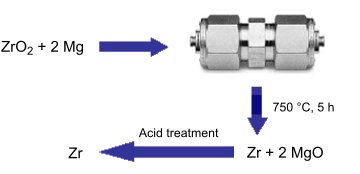
- elemental analysis. The XRD pattern reveals that the product is composed of pure metallic zirconium, without any traces of the MgO by-product. Keywords: Let-Lok®; nanoparticles; RAPET; reduction; zirconium; Introduction Zirconium is a strong transition metal that resembles titanium. Because of its strong
- mainly from the mineral zircon, which can be purified with chlorine [2]. Zirconium metal is also used for making zirconium inorganic and organic compounds. Many examples of the synthesis of zirconium complexes for catalytic applications are described in the literature [3][4]. A very important example for
- the application of metallic Zr is the use of Zr nanoparticles (NP) as catalysts for growing TWCNTs (two or three graphene layer tubing) [5]. The presence of the zirconium as a catalyst ensures an effective method for the synthesis of high purity and good quality CNTs. The best known process for the



Other Beilstein-Institut Open Science Activities



