Search results
Search for "CMOS" in Full Text gives 61 result(s) in Beilstein Journal of Nanotechnology.
Possibilities and limitations of advanced transmission electron microscopy for carbon-based nanomaterials
Beilstein J. Nanotechnol. 2015, 6, 1541–1557, doi:10.3762/bjnano.6.158
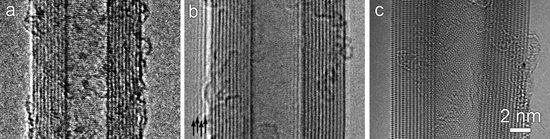
- ratio. A recent development in an advanced high-resolution fast-detection camera (K2-IS camera from Gatan Inc.) has made a significant improvement in both sensitivity and resolution by the elimination of the traditional scintillation process and the capture of electrons directly on a CMOS (complimentary


A scanning probe microscope for magnetoresistive cantilevers utilizing a nested scanner design for large-area scans
Beilstein J. Nanotechnol. 2015, 6, 451–461, doi:10.3762/bjnano.6.46
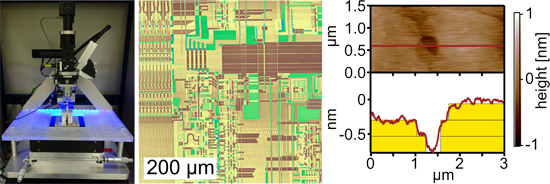
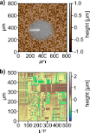
- such structures with a special large-area scanning AFM allows for inspection of a wide field of the chip architecture within one scan. Figure 4b shows a portion of the die surface of a UV-erasable CMOS EPROM memory chip (Type 27C256). The image size is 500 × 500 μm2 imaged with a resolution of 1024
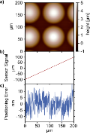
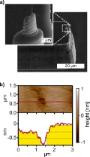
- microscope image with the AFM topography of an optical grating structure with a 256 × 256 μm2 grating periodicity. b) Large-area AFM topography image of a part of a UV-erasable CMOS EPROM memory chip with a scan size of 500 × 500 μm2. Despite the large step heights of 2 μm, there no artefacts are visible, no


Nanoporous Ge thin film production combining Ge sputtering and dopant implantation
Beilstein J. Nanotechnol. 2015, 6, 336–342, doi:10.3762/bjnano.6.32
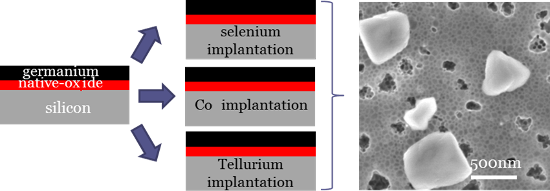
- is compatible with complementary metal oxide semiconductor (CMOS) technology, the production of porous Ge thin films could be used for integration of optoelectronic devices in Si microelectronic technology. The production of porous Ge can be performed using several techniques such as anodization and
- diffusion mechanism of Se and Te atoms [41]. Conclusion The fabrication of highly-doped, porous Ge thin films (which are of high potential use for optoelectronic device fabrication) was successfully achieved using experimental techniques compatible with Si CMOS technology. High-dose (>1015 atoms/cm2) dopant


Bright photoluminescence from ordered arrays of SiGe nanowires grown on Si(111)
Beilstein J. Nanotechnol. 2014, 5, 2498–2504, doi:10.3762/bjnano.5.259
- have been demonstrated for specific core/shell NW configurations with an ultimate control over the NW shape, aspect ratio and radial multishell composition [7]. A major asset of Si/Ge core/shell [8] and axial [9] NW heterostructures is also their ease of integration in CMOS technology, which allows the
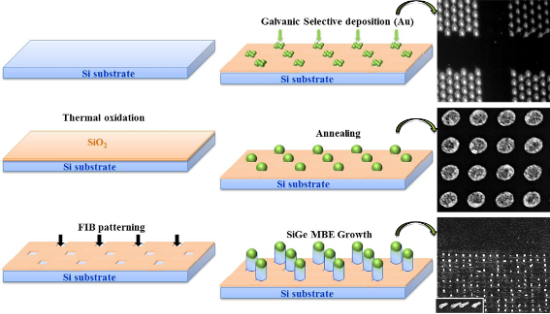
- over those produced by other vapor-solid-solid growth methods and that could be useful for applications in optoelectronic nanodevices. However, their mass production in current CMOS production lines would be problematic. Schematic representation of the process steps: (a) formation of SiO2 (5 nm thick


Electrical contacts to individual SWCNTs: A review
Beilstein J. Nanotechnol. 2014, 5, 2202–2215, doi:10.3762/bjnano.5.229
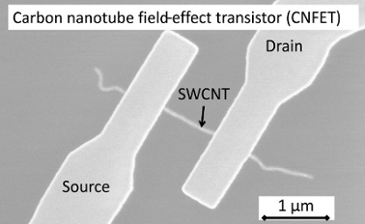
- a process flow for wafer-scale CNFET fabrication, which is compatible with the current CMOS fabrication processes, but the SWCNTs require transfer to a target wafer. The physically and chemically induced impacts on the SWCNT properties which occur during the SWCNT transfer process must be further


Advances in NO2 sensing with individual single-walled carbon nanotube transistors
Beilstein J. Nanotechnol. 2014, 5, 2179–2191, doi:10.3762/bjnano.5.227
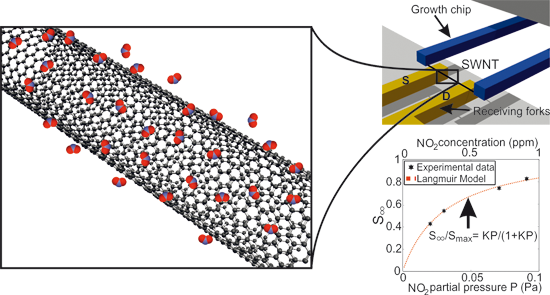
- channel and overlaps the source and drain contacts. Top-gate architectures, which have a closer resemblance to CMOS architectures, are less common for gas sensors due to the need for an exposed channel. Side-gate configurations are not typically used due to their poor gate coupling. Variants of this basic


Silicon and germanium nanocrystals: properties and characterization
Beilstein J. Nanotechnol. 2014, 5, 1787–1794, doi:10.3762/bjnano.5.189
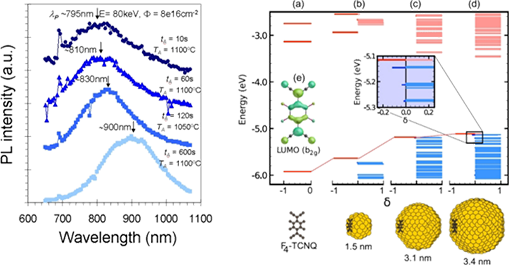
- formation and the formation of the sub-oxide interface states [23]. As ion implantation is unavoidable for CMOS technology today, it is desirable to use it not only for the fabrication of NCs but for the doping of NCs as well. Over the past decade, phosphorus-and erbium-doped Si NCs have attracted a great


Sublattice asymmetry of impurity doping in graphene: A review
Beilstein J. Nanotechnol. 2014, 5, 1210–1217, doi:10.3762/bjnano.5.133
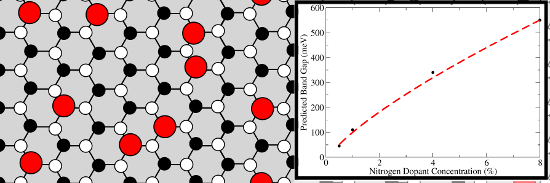
- of over 8%, where impurities are all on the same sublattice, will produce a band gap of around 550 meV far surpassing the minimum required for a CMOS [14][36] and finding that the band gap scales with concentration to the power 3/4, as shown in Figure 3. Even with a 4:1 doping ratio between


A highly pH-sensitive nanowire field-effect transistor based on silicon on insulator
Beilstein J. Nanotechnol. 2013, 4, 330–335, doi:10.3762/bjnano.4.38
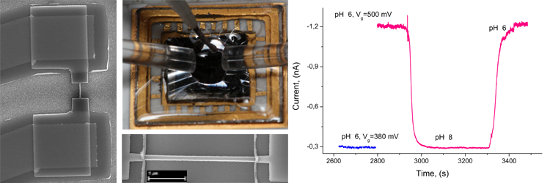
- , Moscow 119991, Russia Keldysh Institute of Applied Mathematics, Moscow 125047, Russia 10.3762/bjnano.4.38 Abstract Background: An experimental and theoretical study of a silicon-nanowire field-effect transistor made of silicon on insulator by CMOS-compatible methods is presented. Results: A maximum
- Nernstian sensitivity to pH change of 59 mV/pH was obtained experimentally. The maximum charge sensitivity of the sensor was estimated to be on the order of a thousandth of the electron charge in subthreshold mode. Conclusion: The sensitivity obtained for our sensor built in the CMOS-compatible top-down
- approach does not yield to the one of sensors built in bottom-up approaches. This provides a good background for the development of CMOS-compatible probes with primary signal processing on-chip. Keywords: charge/field sensor; field-effect transistor; nanowire; pH sensor; silicon-on-insulator


High-resolution electrical and chemical characterization of nm-scale organic and inorganic devices
Beilstein J. Nanotechnol. 2013, 4, 318–319, doi:10.3762/bjnano.4.35

- increase in “More than Moore” developments targeting energy (photovoltaic, energy storage), imaging (e.g., quantitative medical imaging), sensor/actuators linked to CMOS-base circuitry, biochips, etc. The utilization of graphene in order to process high mobility (both for holes and electrons) field-effect
Magnetic nanoparticles for biomedical NMR-based diagnostics
Beilstein J. Nanotechnol. 2010, 1, 142–154, doi:10.3762/bjnano.1.17
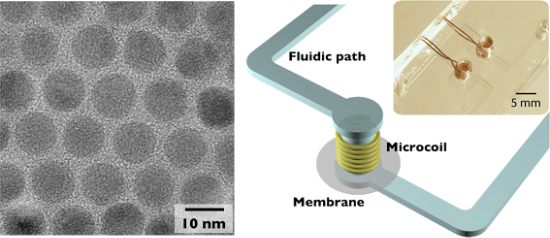
- generation and AD604 for NMR signal amplification; Analog Devices) and off-the-shelf RF components (e.g., ZAD-1 mixer, ZMSC-2 power splitter, and ZYSWA-2 RF switch; Mini-Circuits) [14]. In newer versions, these functionalities have been integrated onto a single CMOS IC chip [17][19]. This chip was designed
- the smaller magnet, this device incorporates a new RF transceiver fully integrated in the 0.18 μm CMOS. (Reproduced with permission from [14]. Copyright 2008 Nature Publishing Group. Reproduced with permission from [15]. Copyright 2009 National Academy of Sciences, USA. Reproduced with permission from