


Search results
Search for "MOFs" in Full Text gives 52 result(s) in Beilstein Journal of Nanotechnology.
Micro- and mesoporous solids: From science to application
Beilstein J. Nanotechnol. 2011, 2, 774–775, doi:10.3762/bjnano.2.85

- , geometry and pore dimensions make these materials outstanding with respect to, e.g., catalytic reaction processes, in the area of sensorics, photonics and gas storage (Figure 1). In the realm of gas storage, mesoporous metal–organic frameworks (MOFs) appeared on the scene a couple of years ago and have

On the reticular construction concept of covalent organic frameworks
Beilstein J. Nanotechnol. 2010, 1, 60–70, doi:10.3762/bjnano.1.8
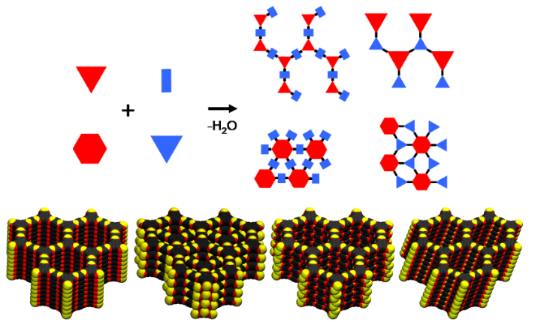
- preservation throughout the assembly process are the key factors that lead to the design and synthesis of reticular structures. One of the first families of materials synthesized using reticular chemistry were the so-called Metal-Organic Frameworks (MOFs) [4]. They are composed of metal-oxide connectors, which
- are covalently bound to organic linkers. The coordination versatility of constituent metal ions along with the functional diversity of organic linker molecules has created immense possibilities. The immense potential of MOFs is facilitated by the fact that all building blocks are inexpensive chemicals
- , and that the synthesis can be carried out solvothermally. MOFs are commercially available, and the scale up of production is continuing. Since the discovery of MOFs, many other crystalline frameworks have been synthesized using reticular chemistry, such as Metal-Organic Polyhedra (MOP) [5], Zeolite




Other Beilstein-Institut Open Science Activities



