


Search results
Search for "X-ray scattering" in Full Text gives 53 result(s) in Beilstein Journal of Nanotechnology.
Simulation of bonding effects in HRTEM images of light element materials
Beilstein J. Nanotechnol. 2011, 2, 394–404, doi:10.3762/bjnano.2.45
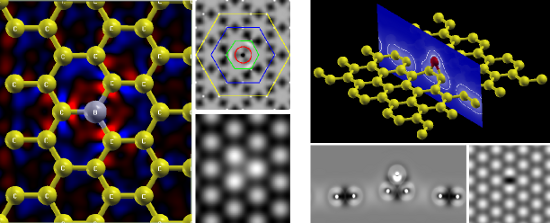
- calculation, and therefore we used the WIEN2k [20] DFT software. Furthermore, WIEN2k has the significant advantage that, besides offering access to the total electron charge density and corresponding X-ray scattering factors, in addition, the calculation of the total Coulomb potential (including all electrons
- and nuclei within the unit cell) is already implemented. Deng and Marks [8] used the X-ray scattering factors, while our method directly makes use of the available potential file. A very important cross-check is to compare the WIEN2k potential to other potentials used in HRTEM simulations. This is


Studies towards synthesis, evolution and alignment characteristics of dense, millimeter long multiwalled carbon nanotube arrays
Beilstein J. Nanotechnol. 2011, 2, 293–301, doi:10.3762/bjnano.2.34
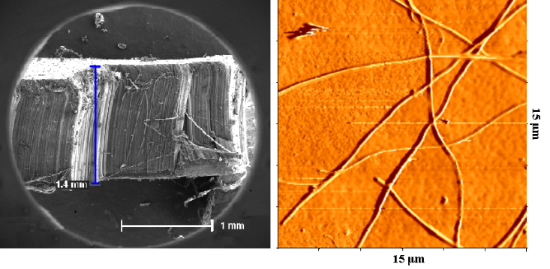
- spectroscopically by small angle X-ray scattering (SAXS) studies. Based on electron diffraction scattering (EDS) studies of the top and the base of the CNT films, a root growth process can be deduced. Keywords: carbon nanotubes; characterization; synthesis; Introduction CNTs have been extensively studied in


Ultrafine metallic Fe nanoparticles: synthesis, structure and magnetism
Beilstein J. Nanotechnol. 2010, 1, 108–118, doi:10.3762/bjnano.1.13
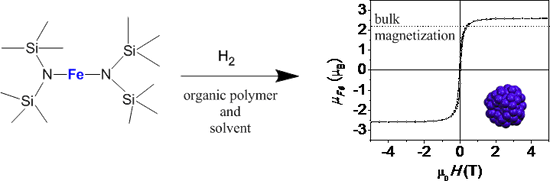
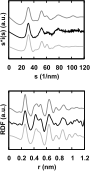
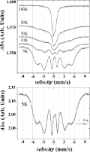
- , monodisperse, with a diameter below 2 nm, which corresponds to a number of around 200 atoms. The X-ray absorption near-edge structure and Mössbauer spectrum are characteristic of metallic Fe. The structural studies by wide angle X-ray scattering indicate an original polytetrahedral atomic arrangement similar
- synthesis of well-isolated Fe NPs embedded in a polymer, with diameters of less than 2 nm. The structural and chemical properties have been investigated by transmission electron microscopy, wide angle X-ray scattering (WAXS), and X-ray absorption near-edge structure (XANES). Preliminary results of this work
- oxidation. The particles were characterized by transmission electron microscopy (TEM), wide angle X-ray scattering (WAXS) [22], and X-ray absorption near-edge structure (XANES). TEM micrographs show the presence of well-dispersed small particles of ca. 1.8 nm mean size with a narrow size distribution (15





Other Beilstein-Institut Open Science Activities



