Search results
Search for "adhesion force" in Full Text gives 60 result(s) in Beilstein Journal of Nanotechnology.
Exploring the complex mechanical properties of xanthan scaffolds by AFM-based force spectroscopy
Beilstein J. Nanotechnol. 2014, 5, 365–373, doi:10.3762/bjnano.5.42
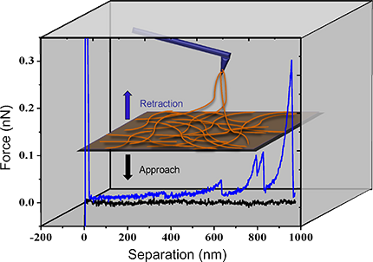
- the AFM tip. The tiny mechanical response is due to the adhesion force between the overlapping fibrils. As a more complex example, the inset of Figure 7B illustrates the case in which the tip fished two fibrils, one of which detached from a third underlying fibril before the two fibrils ruptured from


Exploring the retention properties of CaF2 nanoparticles as possible additives for dental care application with tapping-mode atomic force microscope in liquid
Beilstein J. Nanotechnol. 2014, 5, 36–43, doi:10.3762/bjnano.5.4
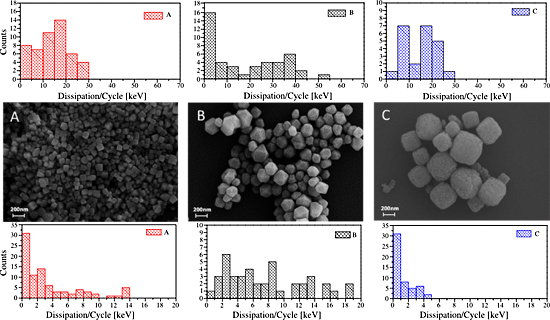
- explained in terms of less contacting asperities in the substrate–particles interface and hence less adhesion force acting between them. Our experiments show the exact opposite behavior, at a higher substrate roughness we observe a higher retention of the nanoparticles. We explain this in terms of the


AFM as an analysis tool for high-capacity sulfur cathodes for Li–S batteries
Beilstein J. Nanotechnol. 2013, 4, 611–624, doi:10.3762/bjnano.4.68
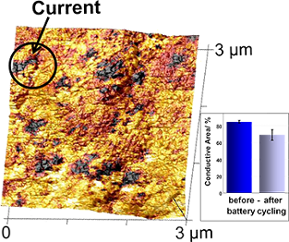
- significant differences were found for the deformation values with the exception of cellulose as a binder material. The adhesion force was smallest for the fluorine containing PVDF binder. For the identification of sulfur the stiffness values were used. During the stiffness measurements the tip puts a
- images measure 3 μm × 3 μm. The topography is displayed together with the simultaneously measured mapping of deformation, adhesion force, DMT modulus (stiffness), TUNA™ current, and peak current. The different properties of image areas allowed for a distinction of different surface materials, which is
- a lower deformation. The adhesion force is higher at those parts of the surface where the stiffness values are smaller. In the centre of the TUNA current image in Figure 6, the current density has lower intensities, whereas the corresponding stiffness is especially high. Deformation values, on the



Functionalization of vertically aligned carbon nanotubes
Beilstein J. Nanotechnol. 2013, 4, 129–152, doi:10.3762/bjnano.4.14
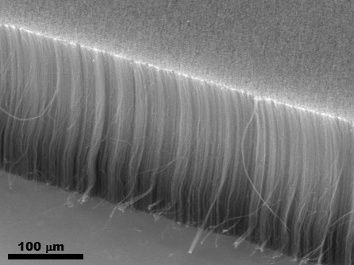
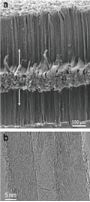
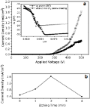
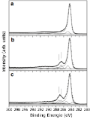
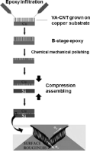
- the top of the CNT. In the second case, the particle remains attached to the substrate. The common explanation for this difference is based on the adhesion force between the catalyst and the substrate. It is reported that a strong (weak) interaction furthers the base (tip) related mode. However








Effect of normal load and roughness on the nanoscale friction coefficient in the elastic and plastic contact regime
Beilstein J. Nanotechnol. 2013, 4, 66–71, doi:10.3762/bjnano.4.7
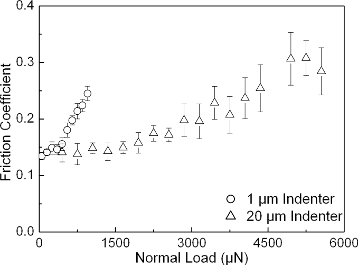
- elimination of any nonzero measured friction force that may be present at a normal load of zero, see Figure 2. This is usually explained by an additional load term due to an intrinsic adhesive force and/or artifacts generated by the equipment. The adhesion force term itself consists of various attractive


Characterization of the mechanical properties of qPlus sensors
Beilstein J. Nanotechnol. 2013, 4, 1–9, doi:10.3762/bjnano.4.1
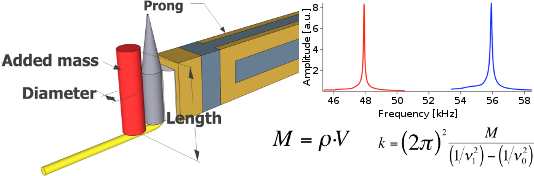
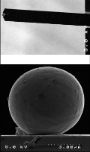
- , experiments showed that the adhesion force between tuning fork and glue was strong enough to hold the tungsten wire during the measurement. On the other hand, the surface of the tuning fork is smooth. Therefore the glue can be easily removed after measuring, without damaging the sensor and voiding its
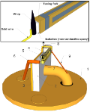


The memory effect of nanoscale memristors investigated by conducting scanning probe microscopy methods
Beilstein J. Nanotechnol. 2012, 3, 722–730, doi:10.3762/bjnano.3.82
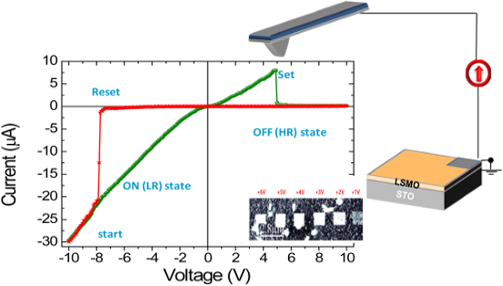
- –sample conditions, the adhesion force was systematically determined from force-versus-distance curves prior to and after each conductivity experiment. In addition, comparison of the conducting properties of nonmodified regions prior to and after the experiments was used as an in situ quality test to


Mapping mechanical properties of organic thin films by force-modulation microscopy in aqueous media
Beilstein J. Nanotechnol. 2012, 3, 464–474, doi:10.3762/bjnano.3.53
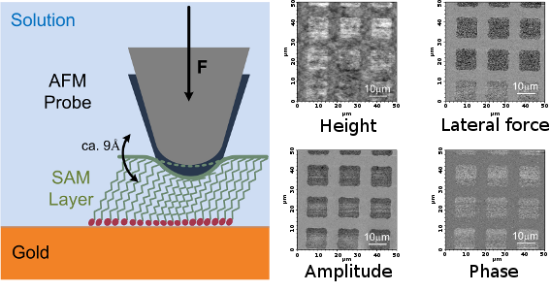
- mechanics when the static contact force is much greater than the adhesion force [41][42][43]. Furthermore, the Hertzian contact model has been successfully extended to characterize the stiffness of thin, layered materials [3][44]. If necessary, tip–sample adhesion can easily be included in the contact
- are significantly softer than the gold substrate. Force–distance curves on the gold and protein regions showed that the adhesion force between the AFM probe and the protein features is negligibly small. The adhesion force on gold is around 0.3 nN, which is only about 3% of the static force applied
- , while the adhesion force on the protein surface is within the noise level of the measurement. This justifies the use of a Hertzian contact mechanics model, as done here. Our approach currently does not capture the viscoelasticity of the protein or the response of the cantilever to a viscoelastic contact



Manipulation of gold colloidal nanoparticles with atomic force microscopy in dynamic mode: influence of particle–substrate chemistry and morphology, and of operating conditions
Beilstein J. Nanotechnol. 2011, 2, 85–98, doi:10.3762/bjnano.2.10
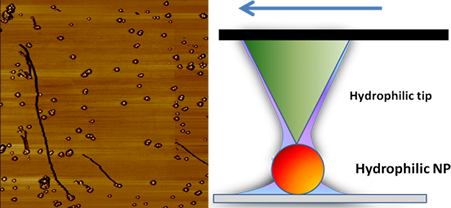
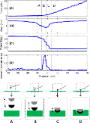
- results in a damage to the tip due to the high particle–substrate adhesion force. This strong adhesion between silicon substrate and hydrophilic coated nanoparticles primarily arises from intermolecular interactions. It may also involve a contribution from capillary bridges between the substrate and the


Switching adhesion forces by crossing the metal–insulator transition in Magnéli-type vanadium oxide crystals
Beilstein J. Nanotechnol. 2011, 2, 59–65, doi:10.3762/bjnano.2.8
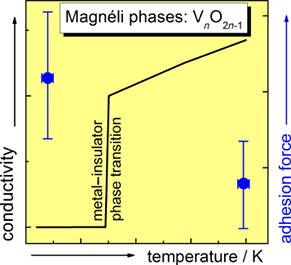
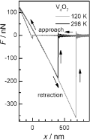
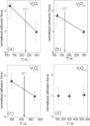
- , Universitätsstr. 1, D-86135 Augsburg, Germany 10.3762/bjnano.2.8 Abstract Magnéli-type vanadium oxides form the homologous series VnO2n-1 and exhibit a temperature-induced, reversible metal–insulator first order phase transition (MIT). We studied the change of the adhesion force across the transition temperature
- crossing the transition temperatures leads to a distinct change of the adhesion force. Low adhesion corresponds consistently to the metallic state. Accordingly, the ability to modify the electronic structure of the vanadium Magnéli phases while maintaining composition, stoichiometry and crystallographic
- integrity, allows for relating frictional and electronic material properties at the nano scale. This behavior makes the vanadium Magnéli phases interesting candidates for technology, e.g., as intelligent devices or coatings where switching of adhesion or friction is desired. Keywords: adhesion force