


Search results
Search for "carbon nanomaterials" in Full Text gives 56 result(s) in Beilstein Journal of Nanotechnology.
Nanostructure sensitization of transition metal oxides for visible-light photocatalysis
Beilstein J. Nanotechnol. 2014, 5, 696–710, doi:10.3762/bjnano.5.82
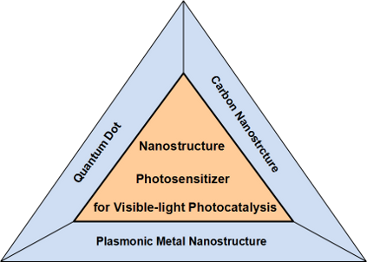
- for more detailed information [106]. Carbon nanodots are a new class of carbon nanomaterials and consist of discrete, quasipherical nanoparticles with sizes below 10 nm [107][108][109][110]. Since they have been reported on in 2004 for the first time [111], carbon dots have gradually become an




A catechol biosensor based on electrospun carbon nanofibers
Beilstein J. Nanotechnol. 2014, 5, 346–354, doi:10.3762/bjnano.5.39
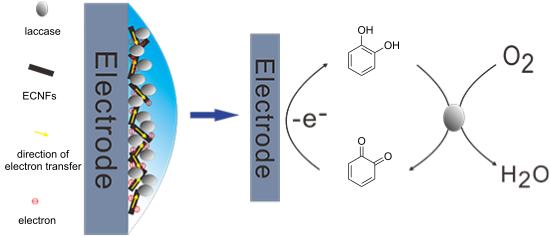
- water samples. Keywords: biosensor; carbon nanofibers; catechol; electrospinning; laccase; Introduction Nowadays, carbon nanomaterials attract a great deal of attention due to their high surface area, excellent electronic conduction and biocompatibility. Among these, mesoporous carbon [1][2][3][4][5


Core level binding energies of functionalized and defective graphene
Beilstein J. Nanotechnol. 2014, 5, 121–132, doi:10.3762/bjnano.5.12
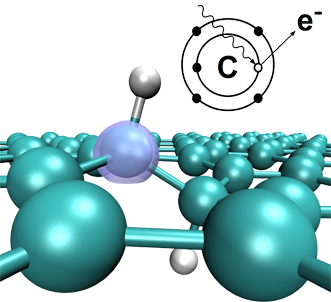
- widely used tool for studying the chemical composition of materials and it is a standard technique in surface science and technology. XPS is particularly useful for characterizing nanostructures such as carbon nanomaterials due to their reduced dimensionality. In order to assign the measured binding
- . However, for low-dimensional carbon nanomaterials such as graphene or carbon nanotubes, the escape depth exceeds the size of the system, and this makes XPS in practice a convenient bulk characterization tool. In order to interpret the binding energies measured by XPS, a reference to which such energies


Size-dependent characteristics of electrostatically actuated fluid-conveying carbon nanotubes based on modified couple stress theory
Beilstein J. Nanotechnol. 2013, 4, 771–780, doi:10.3762/bjnano.4.88
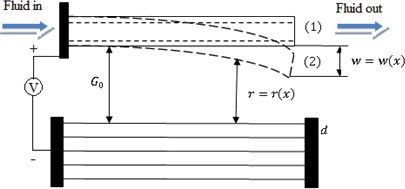
- and structures made from different metallic and non-metallic materials, carbon nanomaterials play a special role. For instance, carbon nanotubes (CNTs) possess extraordinary chemical, physical, mechanical and electrical properties. Thus, since their discovery in 1991 by Iijima [13], they have


Functionalization of vertically aligned carbon nanotubes
Beilstein J. Nanotechnol. 2013, 4, 129–152, doi:10.3762/bjnano.4.14
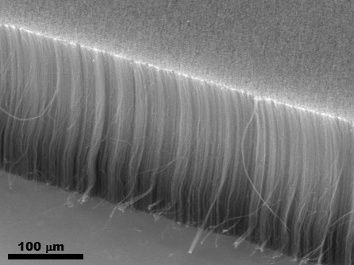
- -emission performance. However, it was demonstrated that a fluorine-based functionalization of carbon nanomaterials such as diamond films [83] or amorphous carbon nanoparticle films [84] increases the yield of the phenomenon. The fluorination of carbon nanofibers [85] and SWCNTs [86] was also underlined








X-ray absorption spectroscopy by full-field X-ray microscopy of a thin graphite flake: Imaging and electronic structure via the carbon K-edge
Beilstein J. Nanotechnol. 2012, 3, 345–350, doi:10.3762/bjnano.3.39
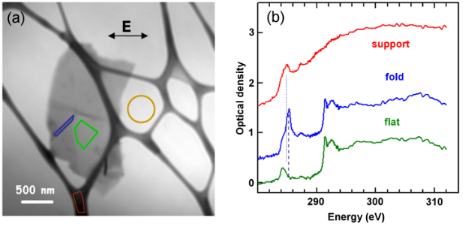
- nanotechnology, particularly in the imaging and analysis of nanoscale samples that are sensitive to electron irradiation. The current study shows that it is applicable to the study of carbon nanomaterials, notably large two-dimensional structures for which statistical spectroscopic analyses over large areas are



Other Beilstein-Institut Open Science Activities



