


Search results
Search for "citric acid" in Full Text gives 59 result(s) in Beilstein Journal of Nanotechnology.
Nanostructured surfaces by supramolecular self-assembly of linear oligosilsesquioxanes with biocompatible side groups
Beilstein J. Nanotechnol. 2015, 6, 2377–2387, doi:10.3762/bjnano.6.244
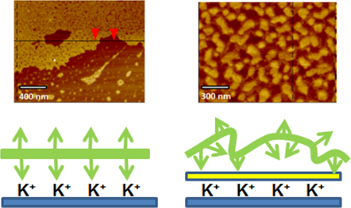
- , citric acid, thioglycolic or acid). The adsorption of both silsesquioxane oligomers and organic primers was confirmed with attenuated total reflectance infrared spectroscopy. The observed physiochemical and textural variations in the adsorbed materials correlate with the differences in the chemical
- used bare or primed, prior to the coating with LPSQ-COOH/X, with a monolayer of N-acetylcysteine, citric acid or thioglycolic acid. The primers are bound to mica by ionic bonds (carboxylates) and simultaneously provide the substrate with new organic functions capable of hydrogen bonding [49]. Atomic
- small molecules [49]. They should be simultaneously capable of the formation of surface salts and hydrogen bonds with functional groups in side chains of LPSQ-COOH/X. Consequently, thioglycolic acid (TG), citric acid (CA) and N-acetylcysteine (NAC) were selected and used as primers to modify the surface




Radiation losses in the microwave Ku band in magneto-electric nanocomposites
Beilstein J. Nanotechnol. 2015, 6, 1700–1707, doi:10.3762/bjnano.6.173
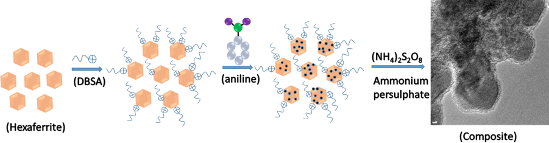
- stoichiometric proportions, at ambient temperature under constant magnetic stirring. Citric acid acts as fuel and chelating agent and is added to the salt solution in a molar ratio of cations to citric acid of 1:1.5. To obtain the fine particles and to enhance the reaction mechanism, ammonium hydroxide (NH4OH


Silica micro/nanospheres for theranostics: from bimodal MRI and fluorescent imaging probes to cancer therapy
Beilstein J. Nanotechnol. 2015, 6, 546–558, doi:10.3762/bjnano.6.57
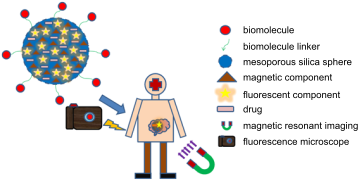
- -shell-encapsulated hybrid nanomaterials consisting of paramagnetic Gd3+ ions and QDs or Au nanocrystals. The citric-acid-capped gold colloids and CdSe/ZnS QDs were silanized by using mercaptopropyltrimethoxysilane (MPS) as surfactant. Further, a Gd3+-DOTA (tetraazacyclododecanetetraacetic acid) complex
- Fe3O4 NPs that were incorporated in silica and functionalized with a carboxylic acid group for bioconjugation. The synthesis involved coating silica around citric-acid-coated Fe3O4 NPs by using the Stöber process. The MPS-activated silica-coated Fe3O4 NPs were then conjugated with TGA-modified CdTe NPs
- was performed by using a vibrating sample magnetometer (VSM). The saturation magnetization of citric-acid-coated Fe3O4 NPs was found to be 40.97 emu/g, which was reduced to 9.90 emu/g after silica coating and was further decreased to 2.26 emu/g after addition of the CdTe QDs. For cell targeting


Imaging the intracellular degradation of biodegradable polymer nanoparticles
Beilstein J. Nanotechnol. 2014, 5, 1905–1917, doi:10.3762/bjnano.5.201
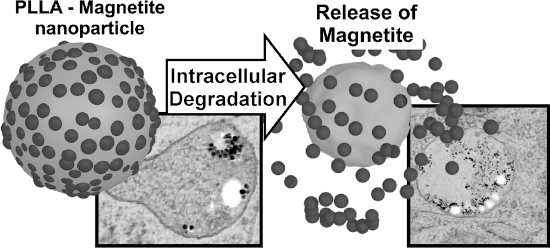
- . It is speculated that L-lactic acid, which is the degradation product of PLLA, is transformed into water and CO2 via the citric acid cycle [9]. In addition to many other factors such as temperature or pH [10], the degree of crystallinity and the molecular weight of the PLLA affect the rate of


Real-time monitoring of calcium carbonate and cationic peptide deposition on carboxylate-SAM using a microfluidic SAW biosensor
Beilstein J. Nanotechnol. 2014, 5, 1823–1835, doi:10.3762/bjnano.5.193
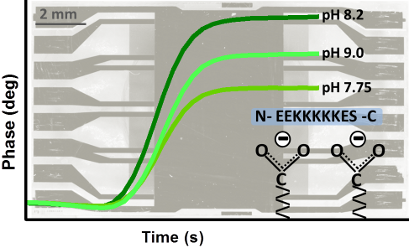
- organic biomolecules and calcium carbonate in the presence of carboxylate surfaces could be reproducibly quantified in real-time assays. Here, we report a case study with calcium carbonate, both in pure aqueous systems and in the presence of citric acid. We also investigated the two cationic peptides ES9
- function of time. The influence of the concentration of calcium carbonate relative to the solubility equilibrium and the flow rate on the SAW biosensor phase and amplitude signals was investigated in real-time. The influence of organic molecules is studied in two different systems: First, citric acid in
- carbonate surface interactions seem to be less well controlled at flow rates higher than 50 µL/min. One can assume that, at higher flow rates, the interaction of calcium and/or (bi)carbonate does not reach the maximum capacity of the sensor surface. Calcium carbonate and citric acid interactions In order to


In vitro and in vivo interactions of selected nanoparticles with rodent serum proteins and their consequences in biokinetics
Beilstein J. Nanotechnol. 2014, 5, 1699–1711, doi:10.3762/bjnano.5.180
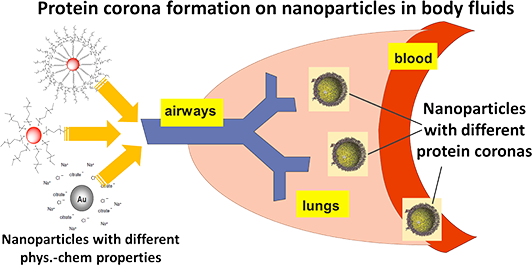
- . Therefore, we studied the role of five different surface modifications on monodisperse AuNP of 5 nm core diameter (i.e., the diameter as determined by transmission electron microscopy). As surface ligands we chose: citric acid (as supplied by the manufacturer), bis(p-sulfonatophenyl)phenylphosphine, a thiol


Synthesis of hydrophobic photoluminescent carbon nanodots by using L-tyrosine and citric acid through a thermal oxidation route
Beilstein J. Nanotechnol. 2014, 5, 1513–1522, doi:10.3762/bjnano.5.164
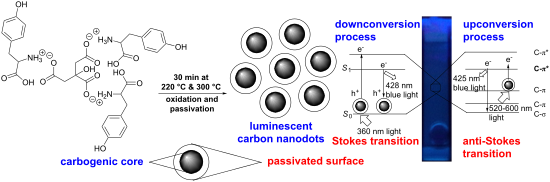
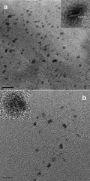
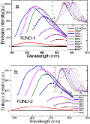
- Venkatesh Gude Department of Chemistry, Assam University-Silchar, Assam, 788011, India 10.3762/bjnano.5.164 Abstract Hydrophobic photoluminescent carbon nanodots (CNDs) were fabricated by using citric acid and L-tyrosine precursor molecules through a simple, facile thermal oxidation process in
- ]. The as-prepared CNDs are hydrophilic in nature. There are some synthetic routes by using citric acid and some surface passivating agents like L-lysine [15], ethanolamine [20], betaine [21] to obtain hydrophilic CNDs through thermal oxidation in air. Amino acids like histidine, arginine, threonine, and
- commonly available laboratory equipment. The CNDs were prepared by using citric acid and L-tyrosine precursors through a thermal oxidation process in air at two temperatures 220 °C and 300 °C, and they exhibit characteristic emission properties. The two chosen temperatures are below the melting point of L






Glassy carbon electrodes modified with multiwalled carbon nanotubes for the determination of ascorbic acid by square-wave voltammetry
Beilstein J. Nanotechnol. 2012, 3, 388–396, doi:10.3762/bjnano.3.45
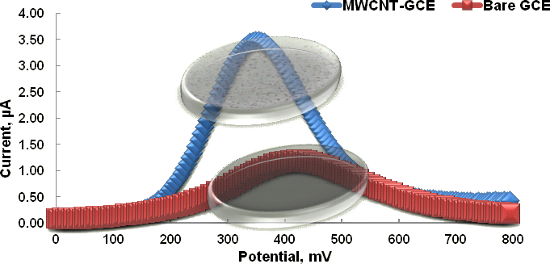
- ) analysed by HPLC were excellent (95–101%). Fresh fruit juices may contain a number of organic acids (e.g., citric acid) and sugars (e.g., glucose, fructose and sucrose), which could cause potential interferences. However no such interferences were evident in the analyses. Comparison of the SWV method with


Manipulation of gold colloidal nanoparticles with atomic force microscopy in dynamic mode: influence of particle–substrate chemistry and morphology, and of operating conditions
Beilstein J. Nanotechnol. 2011, 2, 85–98, doi:10.3762/bjnano.2.10
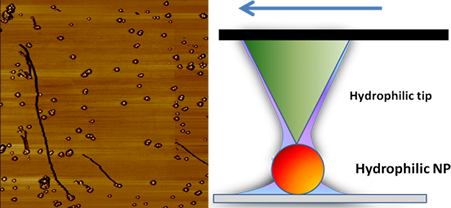
- is essentially affected by electrostatic interactions arising from residues from the synthesis (citric acid) that may be adsorbed on the particles. It is thus normal, in the absence of both physical contact and notable intermolecular forces between the particles, that their mobility is independent of
- nanogold particles, HAuCl4·3H2O supplied by ABCR, Karlsruhe, Germany. The suspension was stabilized with citric acid trisodium salt (Aldrich), which, by reducing HAuCl4, imparts the negative charge of the citrate ions to the gold nano-particle surface [27][28]. The average size of these nanogold particles
- reduce the citric acid concentration. The nanoparticles were then purified from excess surfactant and other reactants by dialysis for one week. Finally, the dialyzed solution was centrifuged and particles were re-dispersed in tetrahydrofuran. 300 µL of the appropriate thiol (methyl- or hydroxyl


Other Beilstein-Institut Open Science Activities



