


Search results
Search for "dichroism" in Full Text gives 53 result(s) in Beilstein Journal of Nanotechnology.
Structure, morphology, and magnetic properties of Fe nanoparticles deposited onto single-crystalline surfaces
Beilstein J. Nanotechnol. 2011, 2, 47–56, doi:10.3762/bjnano.2.6
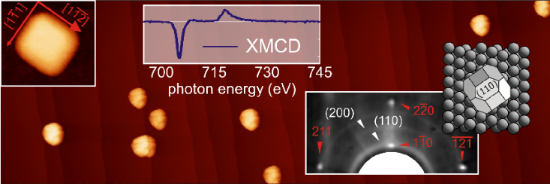
- combined approach of X-ray magnetic circular dichroism (XMCD), reflection high energy electron diffraction (RHEED) and scanning tunneling microscopy (STM) to shed light on the complex and size-dependent relation between magnetic properties, crystallographic structure, orientation and morphology. In
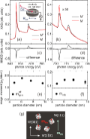
- scaled by a factor of 50. The low magnitude of the Fe signal relative to that of the Ni spectra reflects a well diluted deposit with about 200 particles per μm2 on the surface [38]. At this density, interactions between the particles can be neglected. Figure 2c and Figure 2d show magnetic dichroism

Ultrafine metallic Fe nanoparticles: synthesis, structure and magnetism
Beilstein J. Nanotechnol. 2010, 1, 108–118, doi:10.3762/bjnano.1.13
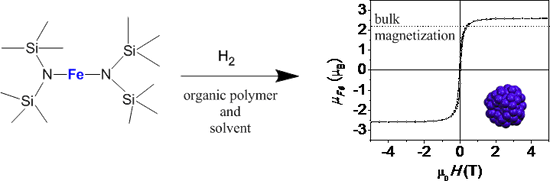
- α-Fe NPs with diameters down to 2 nm show an enhancement of the hyperfine field BHyp, indicative of enhanced µFe [10][11][12]. Recent careful measurements, by X-ray magnetic circular dichroism (XMCD) [13][14][15][16], consistently indicate an increase in the ratio of the orbital magnetic moment over
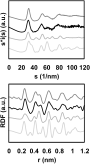
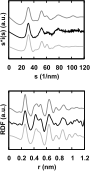

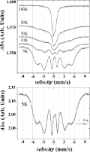




Preparation and characterization of supported magnetic nanoparticles prepared by reverse micelles
Beilstein J. Nanotechnol. 2010, 1, 24–47, doi:10.3762/bjnano.1.5
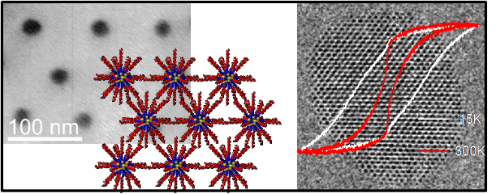
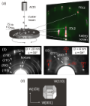
- magnetic circular dichroism (XMCD) which provides information on (i) the chemical state of sample, (ii) element-specific magnetic moments and (iii) element-specific hysteresis loops. The results presented below were measured at beamline PM-3 of the BESSY II synchrotron facility in Berlin, Germany. The






Other Beilstein-Institut Open Science Activities



