


Search results
Search for "dye-sensitized solar cells" in Full Text gives 53 result(s) in Beilstein Journal of Nanotechnology.
Self-assembled monolayers and titanium dioxide: From surface patterning to potential applications
Beilstein J. Nanotechnol. 2011, 2, 845–861, doi:10.3762/bjnano.2.94
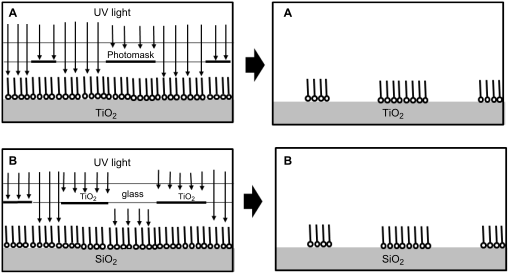
- titanium dioxide serves to accept photoinduced electrons from sensitizers that cannot be strictly considered as SAMs, i.e., most types of dye-sensitized solar cells (DSSCs). Review Self-assembled monolayers chemisorbed on TiO2 Both TiO2 and SiO2 are oxides capable of forming surface hydroxyls, and
- studied quite thoroughly for both organothiolated SAMs on metals and organosilanes on silicon. The appearance of dye-sensitized solar cells [85], based on (disordered) dye molecules attached to the surface of nanoparticulate titanium dioxide, provoked interest also in the charge transport from SAMs to
- . A claim was made that similar paths yielding long-lived charge separation situations may be relevant also in natural photosynthetic systems, and should be considered in the development of dye-sensitized solar cells. In certain cases, feasibility studies with TiO2-containing systems were later



Highly efficient ZnO/Au Schottky barrier dye-sensitized solar cells: Role of gold nanoparticles on the charge-transfer process
Beilstein J. Nanotechnol. 2011, 2, 681–690, doi:10.3762/bjnano.2.73
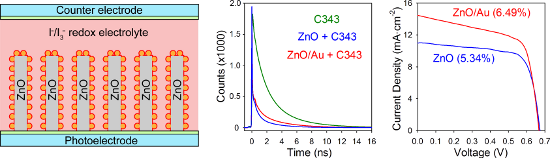
- for Basic Sciences, Sector - III, Block - JD, Salt Lake, Kolkata 700098, India 10.3762/bjnano.2.73 Abstract Zinc oxide (ZnO) nanorods decorated with gold (Au) nanoparticles have been synthesized and used to fabricate dye-sensitized solar cells (DSSC). The picosecond-resolved, time-correlated single
- recombine with the oxidized dye N719 molecules or with the I−/I3− redox electrolyte before they can be transferred to the CB of ZnO, and thus this results in a poor photocurrent and low fill factor, as observed. Conclusion Dye-sensitized solar cells with a ZnO/Au nanocomposite as the photoelectrode were




Aerosol assisted fabrication of two dimensional ZnO island arrays and honeycomb patterns with identical lattice structures
Beilstein J. Nanotechnol. 2010, 1, 71–74, doi:10.3762/bjnano.1.9

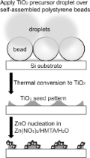
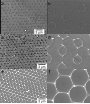
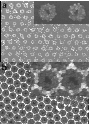
- at room temperature. A large-scale, high throughput, size-controlled assembly of ZnO nanostructures would allow the fabrication of a number of conceivable optoelectronic devices, such as dye sensitized solar cells [1][2], electronic sensors [3], UV lasers [4][5], photocatalysts [6], and two

Other Beilstein-Institut Open Science Activities



