


Search results
Search for "electrochemical deposition" in Full Text gives 53 result(s) in Beilstein Journal of Nanotechnology.
Electron-beam patterned self-assembled monolayers as templates for Cu electrodeposition and lift-off
Beilstein J. Nanotechnol. 2012, 3, 101–113, doi:10.3762/bjnano.3.11
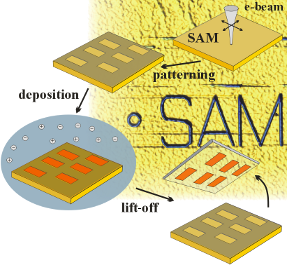
- ) adsorbed on polycrystalline gold substrates served as templates to control electrochemical deposition of Cu structures from acidic solution, and enabled the subsequent lift-off of the metal structures by attachment to epoxy glue. By exploiting the negative-resist behaviour of MBP0, the SAM was patterned by
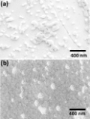
- electrochemical deposition the influence of the irradiation dose on the quality of the Cu structures was also studied. In a series of lines written by the electron beam, the dose was varied between 50 and 750 mC/cm2. As seen from Figure 6a, there is a pronounced improvement in the definition of the lines for
- -electrode configuration. Cu wires served as both reference and counter electrodes. The area of the working electrode was 40 mm2. Electrodeposition of Cu was carried out with a 50 mM CuSO4/H2SO4 solution of about pH 1 (chemicals from Sigma-Aldrich, 99.999%). After electrochemical deposition the substrates

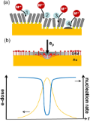




Lifetime analysis of individual-atom contacts and crossover to geometric-shell structures in unstrained silver nanowires
Beilstein J. Nanotechnol. 2011, 2, 740–745, doi:10.3762/bjnano.2.81
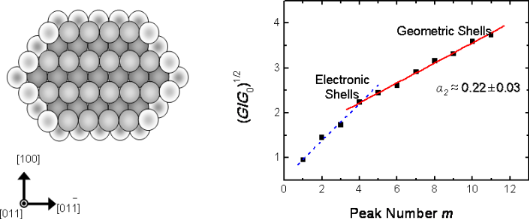
- was formed by electrochemical deposition of silver into a nanoscale gap between two gold electrodes. Applying a control potential relative to a third, independent gate electrode allows opening and closing of an atomic-scale gap by the controlled and reversible relocation of individual atoms. In this
- point contacts obtained by electrochemical deposition allowed the direct observation of the fingerprints of atom-by-atom and subsequent layer-by-layer growth of the metallic point contacts. We gave a complete quantitative description of the different stages of nanowire growth: First, individual-atomic


The atomic force microscope as a mechano–electrochemical pen
Beilstein J. Nanotechnol. 2011, 2, 659–664, doi:10.3762/bjnano.2.70
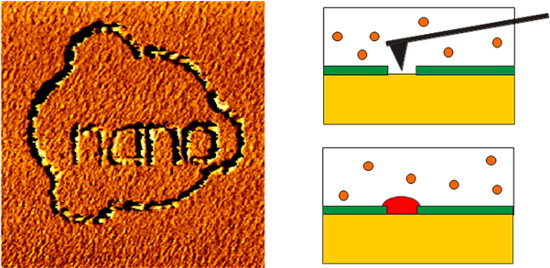
- microscopy; deposition; electrochemistry; nanoelectronics; nanofabrication; nanolithography; nanotechnology; NEMS and MEMS; scanning probe lithography; Introduction The controlled, patterned, electrochemical deposition of metals at predefined positions on the nanometer scale is of great interest for
- electrochemical deposition of metals for the fabrication of atomic-scale contacts and switches. By electrochemical deposition of nanoscale silver contacts and subsequent electrochemical cycling, an electrically controllable single-atom relay was demonstrated, which allows the controlled switching of an electrical
- experiments demonstrated that the tip of an electrochemical STM can also be used for local electrochemical deposition. Material electrochemically deposited on an STM tip was subsequently transferred to the surface [22][23], allowing controlled metallic nanopatterning of surfaces. Improvements of STM-based


Other Beilstein-Institut Open Science Activities



