


Search results
Search for "finite element method" in Full Text gives 56 result(s) in Beilstein Journal of Nanotechnology.
Mechanical properties of sol–gel derived SiO2 nanotubes
Beilstein J. Nanotechnol. 2014, 5, 1808–1814, doi:10.3762/bjnano.5.191
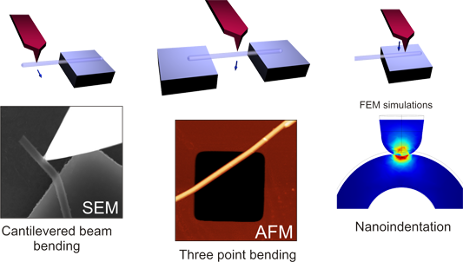
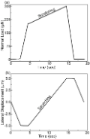
- performed by atomic force microscopy (AFM) under ambient conditions. Half-suspended and three-point bending tests were processed in the framework of linear elasticity theory. Finite element method simulations were used to extract Young’s modulus values from the nanoindentation data. Finally, the Young’s
- solutions based on elasticity theory were used to process cantilever-beam and three-point-bending tests data, while the data from nanoindentation experiments were fitted by using finite element method (FEM) simulations and compared with the analytical models (thin shell or membrane model and Hertz model
- indentation is limited to the thin-shell or membrane case [27]. Therefore, for the case of thick shells studied in this work, we employed finite element method (FEM, COMSOL Multiphysics) models instead, where all geometric parameters can be taken into account. The Solid Mechanics module was used, where the


Calibration of quartz tuning fork spring constants for non-contact atomic force microscopy: direct mechanical measurements and simulations
Beilstein J. Nanotechnol. 2014, 5, 507–516, doi:10.3762/bjnano.5.59
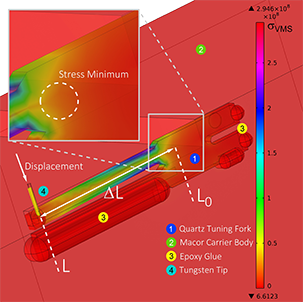
- along the prong of the tuning fork. The results show a significant deviation from values calculated with the beam formula. In order to understand this discrepancy the complete sensor set-up has been digitally rebuilt and analyzed by using finite element method simulations. These simulations provide a
- the formula show large discrepancies up to a factor of 5. In the next step we use extensive finite element method (FEM) modeling of the precise geometry of the tuning fork sensor in order to understand these deviations. The simulations show quantitative agreement with the beam formula if the beam
- determination of “qPlus” sensor stiffness. The combination of finite element method simulation with experimental measurements allows a comprehensive understanding of the spring constant behavior alongside the whole length of the free prong. This knowledge finally opens the opportunity to adapt the beam formula




Near-field effects and energy transfer in hybrid metal-oxide nanostructures
Beilstein J. Nanotechnol. 2013, 4, 306–317, doi:10.3762/bjnano.4.34
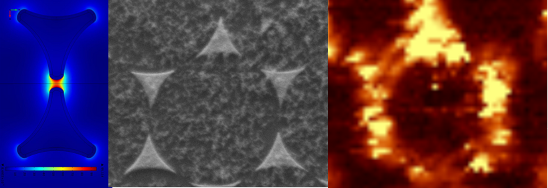
- module, which solves the Maxwell equations in the frequency domain based on the finite-element method. Bowtie model antenna structures have been defined with geometries close to the experimental ones. The aim was to calculate the relative electrical field enhancement factor E/E0 of the local field








Effect of normal load and roughness on the nanoscale friction coefficient in the elastic and plastic contact regime
Beilstein J. Nanotechnol. 2013, 4, 66–71, doi:10.3762/bjnano.4.7
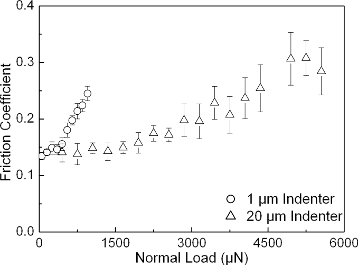
- , Kogut and Etsion (KE model [9]) improved the CEB model by accounting for the resistance to sliding of plastically deformed asperities using the finite element method. According to them, the contact parameters, such as separation, real area of contact, and real contact pressure, are functions of the


Spring constant of a tuning-fork sensor for dynamic force microscopy
Beilstein J. Nanotechnol. 2012, 3, 809–816, doi:10.3762/bjnano.3.90
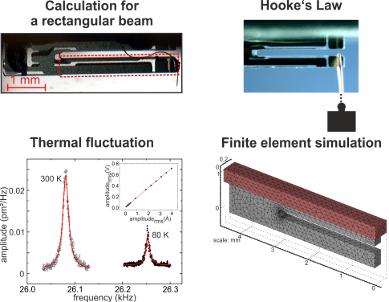
- taking account of the real geometry including the glue that is used to mount the tuning fork. Keywords: atomic force microscopy; finite element method; spring constant; thermal fluctuation; tuning fork; Introduction Quartz tuning forks provide excellent self-sensing probes in scanning probe microscopy
- simulation by the finite-element method. Result and Discussion Calculation for a rectangular beam The formula for the spring constant of a beam that is clamped on one side is where E is the Young’s modulus (for quartz), τ is the thickness, w the width, and L the length of a prong. For the cantilevers used in
- simulation using the finite element method To get more insight into the relevant details of the qPlus configuration, numerical calculations by using the method of finite elements were performed. In contrast to the experiment this enables analysis of the influence of one specific parameter, e.g., the


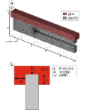


Towards multiple readout application of plasmonic arrays
Beilstein J. Nanotechnol. 2011, 2, 501–508, doi:10.3762/bjnano.2.54
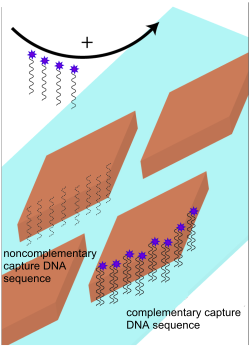
- plasmonic array was optimized for maximum signal enhancement by finite element method (FEM) simulations (COMSOL Multiphysics). Periodically patterned SERS arrays were fabricated by means of electron beam lithography and Argon ion beam etching. Quartz wafer was coated with 20 nm of gold by vacuum evaporation


Other Beilstein-Institut Open Science Activities



